
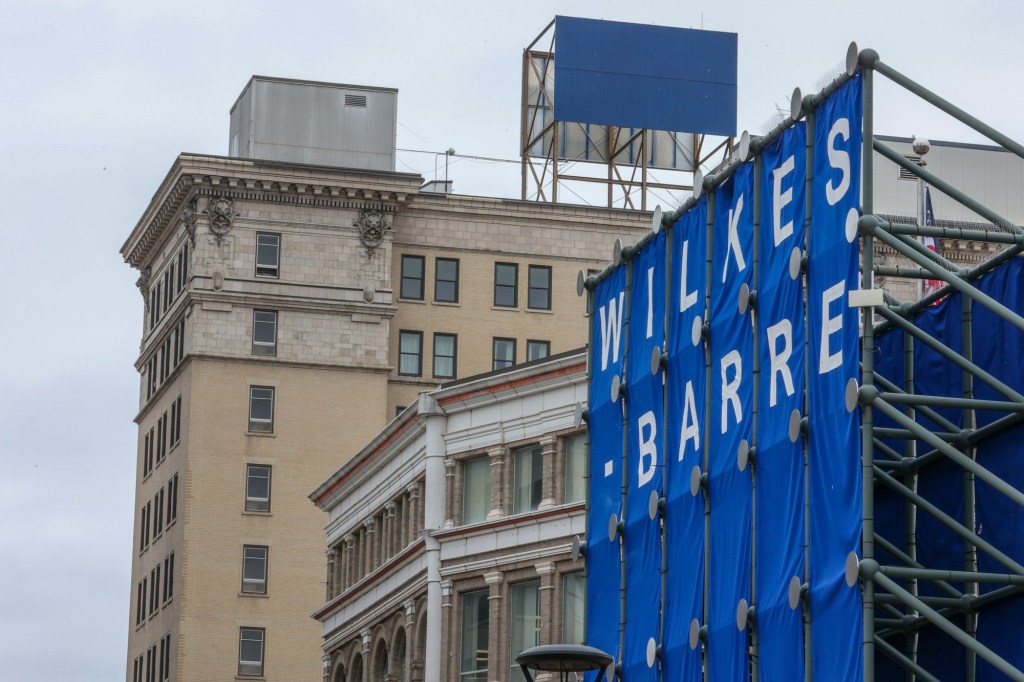
WILKES-BARRE — The growing population of residents who call downtown Wilkes-Barre home and those who spend one or several nights at its lone center-city hotel won’t struggle to find a good meal or lively bar within walking distance of their condo, apartment, dorm or rented room.
They may have a harder time finding somewhere to buy a gallon of milk late at night.
But the downtown on a Friday in late February reflected the considerable progress made in recent decades by private-sector investors and their public-sector partners who in the early 2000s embraced a renewed focus on safety, cleanliness and livability — the kinds of quality-of-life improvements invaluable to fostering economic development anywhere.
Walking around Public Square and its environs, which I found neither unsafe nor particularly unclean for an urban environment of Wilkes-Barre’s size, the fruits of years of efforts by various stakeholders working to bolster the Diamond City’s downtown were conspicuous.
At Cafe Toscana, the upscale Italian eatery on Public Square that opened in 2007, I enjoyed an early dinner of seared octopus and strip steak paired with Malbec wine in an atmosphere that made me mindful of my table etiquette even when dining alone.
After dropping off leftovers at my room at the Genetti Best Western Hotel — the only downtown hotel left after the Ramada was acquired by King’s College and closed in late 2013 — I had a drink at the Diamond City Vault Bar & Grill and then Franklin’s on Public Square, where the demographically younger crowd reflected a downtown bookended by two colleges, King’s and Wilkes University, and home to many young adults.
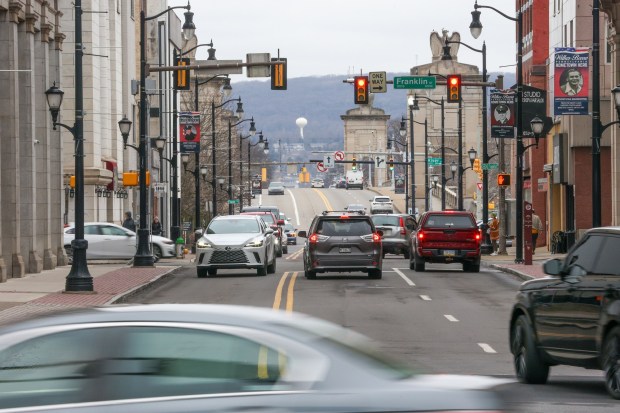 A look down West Market Street in Wilkes-Barre. (JASON ARDAN / STAFF PHOTOGRAPHER)
They make up part of a diverse downtown residential base that includes “everyone from college students to folks living in elderly high rises to some of the most high-income households in the city,” said Larry Newman, executive director of Wilkes-Barre’s nonprofit downtown management organization, Diamond City Partnership, and one of the many stakeholders driving the downtown’s progress.
It’s progress in the continued pursuit of balance, he said, describing a burgeoning downtown with sufficient housing for those who choose to live there and the retail, entertainment and amenities that attract and support a residential population and visitors alike.
“The median age … of a downtown Wilkes-Barre resident is 23, which of course is driven by the colleges, but what we are excited about is it attracts all kinds of people,” Newman said. “And so the goal is as we grow the downtown residential population, you grow the ability of retailers who are really focused on serving those residents, because at the end of the day, particularly today, retail follows rooftops.”
‘Lived experience’
During my recent visit, the Friday evening crowd reflected the diversity Newman described.
The early dinner clientele at Toscana included a mix of couples and small groups studying a menu that included the aforementioned octopus, a veal stroganoff main course and other specials. A trio of older women dined at one table; three college-aged women chatted at another. Cars filled the metered parking spaces outside on Public Square, suggesting a stream of prospective downtown patrons from other neighborhoods and towns.
Diamond City Vault was less busy, likely due to construction that closed a stretch of West Market Street, but a young family finishing their meal seized the opportunity for photos in front of the massive bank vault that serves as the restaurant’s most defining feature and a vestige of the building’s past. As the night progressed, the crowd at Franklin’s remained large as pedestrian traffic on and around the square dissipated.
On nights featuring concerts and events at the iconic F.M. Kirby Center on Public Square — an anchor institution which drew nearly 80,000 people downtown in 2024 and generated more than $14 million in local economic impact — nearby restaurants and bars often overflow with patrons.
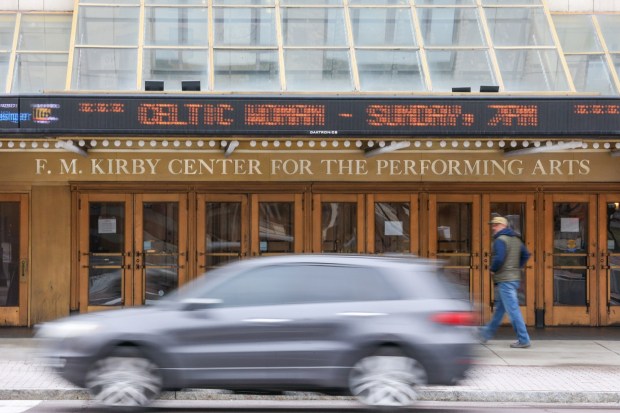 The F.M. Kirby Center for the Performing Arts in Wilkes-Barre. (JASON ARDAN / STAFF PHOTOGRAPHER)
Even my less-hectic experience was of stark contrast to what one might have encountered during a similar trip 25 years ago, when “there was nothing downtown,” Wilkes-Barre’s former three-term Mayor Tom Leighton said in a recent phone interview.
A downtown businessman and former city councilman, Leighton, who led the city as mayor from 2004 to 2016, said naysayers sometimes derisively dubbed him “Downtown Tommy” because of his focus on the downtown.
“We really had a big job ahead of us and we really put a lot of time and effort into what would be the best for downtown Wilkes-Barre,” he recalled, pointing to the 2005 removal of the downtown canopy system erected in the post-Agnes-flood era as an example. “Taking the canopy down really opened the downtown. It took the buses off Public Square. … It opened up the storefronts. And once people saw that, it really, really changed the scope of downtown Wilkes-Barre. It made it actually look cleaner.”
Leighton, who became well-known for his “I believe” slogan, also touted downtown improvements and developments that occurred during his tenure, including the addition of numerous restaurants and businesses he said the area sorely lacked.
“And we not only focused on the downtown, but we focused on what the people were asking for,” he said. “They wanted something to do, and we gave (them) that.”
Newman, meanwhile, reflected on the incremental progress of the early-to-mid 2000s — progress that was foundational to the downtown’s broader transformation driven by cooperation between business-and-commerce-focused nonprofits, the colleges, government and private-sector developers.
It came after former city leaders and stakeholders rebuilt the downtown following the 1972 Agnes flood “using the best practices of 1970s … and 1980s urbanism, which probably was not the greatest idea,” he quipped. “But that’s where we were, and so we rebuilt.”
“That reconstruction as a result of urban renewal post-flood gave downtown 10 more years of life; it was basically like a pacemaker, but it didn’t cure the patient, it just delayed the inevitable, so when … downtown Wilkes-Barre crashed and burned it just crashed and burned 10 years later than everyone else,” Newman continued. “Downtown was really in crisis by the late ’90s, so in 2001 we held a series of public meetings to talk about what to do, and that’s really the origin of Diamond City Partnership.”
One of the key messages that emerged from that “visioning process” was a need to focus on the basics: “cleanliness, beautification, safety, livability,” he said.
“And so from the get-go we built a program to focus on those incremental improvements in people’s lived experience of downtown, and those incremental improvements over time helped to set the table for the large-scale investments that have followed,” Newman said.
Residential trend
Many of the large-scale investments involved housing and contributed to the growth of downtown Wilkes-Barre as a place to live, a trend that’s continued in the post-pandemic era.
In his prior role with the Greater Wilkes-Barre Chamber of Business and Industry, Newman was involved in the development of 21 downtown condominiums in the complex constructed at South Main and Northampton streets that includes the R/C Wilkes-Barre Movies 14 theater. The residential component completed in 2010 was included in the broader revitalization project to test if there was demand for high-end downtown living, and there was, he told the Citizens’ Voice in 2015.
Addressing the continuing residential trend earlier this month, Newman, citing U.S. Census Bureau American Community Survey Estimates, said roughly 4,600 residents live within a downtown area bounded by North Street to the north; the railroad tracks between Pennsylvania Avenue and Wilkes-Barre Boulevard to the east; the Susquehanna River to the west; and Ross Street or Academy Street, depending on the block, to the south. That number, which includes King’s College and Wilkes University students living on campus, is 13% higher than pre-pandemic, he said.
The downtown residential inventory has also grown by more than 400 units not associated with the colleges since 2010, Newman said, identifying D&D Realty Group as downtown Wilkes-Barre’s largest residential developer. The firm’s downtown portfolio now includes the four-building Hampton Park complex, with 40 total apartments and seven commercial units; 116 South, with 34 apartments and a 12,000-square-foot early learning center; Alleghany Lofts, with 20 apartments; and Riverview West in the former PNC Bank building overlooking the Susquehanna River, which includes 43 apartments and 6,000 square feet of office space, D&D co-founder and partner Nicholas Dye said.
They’re the type of developments numerous local stakeholders described as consistent with a livable, mixed-use vision for the downtown.
During my late-February visit I had the opportunity to play several simulated holes of California’s famed Riviera Country Club after booking an hour of time at Virtual Fairways, a golf simulator business located at D&D’s Hampton Park property at the corner of East Northampton and South Washington streets. Having not swung a club since late October, it was a humbling experience, but one likely to appeal to visiting or local golf aficionados who’d otherwise have to leave the downtown to play.
The pair playing in the adjacent bay at Virtual Fairways assured me I’d love my meal at Cafe Toscana, which I did, and that I might see them later at Franklin’s on Public Square, which I didn’t, perhaps because it was crowded.
But my experience at and on the way to all three businesses proved the immediate downtown to be walkable, even when shouldering a full golf bag I wisely left at the hotel before dinner and drinks.
“The key is it’s become a walking downtown,” Leighton said in our phone interview. “You can walk to work, you can walk to shop, you can walk to eat, you can just walk for exercise on the riverfront, so there’s so many opportunities in downtown now that weren’t there 25 years ago.”
Dye agreed, identifying the downtown’s ability to accommodate the “walk-to-anything lifestyle” as one of its most attractive features.
It’s certainly attractive to D&D’s downtown tenants, largely a mix of young professionals and older residents who embraced the opportunity to downsize to a maintenance-free apartment in a walkable neighborhood, Dye said.
Missing pieces
Walkable as it is, Wilkes-Barre’s downtown is currently missing some amenities likely to benefit its growing residential base and visitors alike, especially those without a car.
It lacks, for example, robust grocery options, though Bravo Supermarket is located just outside the downtown’s boundaries and the Wilkes-Barre City Farmers Market on Public Square helps fill the gap on Thursdays from mid-June to mid-November. The Dollar Tree on South Main Street and Anthracite, Not Just a Newsstand on East Market Street, both just off Public Square, also offer some options, but neither stay open as late as many of the region’s larger supermarkets and grocery chains.
Soloff Realty & Development Inc. announced in early March the sale of the former Rite Aid property at 155 E. Northampton St., just outside the downtown’s boundaries, to a firm called 555 Scott Street Realty LLC, an affiliate of Marquez Food Group. The buyer “plans to redevelop the property into a grocery store serving the surrounding Wilkes-Barre community,” Soloff said in a press release.
And while that development has potential to address one need, the closure of the East Northampton Street Rite Aid when all remaining Rite Aid stores shuttered last year left the downtown area with one fewer retail pharmacy. Another former Rite Aid on Public Square closed in 2022.
But Teri Ooms, founding CEO of The Institute, a regional data analytics and research organization with offices in Scranton and Wilkes-Barre, said Wilkes-Barre’s downtown has “been absorbing growth really well,” including residential population growth.
“So I think we’re going to start to see more residential services pop online on maybe some of the side streets and things like that to support the downtown population,” Ooms said. “Those types of businesses and industries aren’t just going to develop in a downtown on their own. They need to be sure that there’s a market, and by having a 24-hour population there other than the students, like that increased residential base, then (it) becomes a market opportunity for them.”
“It’s like the residential comes first, followed by the services and retail that support those residents,” she continued. “There are more opportunities for housing in downtown Wilkes-Barre, both from infill development and adaptive reuse in some of the buildings, and I think as those come online and get developed we’re going to start to see some of that other stuff follow.”
Dye expressed a similar sentiment.
“I think that … one of the most difficult things that, nationwide, we’ve had to figure out since the pandemic is: What is going to replace what formerly was street retail servicing office employees?” he said. “I think nationwide we’re getting better at it. People are recognizing what works, what doesn’t work, and I do think that we’re seeing that trend increase.”
Stephen Barrouk, a longtime former president and CEO of the Greater Wilkes-Barre Chamber of Business and Industry who also helped facilitate the downtown’s turnaround, said the type of development that supports a residential base and the sustained success of the center city area remain priorities.
“Downtown has become a more attractive place to live, but from a public-services standpoint you’ve got to stay on top of it, you have to keep it clean and safe, and have the necessary amenities to support residential development,” he said. “That’s the kind of thing we’re working on right now.”
Hotel infrastructure
Beyond more amenities and resources for residents, a number of stakeholders also spoke to the need for more hotel infrastructure downtown.
In terms of accommodating guests — be they parents of local college students; lawyers, vendors or other professionals doing business with the Wilkes-Barre or Luzerne County governments; or fun-seekers in town for a show at the Kirby, dinner and drinks — such a project would bolster capacity lost when the Ramada closed. It could also create opportunities for conventions, trade shows and similar events akin to those often held at the downtown Scranton Hilton and Conference Center in that city.
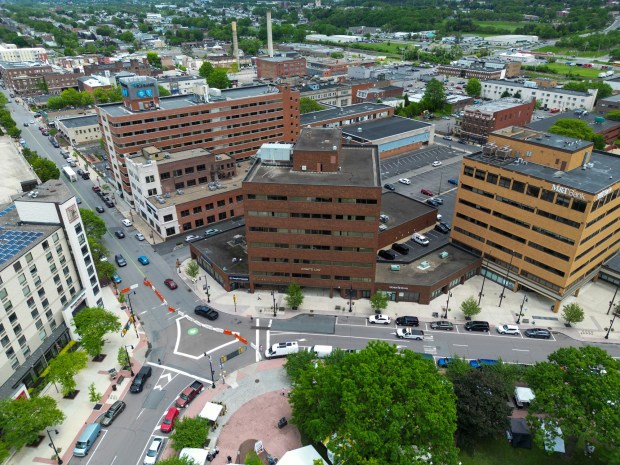 Hysni ‘Sam’ Syla plans to convert this building at 46 Public Square into a hotel rather than build one from the ground up on the former Hotel Sterling site as he announced in 2018. (JASON ARDAN / STAFF PHOTOGRAPHER)
Those kinds of events would in theory mean more foot traffic, more patrons for restaurants, bars and stores, and more downtown commerce in general.
Newman described bolstering hotel capacity as a “critical piece.”
“Obviously I’m very pleased with downtown residential development,” he said. “I do think that it is important for us to continue to build out downtown Wilkes-Barre’s hospitality sector, specifically the lodging sector, because … we don’t have a really robust room count in downtown, which means that we need additional hotel rooms in our downtown to be able to accommodate statewide conferences and conventions that we used to get in downtown Wilkes-Barre that we don’t get anymore.”
Such a project may be close at hand.
Developer Hysni “Sam” Syla, who for years sought to build a new hotel at the former Hotel Sterling site about two blocks to the west, scrapped those plans in favor of transforming the former Martz office building at 46 Public Square into a 110-room hotel and convention center. Mayor George Brown, who announced the project at a news conference last May, said at the time the new hotel will be a “milestone for Wilkes-Barre.”
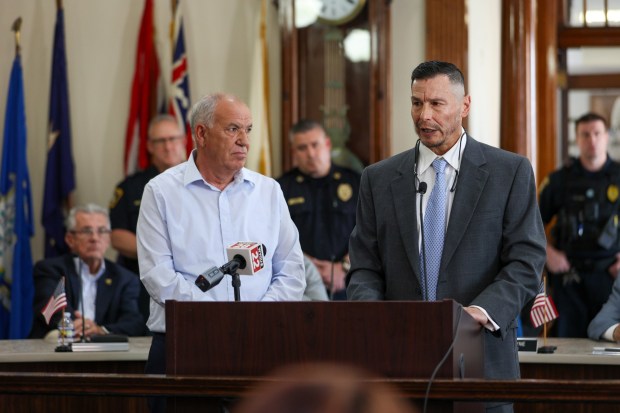 Sam Syla, left, and George Albert describe their plans during the unveiling of a new hotel on 46 Public Square on Thursday, May 15, 2025. (JASON ARDAN / STAFF PHOTOGRAPHER)
“The project will attract tourists, business travelers and large events, while creating good jobs for our residents,” Brown said. “It’s a perfect fit for our city’s vibrant downtown and strategic location, making Wilkes-Barre a go-to destination in Northeast Pennsylvania.”
Efforts to reach Syla, who also owns Cafe Toscana and Diamond City Vault Bar & Grill, for an update on the hotel project were unsuccessful.
Striking a balance
With an eye to the future, Barrouk reflected on the downtown’s past.
He noted its shift over decades from the retail, business and banking-heavy hub it was in the 1950s and 1960s through the 1972 Agnes flood and the post-flood period marked by an infusion of recovery funds, rebuilding and redevelopment, but also the continued bleed of retail, some of which the downtown had already lost with the emergence of strip shopping centers and the opening of the Wyoming Valley Mall. And he recalled the challenges of the 1980s and 1990s marked by vacancies and other issues that informed a renewed focus on downtown safety, cleanliness and livability, all precursors to the residential trend that today continues unabated.
In short, the downtown has “had to reinvent itself,” he said.
Amid its latest and ongoing reinvention, Newman said the goal is to achieve a balance of uses, not simply to “turn downtown Wilkes-Barre from a place that used to be dominated by office buildings and shopping to a place that is dominated by residents.”
“We don’t want to see offices go away,” he said. “We don’t want to become a purely residential neighborhood, although we can absolutely continue to grow downtown Wilkes-Barre’s residential population and we’re going to. But we want to reinforce that with the economy represented by the colleges. We want to reinforce the hospitality component of the downtown economy and we’re doing that hopefully with the addition of the new hotel. … And so it’s about getting a more balanced mix of uses in downtown, because that’s the thing about downtowns. In many places greater activity and greater density mean greater congestion, and in a well-functioning downtown more just equals more.”
“It means more activity and more vitality and more prosperity, because what downtowns are designed to do is bring people together, and the better they do that job the better they perform economically,” he continued. “What we are trying to do here is to reinforce those sectors where we became unbalanced.”
He also discussed what a balanced, thriving downtown might look like a decade from now if the momentum continues.
“We want in 10 years for everyone who utilizes downtown, visits downtown, lives in downtown to see it as the region’s walk-to-everything neighborhood of choice; the region’s college neighborhood; the center of arts, culture, dining and entertainment; a place that is and a place whose attractiveness to visitors is really built around some of our core assets, like our spectacular historic architecture, our riverfront and the fact that we are a college-anchored neighborhood, mixed-use neighborhood,” he said. “And obviously all of that needs to build on a foundation of a downtown that is clean, safe and beautiful.”
That foundation is particularly important in a city where officials and developers are frequently “battling negative perceptions” about Wilkes-Barre in general and downtown in particular, perceptions Newman said aren’t grounded in reality. Ironically, in his experience, people from out of the area often have a much more positive view of downtown Wilkes-Barre than do the locals.
“For the people who sit there — there’s sort of pride of avoidance, ‘I haven’t been downtown in 15 years’ — well, maybe you need to check it out, because I have yet to see people bragging about living in the affluent suburbs of a dead city,” he said. “We know that we’ve got a bunch of institutions here and draws that punch above their weight.”