

Colleges and universities are viewed as anchor institutions in downtown Scranton and Wilkes-Barre.
“We use that term anchor institution for a reason,” said Larry Newman, executive director at Diamond City Partnership in Wilkes-Barre. “Because they are in many ways, the anchoring, place-based entities that are helping to serve as a critical part of the foundation of our downtown economy.”
In downtown Wilkes-Barre, its Wilkes University and King’s College. In downtown Scranton, it’s the University of Scranton and Lackawanna College.
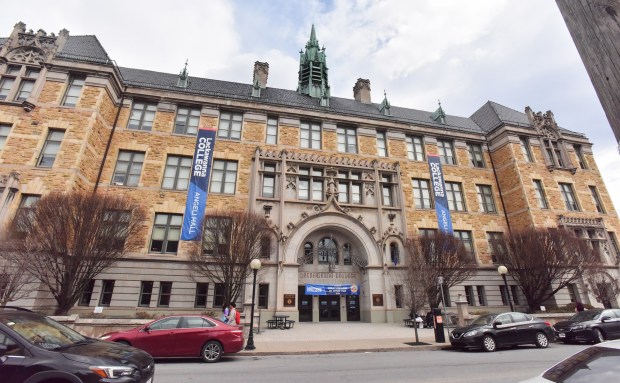 Angeli Hall at Lackawanna College
“We’re important institutions in the city,” said Julie Schumacher Cohen, the University of Scranton’s assistant vice president of community engagement and government affairs, noting the importance of having anchor institutions “in small to mid-size cities like Scranton.”
Lackawanna College became an anchor institution in downtown Scranton after purchasing the former Scranton Central High School building in 1994 and restoring the historic 1896 structure to serve as the cornerstone for the college’s campus in downtown Scranton.
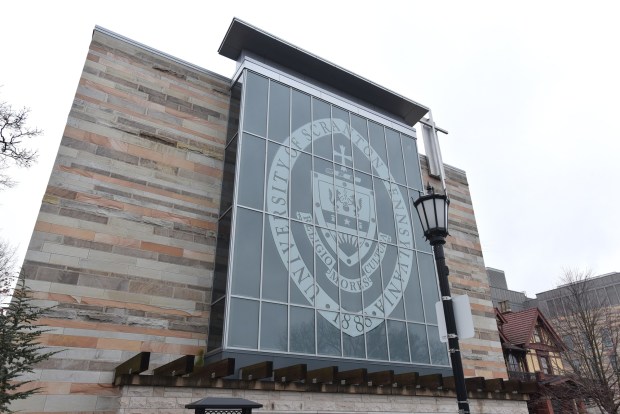 The University of Scranton
According to a 2025 report from the Association of Independent Colleges and Universities of Pennsylvania (AICUP), the colleges and universities in the Scranton/Wilkes-Barre region generate nearly $1.6 million in economic impact, support 12,920 jobs and provide $93 million in state and local tax revenue.
King’s College and Wilkes University “have both been there in their respective ends of downtown for a long time,” Newman noted.
Luzerne County Community College
Luzerne County Community College’s main campus is in Nanticoke but also has centers in downtown Wilkes-Barre and Scranton. Scranton Center is on the second floor of The Marketplace at Steamtown and opened 10 years ago.
The Wilkes-Barre Center on Public Square opened in 1999, and the number of students there has increased from 550 in 2000-01 to 697 this year. The Wilkes-Barre Center has also had a 134% increase in course sections since Fall 2000.
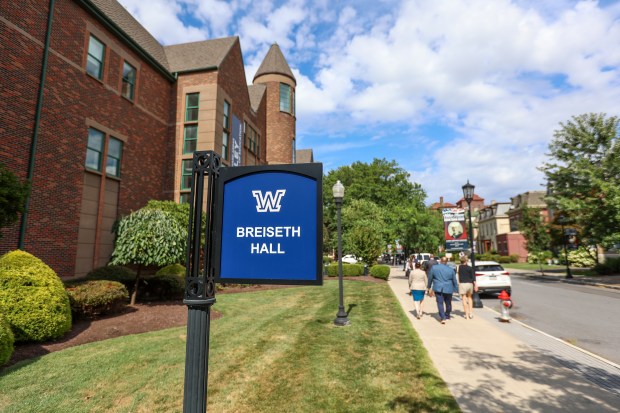 Attendees enter Breiseth Hall for a dedication of the Dr. Richard Abbas Alley School of Education at Wilkes University on Tuesday, Aug. 19, 2025. (JASON ARDAN / STAFF PHOTOGRAPHER)
Wilkes University
Wilkes University estimates its direct and indirect economic output is about $200 million a year,
“That includes our spend, our employees, our consumption in the downtown, construction projects. All of that kind of stuff,” said Mike Wood, special assistant to the president of Wilkes University.
“And it happens in ways that you wouldn’t even expect. For example, we consume about 5,000 room nights a year with our athletic teams, visitors, homecoming, graduation, things like that.”
Wilkes has 374 full-time and 136 part-time staff, plus 164 full-time and 305 part-time faculty. More than 5,000 undergraduate and graduate students are enrolled at Wilkes either full-time or part-time.
Wilkes has investment $40 million over 15 years on streetscape improvements and an expansion of its campus to Main Street in downtown Wilkes-Barre, Wood said.
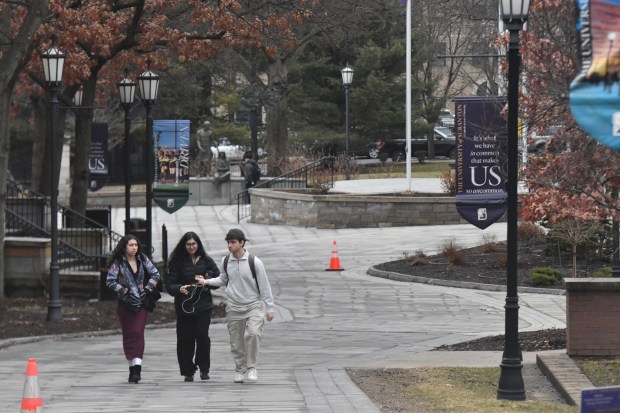 Students walk through the University of Scranton campus in downtown Scranton Friday, March 6, 2026. (SEAN MCKEAG / STAFF PHOTOGRAPHER)
University of Scranton
The University of Scranton’s overall economic impact on Northeastern Pennsylvania totals $277 million, according to a study conducted by the Institute for Public Policy and Economic Development in 2024. Direct expenditures in goods and services were nearly $163 million, and the total value added of indirect and induced impact was $114 million.
“It’s because of our role as an employer, our role in brining people to the area, including prospective students and their families, students themselves who are spending money in the region, and we do a lot to encourage them to go downtown,” Cohen said.
The University of Scranton is the seventh largest employer in Lackawanna County, according to a 2024 report by Pennsylvania’s Department of Labor and Industry. Through the university’s direct employment and its indirect and induced impact, 2,860 jobs are supported in the region in a variety of sectors.
“We view ourselves as part of the downtown and Hill section neighborhood of Scranton,” Cohen said. “For over a decade, we have done what we call a downtown engagement initiative where we do special events. We do all sorts of communications. We partner with groups like Scranton Tomorrow and the city of Scranton itself, basically to make students aware of what’s downtown — the small businesses, the arts and culture, special events.”
 The new Center for Technology Innovation at Lackawanna College continues to be under construction Wednesday, March 11, 2026. (SEAN MCKEAG / STAFF PHOTOGRAPHER)
Lackawanna College
Lackawanna College broke ground for its new Center for Technology Innovation building in December.
The new CTI building on Wyoming Avenue in downtown Scranton and is part of a $10 million investment to meet the needs of today’s industrial workforce.
“That block’s been vacant for a long time,” Costanzo said. “That’s a revitalization and improvement to an empty block. We’re scheduled to have that open for the fall semester.”
Lackawanna College has 300 employees and 3,000 students with 1,300 in downtown Scranton, Costanzo said.
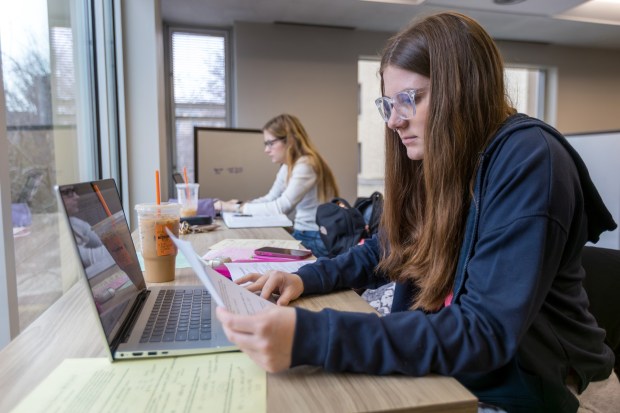 Amanda Schmidt, foreground, and Mia Ashton, both junior exercise science majors at King’s College, study in the library on Thursday, March 5, 2026. (JASON ARDAN / STAFF PHOTOGRAPHER)
King’s College
The economic impact of King’s College on the Pennsylvania economy is $156.6 million and 1,254 jobs, according to a study conducted by Parker Strategy Group. The study considered the direct spending on operations, wages and benefits, capital projects by King’s College and the estimated increase in demand for goods and services in industry sectors that supply or support the College.
The study measured the effect of student and visitor spending and the induced effect of increased household income. The study also concluded King’s College generates about $12.5 million in tax revenues annually for the state and local governments. King’s has about 450 full-time and part-time employees working downtown.
“We have been providing opportunities for growth economically,” said the Rev. Thomas Looney, the president of King’s college. “Then there’s our students that we continue to bring into the city and their family and friends when they come, and the economic impact of that is clearly important to local restaurants, local businesses and the whole downtown corridor.”
Enrollment is more than 1,900 undergraduate and graduate students, and 60% live on campus. King’s College also has around 450 full-time and part-time employees working downtown.
“We have engaged in renovation projects, saving historical buildings, renovating historical buildings,” Looney said. “King’s College has been deeply committed to being at the heart of the city of Wilkes-Barre.”