
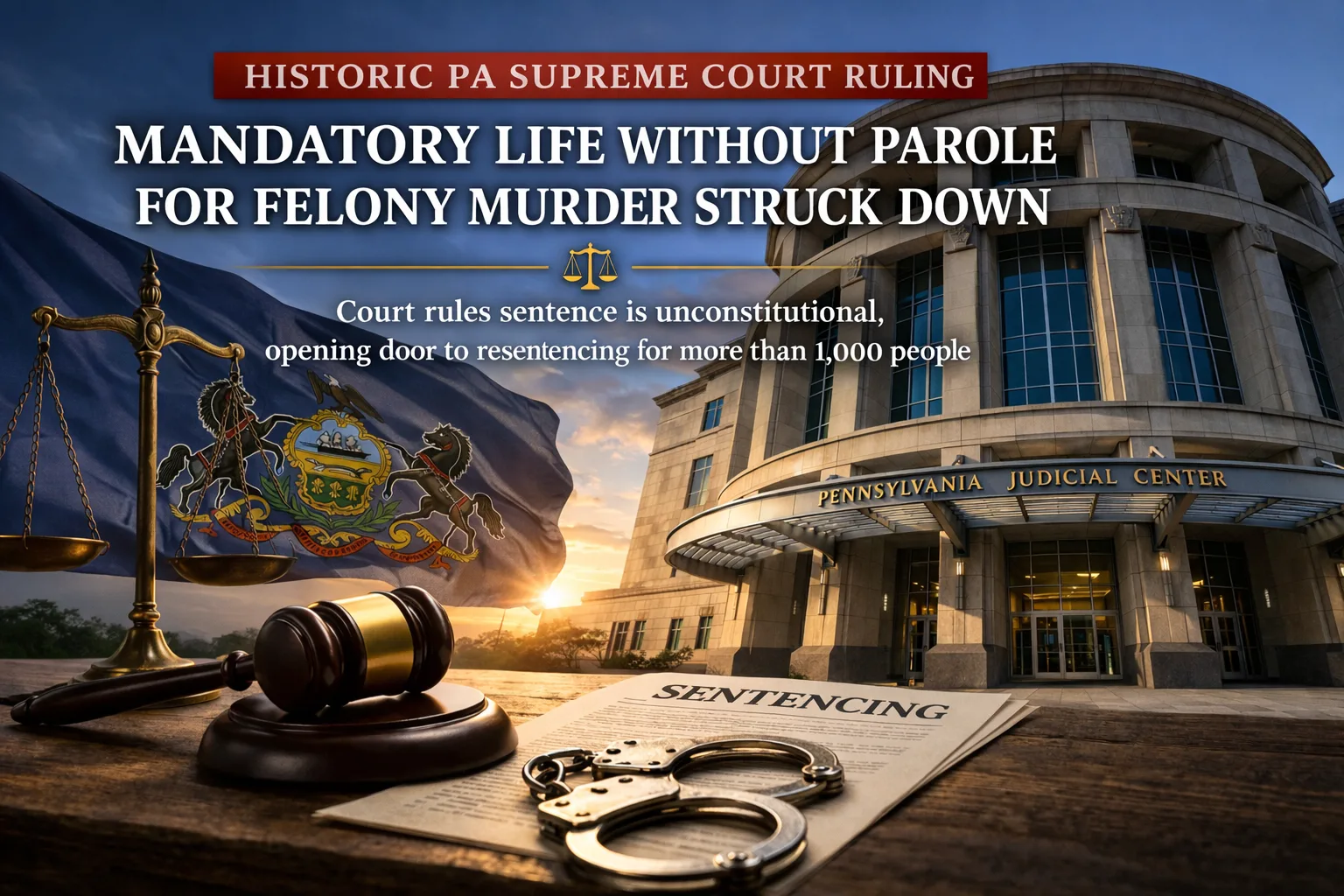
The Pennsylvania Supreme Court on Thursday struck down one of the nation’s most severe sentencing laws, ruling that the state’s requirement of life imprisonment without the possibility of parole for all second-degree murder convictions is unconstitutional, a decision that could reshape the legal futures of more than 1,000 people and force lawmakers to confront the limits of punishment in the state’s criminal legal system.
In a 70-page opinion issued in Commonwealth v. Derek Lee, the court held that a mandatory life-without-parole sentence for felony murder violates the Pennsylvania Constitution’s prohibition on cruel punishment because it fails to account for individual culpability.
At the center of the ruling is a fundamental legal principle: punishment must be proportionate not only to the crime, but to the person who committed it. The court found that Pennsylvania’s sentencing scheme — which imposes the same punishment on all individuals convicted of second-degree murder regardless of their role in the offense — “poses too great a risk of disproportionate punishment” and is therefore unconstitutional.
The decision marks a significant departure from longstanding precedent. For decades, Pennsylvania law required life without parole for anyone convicted of second-degree murder, defined broadly under the state’s felony murder rule. Under that doctrine, a person can be convicted of murder if a death occurs during the commission of certain felonies — such as robbery or burglary — even if they did not kill, intend to kill or directly cause the death.
The case before the court illustrated that dynamic. Derek Lee was convicted for his role in a 2014 robbery in Pittsburgh in which another participant shot and killed a man in the basement of a home while Lee was upstairs. Despite not being the shooter, Lee was automatically sentenced to life without parole under state law.
In overturning that sentence, the court emphasized that the law’s rigidity failed to distinguish between varying levels of culpability. A person who planned a robbery but did not anticipate violence, the court suggested, should not automatically receive the same punishment as someone who intentionally committed a killing.
The justices grounded their reasoning in the Pennsylvania Constitution, concluding that its prohibition on “cruel punishments” offers broader protections than the Eighth Amendment to the U.S. Constitution. The ruling represents a rare instance in which the state’s high court has interpreted its constitution to provide greater safeguards than federal law.
The court vacated Lee’s sentence and remanded the case for resentencing, but stayed its decision for 120 days to give the Pennsylvania General Assembly time to craft a new sentencing framework that complies with constitutional requirements.
According to estimates cited in the case and related filings, more than 1,000 people in Pennsylvania are currently serving life without parole for second-degree murder, while more than 5,000 people overall are serving life-without-parole sentences — among the highest rates in the nation.
Advocates for people serving these sentences described the ruling as a watershed moment in a long-running effort to challenge what they call “death by incarceration,” a term used to describe life sentences that offer no possibility of release.
“Life without parole is really death by incarceration,” said Frances Harvey, interim executive director of the Atlantic Center for Capital Representation. “It’s an extreme sentence that, by definition, denies the possibility for redemption or rehabilitation.”
Supporters of the ruling argued that Pennsylvania’s approach had become increasingly out of step with national and international standards, particularly because it imposed the same punishment regardless of intent. The court’s decision, they said, reflects a growing recognition that rigid sentencing schemes can produce unjust outcomes.
The ruling also carries significant racial implications.
A 2021 study cited in the case found that approximately 70 percent of those convicted of second-degree murder in Pennsylvania are Black, raising concerns about the disproportionate impact of the law on communities of color.
Legal organizations that supported Lee’s challenge framed the decision as the culmination of decades of advocacy by incarcerated people and their families.
“This ruling represents the culmination of decades of movement-building by incarcerated people and their families and communities,” said Bret Grote, legal director of the Abolitionist Law Center. “The movement to end [life without parole] has forced an epochal transformation in state constitutional jurisprudence.”
Still, the decision leaves critical questions unresolved. Chief among them is whether the ruling will apply retroactively to people already serving life sentences, a determination that could affect hundreds — or potentially thousands — of cases.
That question may ultimately return to the Pennsylvania Supreme Court.
In Philadelphia, where more people have been sentenced to life without parole than in any other jurisdiction in the world, District Attorney Larry Krasner said the decision represents both a legal breakthrough and a logistical challenge.
“There are over 500 Philadelphians who are doing sentences of life without the possibility of parole as a result of a law that said for second degree murder, the only possible sentence would be a mandatory sentence of life without the possibility of parole,” Krasner said at a press availability following the ruling.
The court’s decision, he said, “throws into question whether any of those 500 plus people are going to be actually facing a sentence of life without parole,” upending expectations that in some cases had been in place for decades.
Krasner, whose office supported the ruling and filed an amicus brief arguing that the sentencing scheme was unconstitutional, framed the decision as part of a broader shift away from mandatory sentencing.
“The fundamental point is that justice should be individual, not mechanical, not robotic,” he said, describing the ruling as a rejection of “the simplistic, unjust view of mandatory sentencing as being a good solution on criminal justice issues.”
But he also acknowledged the complexity of implementing the court’s directive. The prospect of resentencing hundreds of people, he said, would require significant time and resources.
“It does require the dedication of a lot of time and a lot of resources to make sure that we do justice in these cases and that we do individual justice,” Krasner said.
Officials in his office said they expect courts will now have discretion to impose individualized sentences that include the possibility of parole, allowing judges to weigh factors such as intent, role in the offense and evidence of rehabilitation.
Peter Andrews, a supervisor in the district attorney’s law division, described the ruling as a recognition that sentencing must reflect individual responsibility.
“What we expect will happen going forward is that courts will have discretion in setting minimum sentences for second degree murder where the [person] will now have a parole eligibility date at some point,” Andrews said.
The decision also raises difficult questions for survivors and victims’ families, many of whom were told at the time of sentencing that life without parole would be permanent.
Krasner said his office plans to begin reaching out to those families immediately, even as uncertainty remains about how the law will ultimately be applied.
“There are undoubtedly a lot of survivors, co-survivors who sat through a trial a long time ago, left with the clear understanding that the outcome of the case was a sentence of life without parole, and that understanding is no longer clear,” he said.
Follow the Vanguard on Social Media – X, Instagram and Facebook. Subscribe the Vanguard News letters. To make a tax-deductible donation, please visit davisvanguard.org/donate or give directly through ActBlue. Your support will ensure that the vital work of the Vanguard continues.
Categories: Breaking News Everyday Injustice Tags: Criminal Justice Derek Lee Felony Murder Life Without Parole Pennsylvania Supreme Court Sentencing Reform