
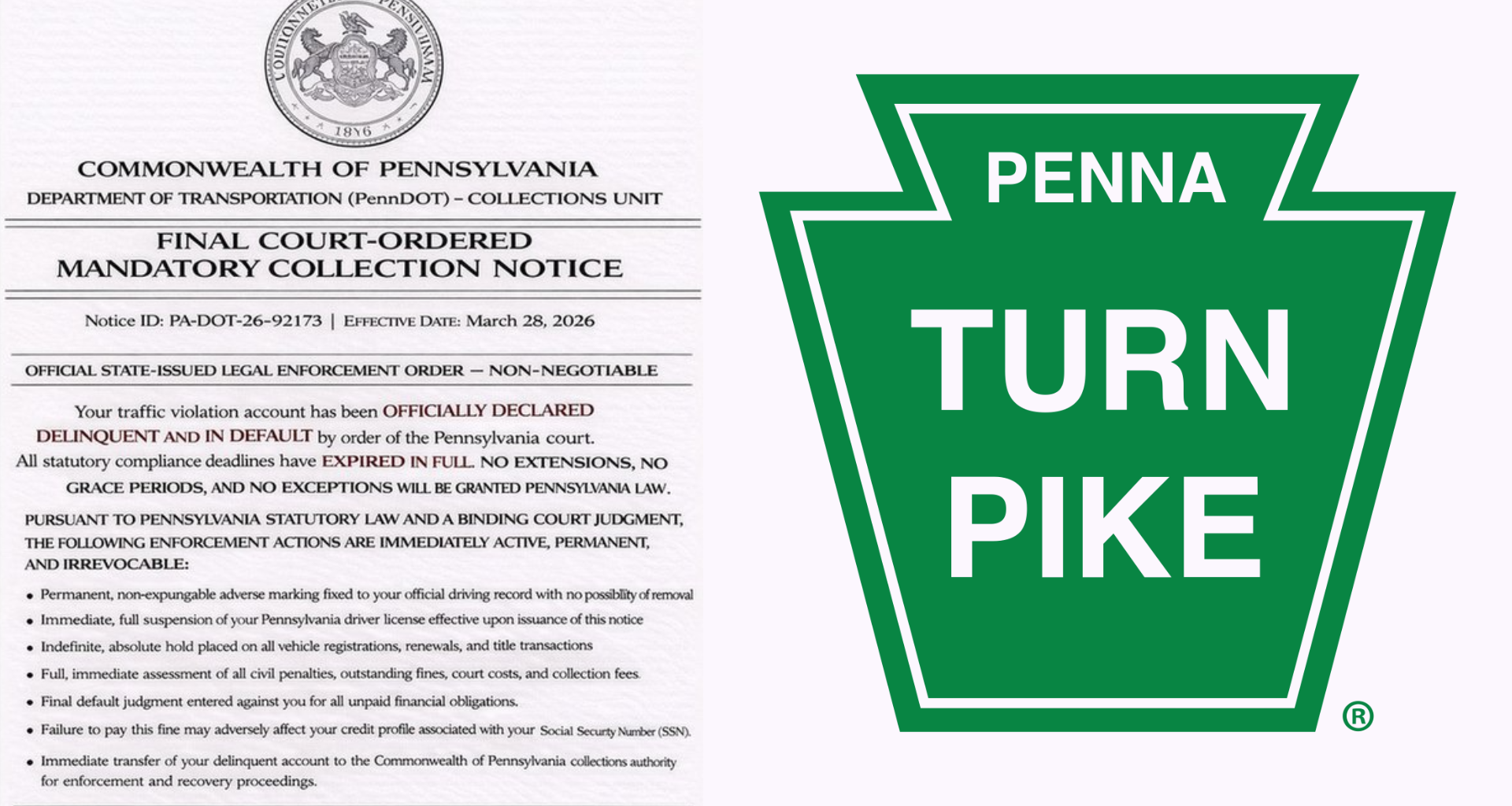
A surge of fraudulent text messages impersonating the Pennsylvania Department of Transportation is targeting drivers statewide, threatening license suspensions and demanding payment through embedded links or QR codes, state and local authorities warn.
The Shapiro administration — alongside the Pennsylvania Department of Transportation, Pennsylvania State Police and the Pennsylvania Turnpike Commission — issued a joint warning March 27 as reports of the messages spiked across the state.
Northampton Township Police Department posted its own alert the same day after community members forwarded examples of the texts.
The fraudulent messages closely mimic official government documents, in some cases displaying Pennsylvania state seals, formal legal language and “FINAL COURT-ORDERED MANDATORY COLLECTION NOTICE” headers. Some versions include QR codes directing recipients to payment portals designed to steal financial information.
Security experts note that QR codes carry the same risk as embedded links — scanning one can direct a phone to a malicious site just as readily as tapping a URL, and the destination is often harder to preview before visiting.
PennDOT officials emphasize that the agency does not send text messages to customers and has never used them to communicate about traffic violations or fines. All legitimate correspondence from PennDOT arrives by U.S. mail.
“If you receive a text message notice from a sender claiming to be from PennDOT who is threatening to suspend your license or registration privilege, do not click on any links and just delete the message,” said Kara Templeton, PennDOT Driver and Vehicle Services deputy secretary. “These messages are not from PennDOT.”
Pennsylvania State Police Acting Commissioner Lt. Col. George L. Bivens said the messages are engineered to panic recipients into quick action.
“These messages threaten license suspension or legal action, urging recipients to log in through a provided link,” Bivens said. “Such messages are fraudulent and are designed to create a sense of urgency to steal personal or financial information.”
The PA Turnpike Commission said it also never texts E-ZPass or Toll By Plate customers. Officials said any links included in such messages are not connected to the commission’s systems. Customers with questions about their accounts should use only the official PA Turnpike E-ZPass website or the PA Toll Pay app, available through the Apple App Store and Google Play.
Fake toll and traffic texts have surged nationwide since 2024, as scammers adapt their tactics to local agencies and expand their target lists. Pennsylvania Attorney General Dave Sunday also issued a warning this week, urging anyone who receives a suspicious message to report it as spam and not click any links.
“PennDOT does not send text messages about traffic violations or fines,” Sunday said. “Consumers who receive a text message or email from anyone alleging to be from a government agency should reach out to that agency to confirm the authenticity of any such message.”
How to Protect Yourself from the Scam
State Police offered the following guidance:
Never share personal information, including banking or credit card details, through text or email.
Treat any unexpected message from a government agency with skepticism, even if it appears legitimate.
Look up a verified customer service number and contact the organization directly, rather than using any links or numbers provided in the message.
Both major smartphone platforms offer built-in tools that can help reduce messages like these before they land in an inbox.
iPhone users running iOS 16 or later can go to Settings > Messages and enable “Filter Unknown Senders,” which routes texts from unsaved numbers into a separate folder and automatically disables any links inside them. Users on iOS 26, released last fall, get additional automatic sorting that pushes suspected spam further out of view.
Android users with Google Messages can enable spam protection in Settings > Spam protection to flag suspected junk before it reaches the main inbox.
On either platform, residents can forward suspicious texts to 7726 — which spells “SPAM” — a shortcode supported by AT&T, Verizon and T-Mobile that feeds reported numbers into carrier-level filters. Experts caution against replying to scam texts at all, even with “STOP,” as any response signals to scammers that a number is active.
Residents who believe they may have received a fraudulent text related to their driving or vehicle records can contact PennDOT Driver and Vehicle Services at 717-412-5300.
Victims of the scam should report the incident to local law enforcement and file a complaint with the Federal Trade Commission. Complaints about the texts can also be submitted to the Pennsylvania Office of Attorney General’s Bureau of Consumer Protection at 1-800-441-2555.
What to Do If You’ve Already Responded
Anyone who has already submitted payment or entered personal information should act quickly. The FTC recommends contacting your bank or credit card issuer immediately to dispute the charge and freeze or cancel the affected card.
If a Social Security number or other sensitive personal data was entered, visiting IdentityTheft.gov can help generate a personalized recovery plan.
Placing a fraud alert or credit freeze with the three major credit bureaus — Equifax, Experian and TransUnion — can prevent scammers from opening new accounts in a victim’s name.
Experts also advise changing passwords on any accounts that use the same credentials as those entered on the fraudulent site.
For further assistance, victims can contact law enforcement, the Federal Trade Commission, or the Pennsylvania Office of Attorney General’s Bureau of Consumer Protection.
This is the part where we ask.
No billionaire owner. No paywall. Just you keeping local news free.
$5 keeps us going
100% funds local journalism.

Jai Smith is a lifetime Lehigh Valley resident on a mission to empower local underserved communities and inform the public while providing journalists and storytellers a platform to develop the next generation of news media.