
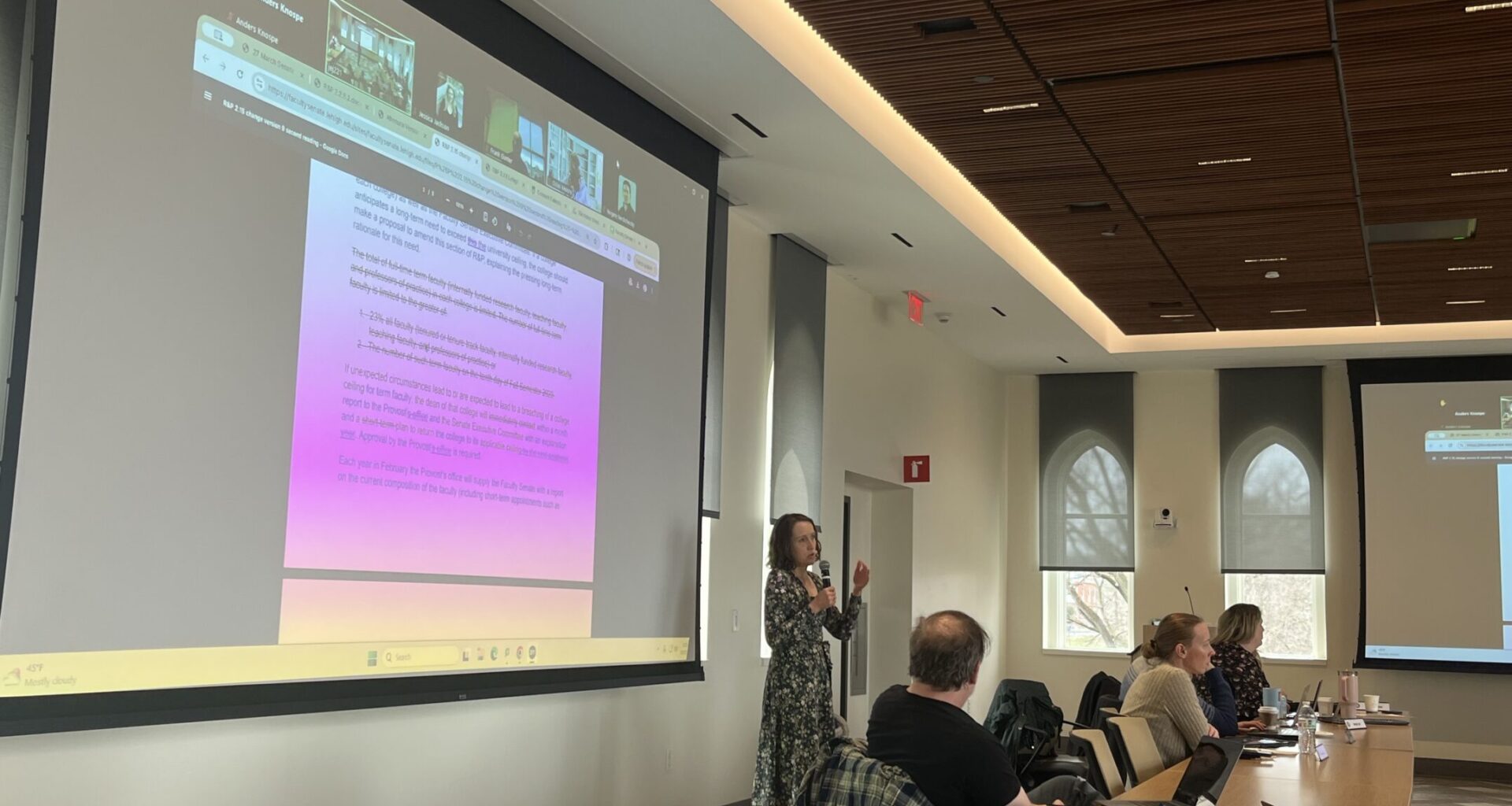
Lehigh’s Faculty Senate met on Friday to discuss campus climate, building access policies and plans to transition to mobile identification credentials. They also voted on adjustments to the language in the Senate’s rules and procedures.
Concerns about campus climate
The Senate briefly addressed the campus climate after two BORGs with racist images were discovered, prompting students to call for administrative action to promote an equitable and anti-racist community.
In response, President Joseph Helble issued a statement announcing a working group of university leaders is developing measures to prevent racism on campus. The Student Senate also released a resolution outlining actionable steps to create a more inclusive campus environment.
Peter Zeitler, chair of the Senate, opened the floor for discussion. Jenna Lay, the Senate’s vice chair, said the university is addressing the incidents through its conduct system. She said the university has likely identified those responsible for the first BORG but was unsure about the second.
Senator Angela Hicks said the Student Senate’s statement regarding the Title IX office was concerning.
“Currently, students are only able to report harassment and bias incidents through the Title IX office, which many may no longer feel comfortable doing,” the resolution states.
Lay noted the university currently lacks a Title IX officer following Brigid Benicasa departure in December.
Hicks said the reports from the Title IX and Equal Opportunity Compliance Office are no longer consistently annual, calling the issue something the Faculty Senate should prioritize.
The meeting adjourned before further discussion. Zeitler said senators could continue the conversation on the Senate’s private online forum ahead of the next meeting.
Campus safety and building access
The Senate heard from Christine Cook, vice president for finance and administration, and Jason Schiffer, chief of the Lehigh University Police Department, about building access policies and plans for mobile credentials.
Academic and administrative buildings are currently open weekdays from 8 a.m. to 10 p.m. with ID access required outside those hours. Cook and Schiffer said the university is considering requiring credentialed access at all times.
Under the proposal, most academic buildings would require ID access 24/7, with exceptions for main entrances of public-facing buildings such as Linderman Library and the Clayton University Center.
Some faculty members said increased restriction could negatively affect perception of campus openness. Senator Haiyan Jia said campuses should foster trust and accessibility, and stricter access could discourage interaction.
Other senators said credentialed access could improve perceptions of safety.
Cook said student surveys show 75% of respondents support expanded credentialed access as a safety measure.
The university is also planning a transition to mobile credentials, allowing IDs to be stored on phones for building entry or purchases.
Cook said 100% of surveyed students supported credentialed access when paired with mobile ID options.
Schiffer said the transition to mobile credentials will begin this summer as an optional program. Physical ID cards will remain available.
Senators requested a follow-up discussion with additional data on student feedback regarding safety and mobile access.
Adjustments to rules and procedures
The Senate approved multiple proposals related to promotion review processes and guidelines for faculty.
After a second reading, senators approved revised language clarifying that tenured associate professors may be considered for promotion at any time, with automatic review initiated in their ninth year in rank.
The Senate also approved updates clarifying timelines for annual and early tenure reviews, as well as more specific guidelines for graduate certificates.
Additionally, the Senate discussed new language establishing a universitywide cap of 33% for full-term faculty. Any changes to a college’s cap would be reported to Provost Nathan Urban and the Faculty Senate Executive Committee.
The Senate’s next meeting is scheduled for May 1. The agenda will be available on the Faculty Senate website in advance.