
Listen to article • 0:00 min
Syd Carpenter and vanessa german, two renowned sculptors with ties to Pittsburgh and a gift for blending found objects into their works, will be among the featured artists in two Northwest Philadelphia museums this spring.
“Syd Carpenter: Planting in Place, Time, and Memory,” is taking over the first floor of Chestnut Hill’s Woodmere Museum’s Charles Knox Hall through May 24. It is a bold statement of Black women as mothers, planters, and keepers of the Earth. Carpenter’s work is not meant to be glanced at or taken in quickly. It has to be studied and breathed in phases.
Each ceramic pail, trowel, spade of half-eaten apples represents our connection to the soil.
With a career spanning almost 50 years, Carpenter has many of her works on permanent view at the Renwick Gallery of the Smithsonian Institution, the Metropolitan Museum of Art, the Philadelphia Museum of Art, and the African American Museum of Art Philadelphia, as well as colleges and universities across the country.
She began her career in 1980s Philadelphia. Carpenter has designed the ancestral garden leading to the Colored Girls Museum’s Germantown twin and is one of five artists whose ceramic vessels are installed in the garden.
“To be able to look back through time and place and see my work at so many major museums and places … it’s such an affirmation,” Carpenter said.
“Planting in Place and Time” traces the evolution of her work, starting with gourd and womb-shaped clay vessels created after completing her master of fine arts degree at Temple’s Tyler School of Art.
Throughout the more than 60-piece exhibition are works featuring Carpenter’s signature “Mother Pin,” the knobby wooden clothespins. The artist likens them to the form of women’s bodies, their curvy shapes speaking to the consistency, durability, and unshakable faith of Black mothers, like her own.
Carpenter is the daughter and granddaughter of gardeners. Her grandmother moved to Pittsburgh from the Deep South in the early 20th century during the Great Migration, and Carpenter was raised in Pittsburgh before the family moved to Philadelphia in the 1960s.
Many pieces from Carpenter’s African American Farm Series are in the Woodmere show.
In 2012, Carpenter went on a sojourn to the Deep South, visiting farms owned and operated by Black families for generations. Massive wall sculptures featuring farm utensils, animals, and plants Carpenter formed with her fingers and fire came out of that visit. They serve as a portrait gallery on Woodmere’s first floor.
Freestanding sculptures feature Carpenter’s earthen pieces and found objects — kitchen tools, farm implements, and small pieces of furniture — welded to their base. Each piece is named after a farmer.
“It was important that each piece had a name so it was connected to the person who worked and cultivated the farm,” Carpenter said. “It is how we keep these names, their legacy, alive.”
Ramshackle Fence, a 6-foot-wide sculpture of seemingly disparate items Carpenter fashioned — bottles, jugs, clothespins, and tattered T-shirts — and mounted on Woodmere’s orange accent walls, an intentional monument to the Black farm.
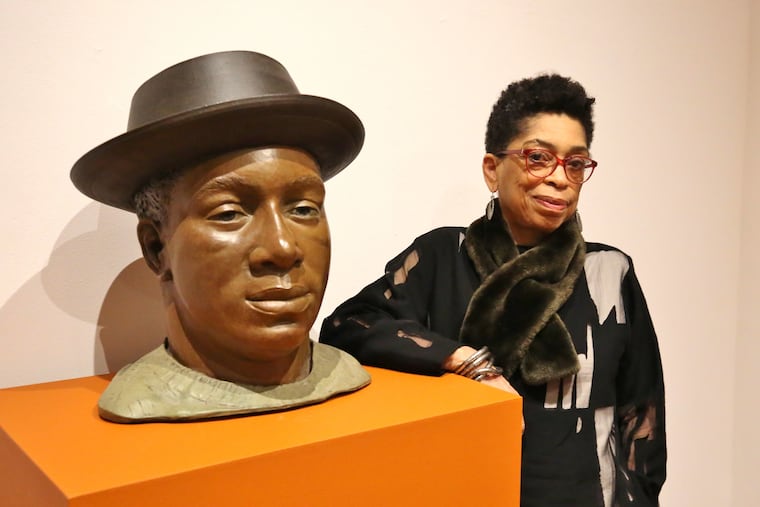
Busts of Carpenter’s brother Frank, a Desert Storm veteran who returned to Philadelphia as a quadriplegic, are among the exhibition’s most moving pieces. The life-size image of Frank in his too-tiny fedora, semi smile, and wide eyes that look like they just finished crying, speak to the bond between siblings and how war might make a country whole, yet soldiers a shell of themselves. Frank died in 1997.
“Planting in Place and Time” is part of a three-site celebration of Carpenter’s work in the Philadelphia area. “Re-union: Syd Carpenter, Martha Jackson Jarvis, Judy Moonelis, Sana Musasama, and Winnie Owens Hart,” is on display at St. Joseph’s University’s Frances M. Maguire Art Museum at St. Joseph’s University through March 29.
It’s a retrospective of Carpenter’s work and the women who shaped it.
“Home Bound in Wood, Steel, and Clay,” at Ursinus College’s Berman Museum explores Carpenter’s large scale work, featuring a series of ceramic leaves Carpenter shaped to invoke animals. It will close April 5.
“Syd has been an anchor figure in the arts community of Philadelphia for many decades now,” said William H. Valerio, executive director at Woodmere. “She has produced almost 50 years of art that we can assess for its messaging that speaks to the life-affirming strength of the human spirit.”
📅 Through May 24, 📍 Woodmere Museum of Art, Charles Knox Hall, 9201 Germantown Avenue, 🌐 woodmereartmuseum.org
vanessa german
Colored Girls Museum executive director Vashti DuBois has no idea what artistic flavor Asheville-based sculptor, performance artist, and community activist vanessa german will bring to the museum’s living room, but she knows it will represent to the spirit of her 10th anniversary show, “Say it Loud, I’m Black and I’m Proud.”
“Say it Loud” takes its name from the late James Brown’s 1968 Black power theme song, and like the fast-paced record, it speaks to the spirit of the Black American experience at a time of racial upheaval.
“I traveled a lot in the last two years … to Kenya, Ghana, Grenada,” DuBois said. “I came back with a feeling in my bones and profound sense of pride about being a Black woman. That song jumped into my head as an appreciation of how much Black people have done under extraordinary circumstances.”
german, who grew up in Los Angeles, moved to Pittsburgh in the early 2000s and spent close to 20 years making art and teaching children how to be artists at ArtHouse. Her work is grand, an amalgamation of found objects and mixed media art.
In 2017 she gained a bit of fame from Miracles and Glory Abound a 17-foot traveling piece that reimagines Emanuel Leutze’s painting of George Washington crossing the Delaware River as a Black woman.
She is currently community artist facilitator at the Shirley Chisholm Recreation Center in New York’s East Flatbush.
In 2023, Montclair Art Museum featured a retrospective collection of her work, “Please Imagine All the Things I Cannot Say.”
That is where DuBois met her. The two women clicked, and it didn’t take long for DuBois to figure out that german’s aesthetic blended in with TCGM’s.
“It will be a site-specific installation,” DuBois said. “It will span across mediums. I’m sure she will build power figures incorporating gem stones and found objects. Whatever she does will be in conversation with the rest of the show.”
It will also be in conversation with DuBois’ forthcoming book, Housekeeping: A Memoir. The installation process will begin in the spring and the show will open on the summer solstice, June 20. It will be up through 2027.
📅 From June 20 through 2027📍 The Colored Girls Museum, 4613 Newhall St.,🌐 thecoloredgirlsmuseum.com