
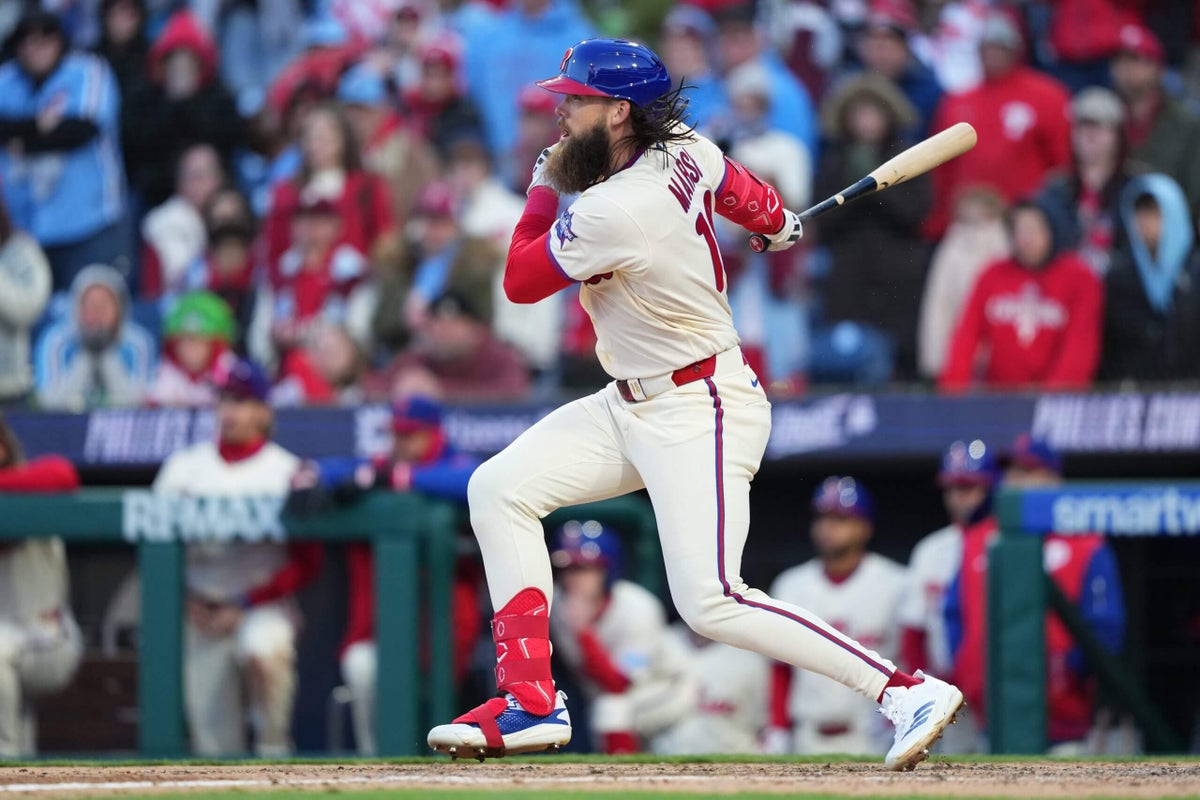
PHILADELPHIA — The Philadelphia Phillies learned early Saturday that Jacob deGrom would not start against them and, instead, the Texas Rangers would pitch a lefty. That presented Rob Thomson with a dilemma; he could have changed his lineup intended for deGrom and deployed his platoons at second base and left field.
“I thought about it,” Thomson said before a 5-4 Phillies loss.
Thomson had his reasons. The Phillies are going to face lefty starters Sunday and Monday, too. That would have meant too much downtime for Bryson Stott and Brandon Marsh. So the manager stuck with his normal nine, then watched a deluge of Rangers lefties hold the Phillies to one hit over eight innings.
Then, with the Phillies down to their last out Saturday night, Thomson pinch hit for his No. 5 hitter. Edmundo Sosa batted for Stott and drew an eight-pitch walk against a lefty reliever to elongate the game. The Phillies tied it when Marsh was afforded a chance to hit against a righty reliever. They lost it in the 10th inning.
These early-season games have intrigue beyond the results; every strategic decision is a peek into how the manager feels about his team — how he makes his lineup, whom he trusts when, how he uses his bullpen, etc. The Phillies are committed to two platoons — for now — but that is not a hard-and-fast rule. If it were, Stott and Marsh would have sat Saturday.
It might not have mattered. Kyle Schwarber and Bryce Harper faced a Texas lefty in all 10 of their combined plate appearances. They went 1-for-10, the lone success a Harper run-scoring single in the 10th that moved the potential tying run to third base.
Schwarber was 0-for-5 with four strikeouts. It was his first four-strikeout game since Aug. 20, 2024.
“Yeah, it wasn’t my best one,” Schwarber said. “Get to work on that stuff. Just have to get back to the things that I want to feel.”
He would have struck out only three times had he waited to challenge in the decisive 10th inning. Schwarber took a close 2-1 pitch called a strike. He tapped his head. The review showed the pitch nicked the bottom corner of the zone. The Phillies were out of challenges, because rookie Justin Crawford had lost one in the eighth inning.
The next pitch to Schwarber, a changeup down for a called strike three, was even more borderline. Schwarber would have won a challenge to overturn the strikeout; a dugout iPad with the Automated Ball-Strike system confirmed it for him.
“You never know, right?” Schwarber said. “You never know. It’s not like I’m mad about it, right? I did it when I thought I should have done it. And he made a good pitch. Then he made another good pitch. You tip your cap.”
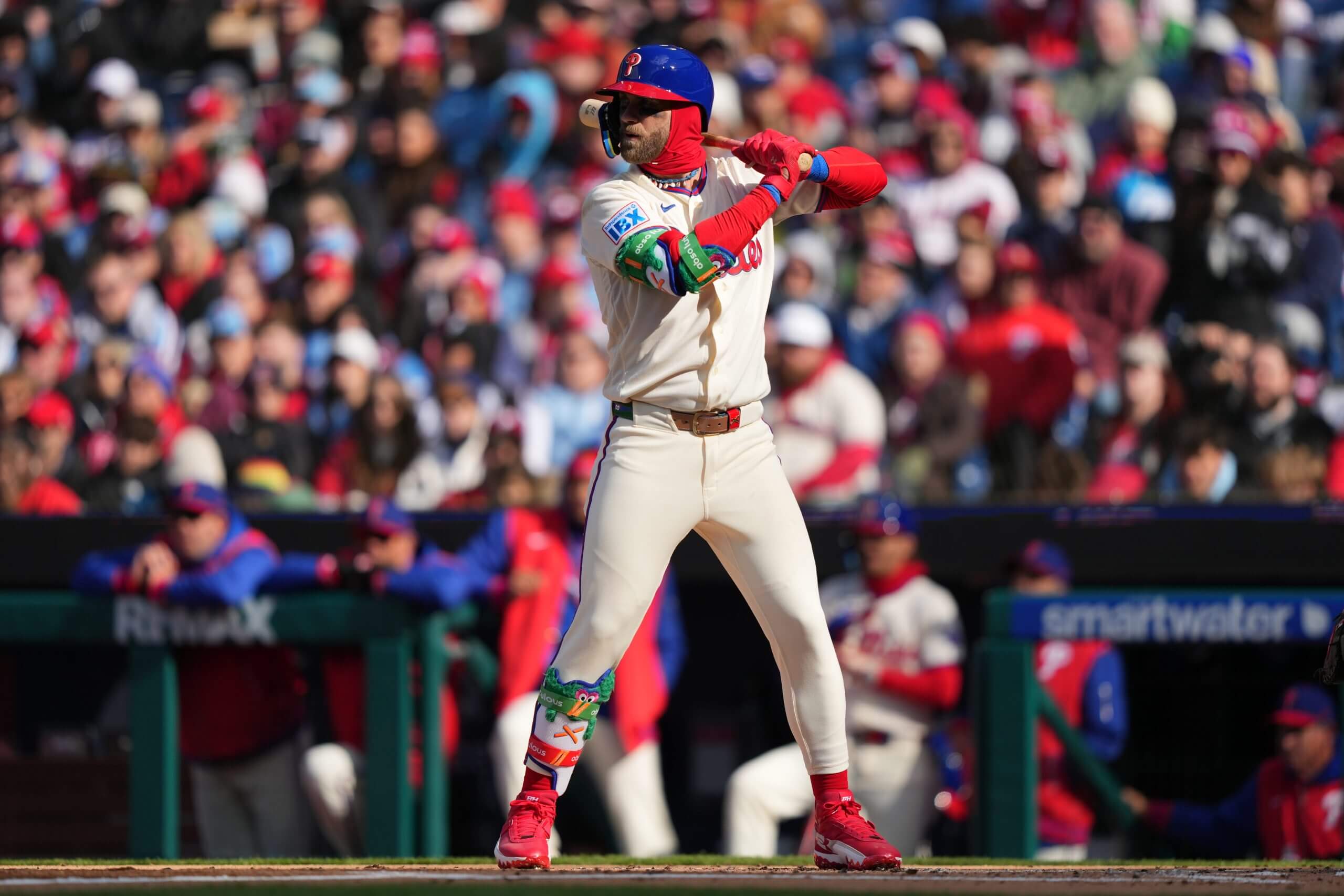
Bryce Harper was 1-for-5 on Saturday, the only batter in the top three of the Phillies’ lineup to get a hit. (Kyle Ross / Imagn Images)
It doesn’t matter what lineup Thomson uses if his top three guys — Trea Turner, Schwarber and Harper — go 1-for-15. Turner, in particular, had some uncompetitive at-bats on a day he was honored pregame for winning last season’s National League batting title. It happens.
Three of Turner’s five at-bats were against lefties; he crushed them to an .836 OPS in 2025. The Phillies, as a team, ranked sixth in the majors with a .747 OPS against lefties. Schwarber hit lefties last season like few lefty hitters ever have. Harper always has.
Stott did three years ago. But in 2024 and 2025, his .585 OPS left-on-left ranks 63rd among 75 batters with 150 plate appearances. Sosa boasted an .895 OPS against lefties in 2025.
The Phillies trust Stott enough to bat him fifth against righties. But, for now, the other numbers are too glaring to ignore.
“I mean, obviously, you want to play,” Stott said during the last week of spring training. “And the only way you get out of that is by showing that you do it. So when or if I get the chance to do it, you have to do it.”
That can affect his mindset.
“Sometimes I’ll go up,” Stott said, “and I’m like, ‘Well, I have to get three hits in this at-bat because I have to show I can do it.’ So you start trying harder and it gets worse.”
Stott had a chance on Opening Day; he singled against Texas lefty reliever Jalen Beeks, then stole a base. He flied out and walked in his two plate appearances against a lefty in Saturday’s game. He was happy about his approach in the spring. His thinking: If it doesn’t happen against a lefty, it doesn’t happen. It is not the end of the world.
“It’s not that I’ve never done it,” Stott said. “Just kind of getting back to that kind of mindset: I don’t have to get three hits against them in one at-bat. If I get some hits against them, then obviously you would hope that would make decisions harder. Control what you can control. If I go out there and have good at-bats against lefties, and then it doesn’t happen, then it’s out of my control. Let’s see what happens.”
Marsh, who has struggled against lefties for his whole career, is firmly in a platoon with Otto Kemp in left field. With the Phillies trailing by two runs in the bottom of the 10th, Thomson sent Kemp to pinch hit for Crawford to begin the inning. Kemp was hit by a pitch.
In the past, Thomson has stacked the two righty platoon bats near the bottom of his lineup. It has created matchup problems later in games because, as the manager tells Stott and Marsh, they are likely to play even when they do not start. The problem is, it creates another lefty-heavy pocket for the opposing team to deploy a lefty reliever. The lineup Sunday against Rangers left-hander MacKenzie Gore will show Thomson’s hand.
“It’s something we’re going through,” Thomson said, “and something we’re thinking about.”
Whatever the strategy, it is probably advisable to collect more than one hit in the game’s first eight innings.