
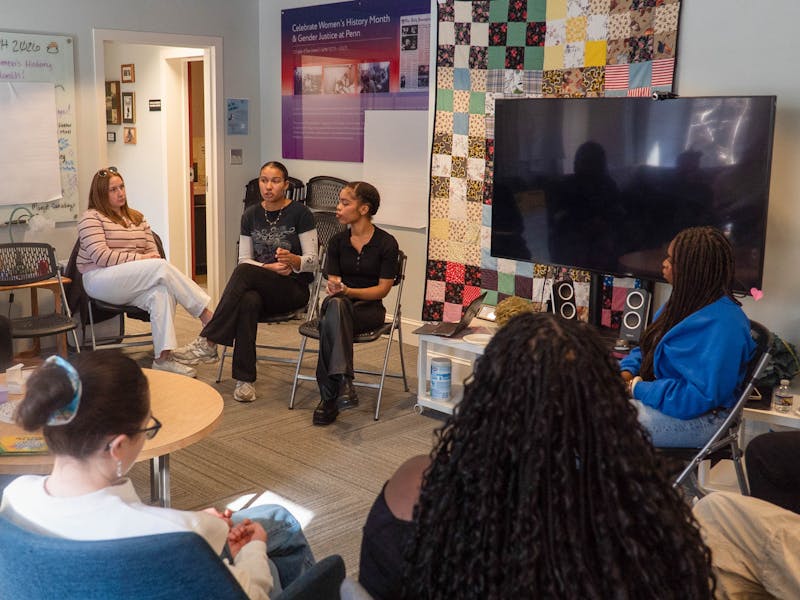
The Social Equity and Community Fellows Program hosted a workshop about domestic violence and abuse at the Penn Women’s Center on Saturday.
The March 28 event featured an open discussion about the topic along with a University presentation on prevention resources and card writing to support domestic abuse survivors. The workshop was organized by College sophomore London Haynie and College junior Tricia Tchamabo as part of the Penn Association for Gender Equity’s annual week of programming.
In an interview with The Daily Pennsylvanian, the organizers — both of whom are SEC fellows — emphasized that their goal was to educate students about domestic violence and methods of advocacy.
“It’s overall a mini campaign where we’re saying that domestic violence is a Penn student issue,” Tchamabo explained. “There are students who are going through this, and we want to make sure that they feel seen.”
Haynie expressed that domestic violence is a “gendered issue,” prompting the organizers to host their workshop during Gender Equity Week. They also collaborated closely with PAGE and Penn’s minority coalition groups — commonly known as the 7B — to “make sure that every minority group is represented.”
Get the DP delivered straight to your inbox.
“The data does show that domestic violence is something that is disproportionately experienced by gender minorities,” Haynie added.
College first-year and PAGE coordinator Max De Rosa Purcell attended the workshop and expressed interest in “seeing how Penn can support students who come from nontraditional backgrounds.”
“I don’t think the University does a good job of supporting students — especially students who experience domestic violence in some way,” she said.
When describing her takeaways from the workshop, Purcell expressed that while students have various perspectives, “we’re all united in that we feel not supported by the University.”
“There are cultural and structural issues that the University has that really inhibit students who experience domestic violence from really thriving,” she added.
Nursing first-year Natalie Hodge-Hannula explained that she attended the workshop to learn what resources are available to survivors of domestic abuse. She echoed Purcell’s sentiments, expressing that students “don’t really get a good introduction” to Penn’s domestic abuse resources when arriving on campus.
“I don’t think [Penn] does a great job of advertising any of the resources, which I feel like has been something students have said across the baseline,” Hodge-Hannula said. “We don’t know what’s out there, and we don’t know how to access it.”
She said that the workshop was “very encouraging,” because attendees were “actively listening” and “letting people have their own voice.”
“It was a good balance of people who I felt were like survivors, and also people who were just there to learn,” Hodge-Hannula added.
Staff from Penn Women’s Center, Penn Violence Protection, and Penn Restorative Practices also attended the workshop to help “foster a conversation” about the sensitive topic, according to Haynie. Attendees had the option to seek them out as “confidential resources” if they wanted a break from the conversation.
Haynie and Tchamabo will continue their work by collecting auditory stories of student experiences and knowledge related to domestic violence.
“We’re leading research to gather student information about who’s experienced domestic violence before coming to Penn, how they feel like they can be better supported here, and what they feel like they’re struggling the most with,” Tchamabo explained.
They hope to present their research to members of the Penn community in April.