
Feeding Washington’s army
The Continental Army provided each soldier with a pound of bread and a pound of meat daily, along with weekly rations of vegetables and rum. For many enlistees who came from poverty, the guarantee of daily food was a strong incentive to join.
Unfortunately, the Continental Army often did not live up to its own bargain because it competed with the British army for supplies and fell short of money due to the constant shortage of funds from the Continental Congress.
“The troops are worn out with fatigue, badly fed and almost naked,” noted Maj. Gen. Nathanael Greene in January 1778, cited in Ricardo Herrera’s “Feeding Washington’s Army” (2022).
The soldiers “have been on the eve of starving and the Army of mutinying,” Greene wrote.
To meet the hunger, Washington appointed Christopher Ludwick to create a network of bakers and strategically placed ovens across the colonies to supply the army, wherever it marched, with a constant supply of bread.
Bustill was one of Ludwick’s army of bakers.
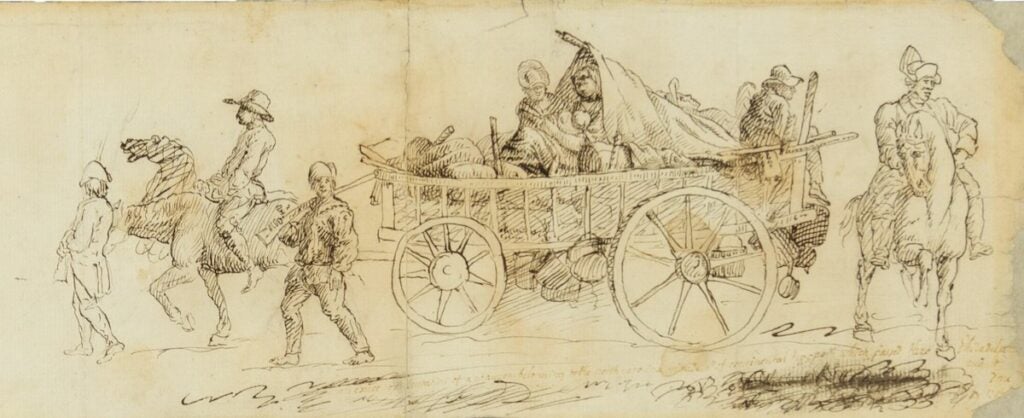 An eyewitness sketch of a Revolutionary War wagon in 1777 traveling though Philadelphia on its way to George Washington’s army, by Pierre Eugène du Simitière (1737-1784). Cyrus Bustill likely transported his bread from Burlington, NJ, to Valley Forge in a similar wagon. (Museum of the American Revolution, Gift of Judith F. Hernstadt; Conserved with support from the North Carolina Society of the Cincinnati)
“They would get flour at the port of Burlington and for one month, Cyrus was commissioned to bake that bread. Then they drove the bread to Valley Forge,” Mosley, Bustill’s descendant, said. “They would leave Burlington, New Jersey, take the ferry to Pennsylvania and then drive up to Valley Forge.”
Mosley said Bustill likely had a face-to-face meeting with Gen. George Washington.
“In my family history, there is a story that George Washington gave Cyrus a gold coin,” she said. “In the late 1800s, it’s mentioned that one of my ancestors had that in her possession. Two Quakers certified that she had it. But I don’t know what happened to it.”
Around the time of the Revolution, Bustill married and became part of one of Philadelphia’s founding Black families, and one of America’s first Black landowning communities.
His wife, Elizabeth Morrey, a mixed-race woman, was the granddaughter of Philadelphia’s first mayor, Humphrey Morrey, and the daughter of a formerly enslaved woman of Lenape and African descent, Cremona Satterthwaite, who worked as a freed servant for the Morrey family. Humphrey’s son Richard had a relationship with Cremona that history suggests was a committed one, which produced five biracial children.
Richard Morrey ultimately ended the relationship but transferred 198 acres to Cremona in what is now Glenside, Pennsylvania. When her daughter Elizabeth married Bustill, the couple acquired 12 acres of land in what was then known as Guineatown after its residents of African descent.
Elizabeth’s sister, also named Cremona, married John Montier. From them descended a successful bootmaker in the early 19th century who posed with his wife for what is now the oldest surviving pair of portraits of an African American couple, at the Philadelphia Museum of Art. They became the subjects of a WHYY documentary film.
Building a Black community
After the war, Bustill moved to Philadelphia to open a new bakery. The city’s Black community was going through a historic period of transition. About 10 years before the war, the ratio of enslaved to free Black Philadelphians was about 10-to-1. Ten years after the war, that ratio flipped: About 90% of Black Philadelphians were free.
The reasons for that swift and enormous population change were, in part, legal. Pennsylvania had passed the Gradual Abolition Act of 1780. This era also saw a rise in abolitionist fervor, mostly among Quaker meetings who insisted their followers free their slaves, which many did through mass manumissions.
Philadelphia’s free Black community was growing exponentially and needed someone to show them how to thrive. As a formerly enslaved entrepreneur, Bustill shepherded newly freed residents into affluence.
“He bridged the difference between the people being enslaved and then people being free,“ Mosley said. “He was able to walk that line.”
Bustill joined Absalom Jones and Richard Allen as founding members of the Free African Society, a benevolent organization that provided religious services and mutual aid to Philadelphia’s Black residents. The organization expected members to donate money monthly to a community fund and to lead moral lives that forbade indulgent feasting, gambling and drinking.
Jones and Allen later became prominent figures in Black American history: Jones was named the first Black Episcopal priest and Allen founded the African Methodist Episcopal Church.
By this time Bustill was already seen as a revered elder. He was 55 years old when the Free African Society was founded and 62 when the AME Church was created.
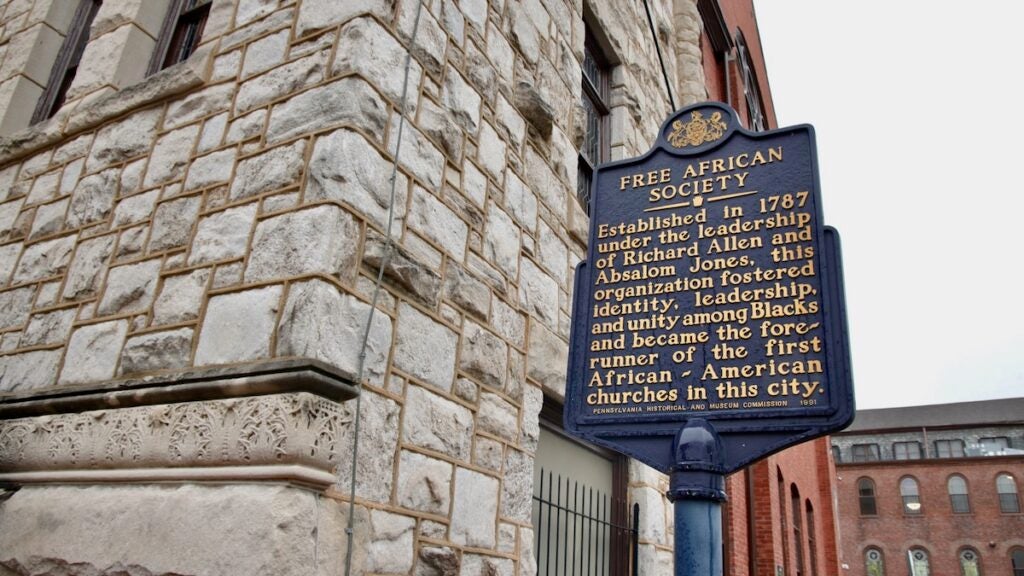 A historical marker outside Mother Bethel AME Church commemorates the formation of the Free African Society, of which Cyrus Bustill was a founding member. (Emma Lee/WHYY)
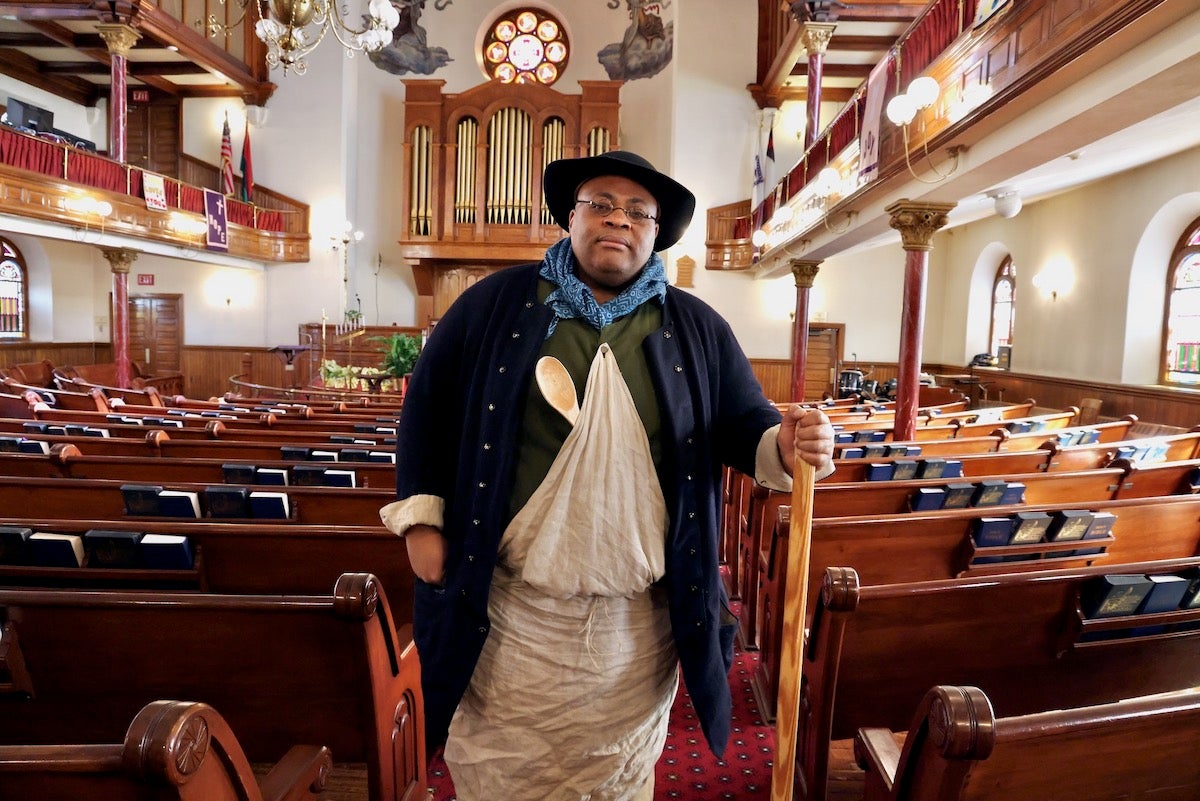
Idriss, who often bodily interprets Bustill while in costume as an 18th-century baker, believes his bakery became a hub of Black life in Philadelphia.
“As one who was enslaved and one who has that business and had to move on his feet quickly in order to meet the needs of those in his community, I think people of African descent are coming to Cyrus, to his bake shop, to understand and make connections with this person of African descent who is doing well for himself,” he said.
The Free African Society did not survive long, lasting from 1787 to 1794. Still, it was the first Black mutual aid society in a city that would develop over 100 similar organizations over the next four decades. Many members followed Jones and Allen into their respective religious congregations.
Bustill did not join Jones and Allen’s congregations because he was a practicing Quaker, even though he could never become a member. He was allowed to attend meetings but not to join.
“Because of the color of his skin, he didn’t get membership,” Mosley said. “His daughter and his granddaughter were almost lifelong Quakers. Not member-Quakers, just practicing Quakers. They had to sit on the Negro bench.”