
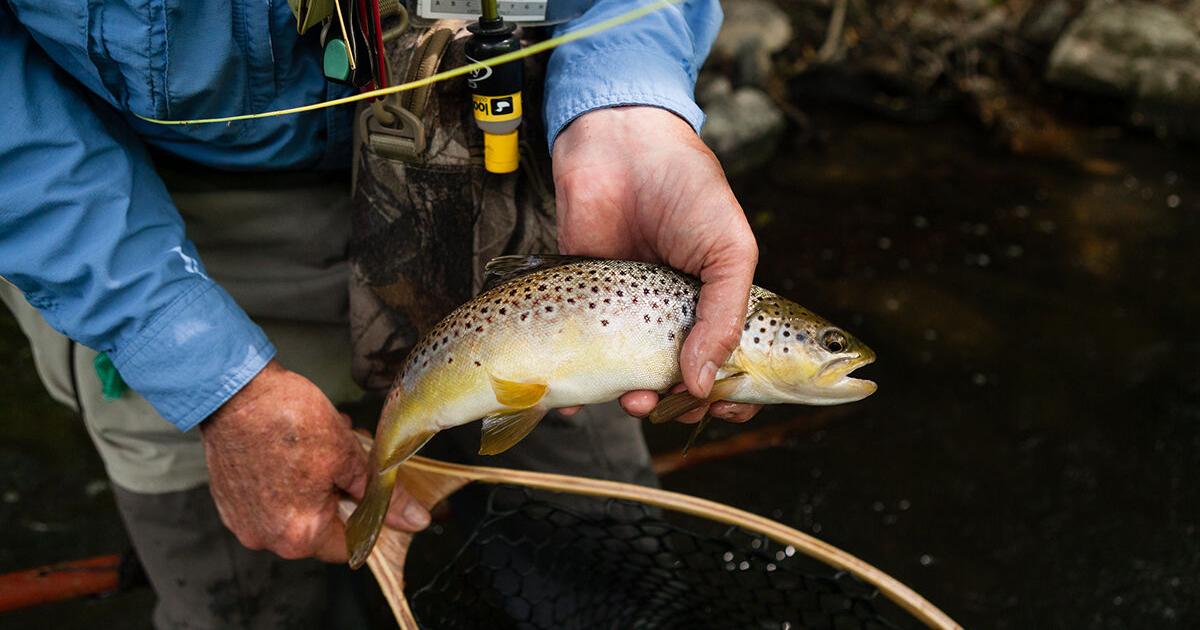

An angler displays a brown trout caught on the Little Juniata River in Pennsylvania.
Will Parson/Chesapeake Bay Program
As a child in the 1980s, Jared Manning never missed opening day of trout season. Freeman Run in Potter County, PA, flowed through his town of Austin and about 100 feet from his back door. By 8 a.m., he and his family were dropping worms to lure the plentiful trout freshly stocked by the local anglers club and the Pennsylvania Fish and Boat Commission. “You could look up and down the stream in either direction and see dozens of people,” he said. “Mostly families.”
As an adult, Manning developed a preference for chasing wild brook trout in remote streams. But he regularly returned to Freeman Run for the community, especially on opening day. Neighbors hosted cookouts. Often there was a chicken barbecue organized by the local church or Scout troop.
But that changed in 2021, when the Fish and Boat Commission stopped stocking Freeman Run, Manning said. The agency’s fish survey, conducted in 2018, had shown that it qualified as a Class A wild trout stream — meaning it had a sufficient biomass of the wild fish to support what the agency calls “a long-term and rewarding fishery.” Per state policy, Class A wild trout streams, with few exceptions, are not supposed to be stocked.
Anglers gathered for a fishing derby on Freeman Run in Austin, PA, in April 2018, three years before the Pennsylvania Fish and Boat Commission stopped stocking the stream with brown trout. (Darwin Manning)
Many conservationists and anglers champion this policy of prohibiting stocking in healthy streams where trout reproduce on their own. Stocking can increase the competition for food and habitat, so most research has shown that stocking has either negative or, at best, neutral effects on wild trout, said ecologist Shawn Rummel, a senior manager and science advisor for Trout Unlimited’s Northeast Coldwater Habitat Program.
But for many anglers accustomed to the bountiful harvest of stocked trout, there is simply no other way to fish. After stocking ended in Freeman Run, Manning said he was hard pressed to find anyone fishing there on opening day or any day.
Now, the Fish and Boat Commission has made the controversial decision to stock a portion of Freeman Run again — as part of a five-year study that will test whether the agency can protect wild trout in a Class A stream by stocking it with rainbow trout and prohibiting anglers from harvesting brown and brook trout.
“I’ve not been shy about recognizing that there are negative impacts to wild trout populations when stocking occurs,” said fisheries biologist Kris Kuhn, director of the commission’s Bureau of Fisheries. “The question here is, can we mitigate those negative impacts?”
Conservation dynamics
By the 1800s, brook trout (Salvelinus fontinalis) — the only salmonids native to Pennsylvania streams — were in trouble. Pollution and stream disruption from the mining and lumber industries had caused the population to dwindle, along with other native fish. An 1870s report from the Pennsylvania Fish Commission noted, “The large number of streams running through our state have become so depopulated of fishes by pollution and persistent wanton slaughter as to render them almost valueless to the people as a source of food.”
An angler displays a brook trout.
Will Parson/Chesapeake Bay Program
And so, the agency began stocking. In the 1880s it started releasing brown trout (Salmo trutta, native to Europe) and rainbow trout (Oncorhynchus mykiss, native to the western U.S.). Many other states also began stocking programs that continue to this day. Brown trout have been stocked in nearly every U.S. state.
In Pennsylvania, brown trout naturalized widely, surviving in waters too warm or polluted for native brook trout. These wild brown trout fisheries are now a major draw for many anglers.
Meanwhile, the “brookies,” which are the state fish of Pennsylvania and several other states, are still in decline. The main threats are the warming climate and floods that disrupt overwintering eggs, said fish biologist Nathaniel “Than” Hitt, formerly with the U.S. Geological Survey and now a senior scientist with the West Virginia Rivers Coalition.
But many studies have demonstrated that the presence of brown trout can also reduce brook trout numbers. Hitt’s research suggests that brook trout are displaced by brown trout particularly in warmer waters where they could otherwise survive if not for the added competition.
The Fish and Boat Commission, along with conservation organizations such as Trout Unlimited, has spent decades working to clean up polluted streams, in part to encourage the return of brook trout.
But often when waterways become healthy enough for brook trout, there is pressure to stock them “even though we did that work in order to get native fish, that maybe have been isolated up in the headwaters, to recolonize,” said Rummel of Trout Unlimited.
This fishing season, the Fish and Boat Commission is stocking 3.2 million trout in Pennsylvania waters, including rainbow trout, brown trout, brook trout and golden rainbow trout. Another 1.1 million trout will be stocked by cooperative nurseries, hatcheries run by local organizations such as sportsmen’s clubs, that raise trout provided by state hatcheries as fingerlings.
The vast majority of these fish will never see a Class A wild trout stream. The commission’s 2025-2029 Strategic Plan for Management of Trout Fisheries notes that “Class A waters contain the most abundant wild trout populations and, with rare exceptions, the [commission] manages these stream sections solely for the perpetuation of the wild trout fishery with no stocking.”
Of the 1,316 stream sections designated as Class A, 14 are now stocked by the commission. Another 14 are stocked by other sponsors, such as cooperative nurseries, which typically stock once a season for events like fishing derbies.
Freeman Run study
Freeman Run is the latest of the Class A wild trout streams to receive an exemption for stocking. In October 2025, the commission’s board voted to allow stocking of rainbow trout over the course of a five-year study beginning in 2026, in a 3-mile stretch of the stream labeled Section 4.
A special regulation — designed to give wild trout an edge — requires anglers in Freeman Run to release any brown or brook trout they catch but permits them to keep rainbow trout. “Previously, the wild trout would have been open for five fish per day harvest,” Kuhn said, “[but they] now have more protection than they did before we reinstituted stocking.”
Jared Manning holds the brown trout he caught after hours of fishing in Pennsylvania’s Freeman Run in 2021, the first season after the state discontinued stocking trout in the stream. (Jessica Manning)
Rainbow trout are unlikely to naturalize in Potter County, though they have done so in some locations across the state, such as the Cumberland Valley, where water temperatures remain warm enough through winter.
The Fish and Boat Commission will periodically measure the wild trout population in Freeman Run to test the influence of stocking over time. As a comparison, they will also measure the wild trout population in Section 3, a Class A section immediately upstream of Section 4, which will not be stocked.
The agency will also count anglers and gather opinions. “If angler use isn’t high enough to justify continued stocking, we may go back to the board and recommend that we discontinue the stocking,” Kuhn said.
Angler views on the Freeman Run study — and stocking in general — vary widely. “[Freeman Run] is so popular and it is so heavily fished by all types of anglers,” said John Mahn Jr., president of the agency’s Board of Commissioners. “When it was decided that it would be stocked again, there was considerable uproar, and there still is.”
An angler fishes for trout in a stream near Boiling Springs, PA. (Harvey Barrison//CC BY-NC-NC 2.0)
During the public comment period prior to the board’s vote to reinstate stocking, the agency received 96 comments that opposed the stocking and 13 that supported it.
Along with brown trout, Freeman Run also contains a sparse brook trout population. Native fish enthusiasts like Potter County resident Andy Mickey are especially opposed to stocking in streams that have brook trout.
“These funds could be far better spent studying, sustaining and improving wild brook trout populations,” said Mickey, who chairs the Pennsylvania Chapter of the nonprofit Native Fish Coalition. He said all wild trout streams, not just those designated as Class A, should be off limits to stocking.
Jared Manning said he has in recent years often been one of very few pro-stocking voices from the public at meetings of the Fish and Boat Commission in Harrisburg. But that, he theorized, is because Austin is a small, mostly blue-collar town whose residents wouldn’t be inclined to take off work to make the three-hour drive to the capital.
When the commission surveyed landowners along section 4 of the stream, 14 of the 17 who responded supported stocking as part of the proposed study.
The broader debate
This division over Freeman Run mirrors a wider disagreement over fish stocking in Pennsylvania. An estimated 60% of the total stream miles stocked by the Fish and Boat Commission are home to at least some wild trout, though in many places the populations are too small to support a fishery and, according to agency communications director Mike Parker, do not have suitable water quality and habitat for an abundant wild population.
But a 2023 survey by the commission of 3,383 Pennsylvania trout anglers found that 58% were in favor of moving stocking operations to nearby locations without wild trout rather than stocking where wild trout are present. Sixteen percent were opposed to moving stocking operations out of wild trout waters.
Brook trout swim in a Pennsylvania stream.
Charlie Nick/Chesapeake Bay Program
Stocking may have been necessary after pollution from mining and logging operations had wiped out much of the wild trout population, Mickey said, but “that’s just not the situation we’re in anymore.”
Mickey favors fishing for brook trout on isolated, hemlock-lined streams. “It’s just really special,” he said, “to be able to watch that fish take your fly, and get a good look at it, and release it back to its home, knowing that it’s a species that’s evolved here since the beginning of time.”
But for the anglers who take their kids fishing in the first week of trout season, they want to go where they will catch fish, and most of the time that means fishing for stocked fish, Mahn said. Still, he said he will vote to stop the stocking of Freeman Run if the study shows that the practice is harming wild fish.
Some anglers worry about what the study means for other Pennsylvania streams. “The biggest issue with stocking Freeman Run is the precedent it sets,” Mickey said. “If [the Fish and Boat Commission] is willing to provide an exemption to stock this small, freestone Class A wild trout stream, where does it end?”
Mickey would support stocking in waters where the hatchery-raised fish can’t travel into wild trout streams.
But finding suitable alternatives is challenging, Mahn said. Many streams near Freeman Run are Class A, and anglers are often committed to the waters their families have fished for generations.
Kuhn often tells people that fisheries science is not rocket science — it’s harder. “We have to balance the biology and the social aspect, as well as the habitat.”
“We understand that state fish and wildlife agencies must balance ecology with other complex factors but support the reliance on sound science as a priority to inform management decisions,” said Mark Taylor, Trout Unlimited’s eastern communications director.
Mahn hopes the Freeman Run study will ultimately give all anglers a bit of what they want, if not everything. “Isn’t that the definition of compromise?” asked Mahn. “It’s trying to please as many people as we can without damaging the fishery.”
Carolyn Beans is a freelance science writer based in Pennsylvania.