
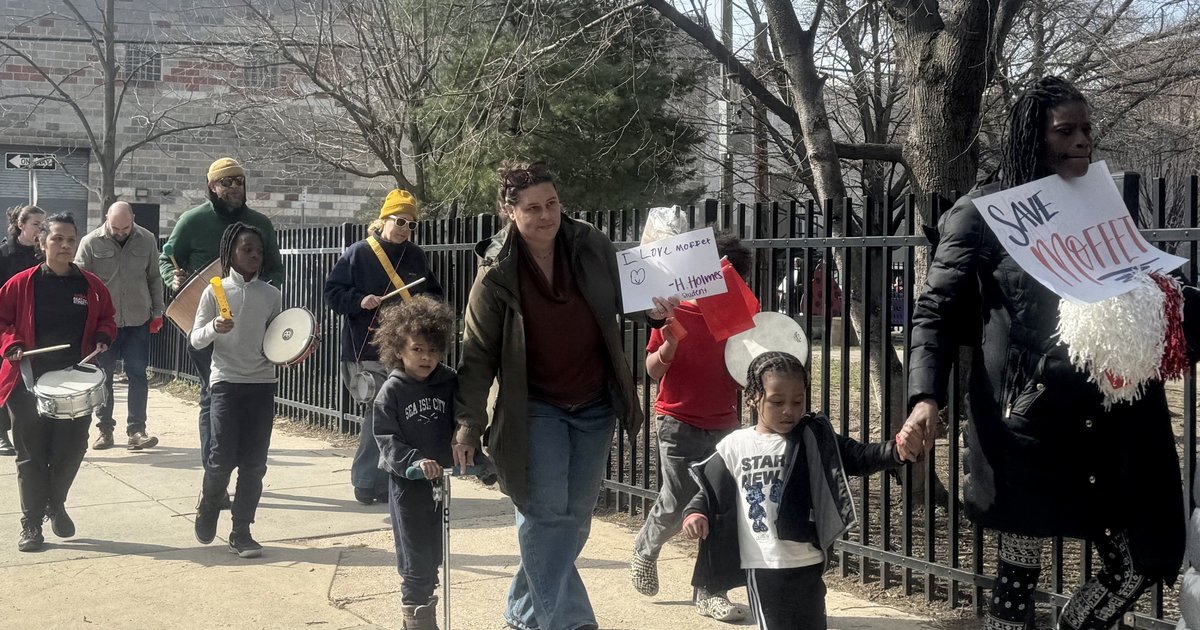
Sarah Nagle moved into her South Kensington home in January 2025 with the intention of keeping her 4-year-old daughter, Poppy, enrolled in the neighboring John Moffet Public School, where she had “blossomed” in its Pre-K program.
But when she and her husband heard that the School District of Philadelphia plans to retrofit the 53-year old elementary school building for middle school students and transfer more than 180 students to Horatio B. Hackett Elementary, about 1 mile away, Nagle said it felt like the wind was knocked out of them.
MORE: SEPTA to begin shuttle bus service on the Norristown High Speed Line amid repairs
“It breaks our hearts a little bit,” she said. “We walk by here every day and Poppy would say ‘That’s going to be my school!'”
Nagle was one of nearly 100 people who gathered in Moffet’s schoolyard Wednesday to rally against its proposed relocation. Community members, students and teachers held flags in the school’s red and white colors and student-made signs written in English, Spanish and Arabic as they marched around the perimeter of the building at 127 W. Oxford St., demonstrating the extra distance families will have to travel to their new school.
The recommendation to relocate Moffet’s elementary students to a Hackett Elementary is part of the district’s sweeping and controversial Facilities Plan. Over 10 years, the $2.8 billion investment plan would modernize 159 schools, but also close 18 schools and merge several others. Moffet, now a K-5 school, would become a middle school serving grades 5-8.
The facilities plan is being considered as the district also tries to close a nearly $300 million budget deficit. On Thursday, Superintendent Tony Watlington presented a proposal to cut $225 million from the budget by eliminating hundreds of positions.
District officials want to transition Moffet into a middle school to create a clearer K-8 pathway for families that want to stay in their neighborhood public schools, spokesperson Monique Braxton told the Inquirer earlier this month. The school’s enrollment slowly has declined over the past four school years and few students enroll in Penn Treaty, the catchment school for grades 6-12. Penn Treaty is among the schools recommended for closure.
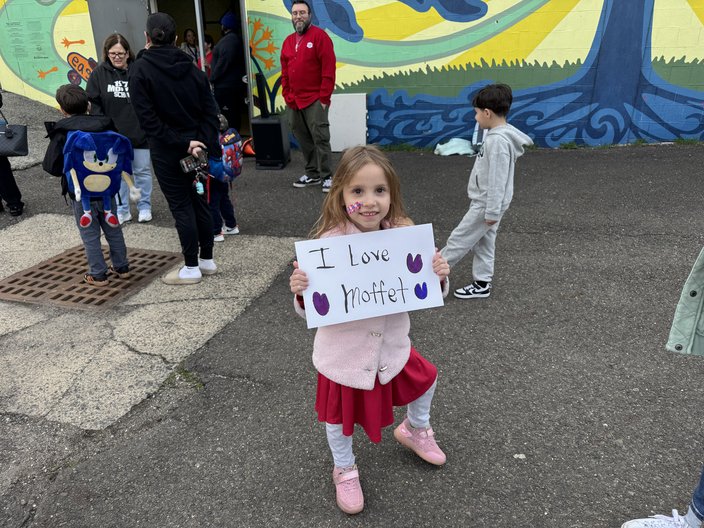 Molly McVety/PhillyVoice
Kindergarten student Saoirse Dougherty, 6, displays a poster she made for Wednesday’s rally against John Moffet Public School being turned into a middle school.
Community members and teachers have expressed frustration at the proposed transition for Moffet, saying the district has failed to acknowledge the changes they must face — even though they are not one of the schools to be closed.
“The district didn’t talk to us for a very long time because we weren’t labeled a closure,” said Kathryn Hoffman-Williamson, president of Moffet’s Family School Organization. “For us, this feels like you are displacing this whole community that’s been here for 50 years.”
One of the biggest concerns for Moffet’s families is the distance between Moffet and Hackett. Though they are both in South Kensington, their catchment areas do not overlap. Some students in Moffet’s catchment live 1 1/2 miles from Hackett. For Nagle, who works in New York City and doesn’t have access to a car in the mornings, the extra travel would be “very, very difficult.”
“It will add close to an hour of commuting for me each day to drop (Poppy) off,” she said. “I think one of us will have to change our work situation or we’ll have to hire someone or lean on a neighbor or something. I didn’t want to have to think about that.”
Parents also question why the district wants to make changes to a school that is showing gains in academic performance, pointing to overall increases last year on PSSA math and reading tests, and a boost in attendance.
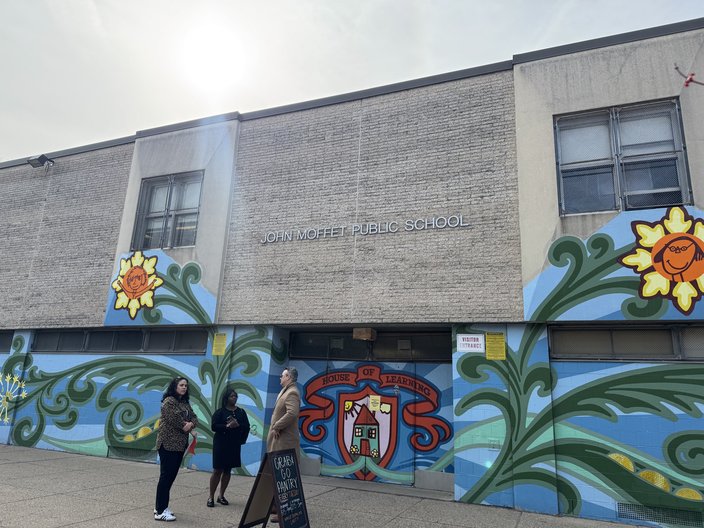 Molly McVety/PhillyVoice
John Moffet Public School is being proposed by the School District of Philadelphia to be turned into a middle school starting in the 2027-28 school year.
Mike Demeno has worked at Moffet as a school technology coordinator and STEAM teacher for more than a decade. In that time, he said, he’s seen the school’s programs make “groundbreaking” changes with support from the community. It now houses a maker’s space, media hub, esports room and two autism support classes, which he worries could be lost in the transition.
“In my time here, the STEAM program has been growing each year with very little help from the district — it’s the community that’s been making it grow,” he said. “To move us to Hackett, we’d lose all those connections and all of the things we’ve built here that are age-appropriate for elementary schoolers.”
Moffet also has fostered a close-knit, diverse community that is valued by the neighborhood. District statistics show 72% of the student population this school year are people of color, and 91% of the student body is economically disadvantaged.
Marita Anderson, a fourth grade teacher who has worked at the school for 26 years, said she worries that her students may not feel as accepted elsewhere in the district.
“It’s more than just a school,” Anderson said. “It truly is a community. Being here as long as I have, I’m teaching children of children I taught. It really is a family.”
South Kensington resident Latisha Krupincza, who has three children attending Moffet, said the connections she’s made with parents and teachers have allowed her children to thrive.
“My main concern is about the diverse community we’ve built here,” she said. “We’ve been in the neighborhood for a long time. … This is something unique for the city. This is all the colors of the rainbow. … It’s why we chose this school.”
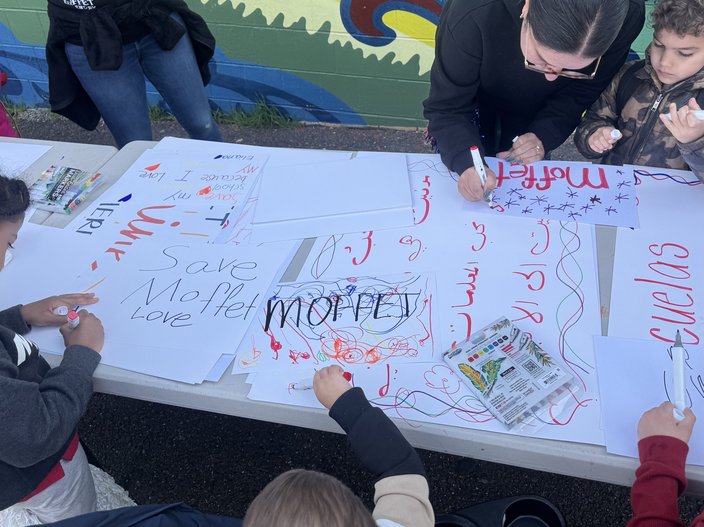 Molly McVety/PhillyVoice
Nearly 100 parents, teachers and students gathered in the school yard of John Moffet Public School on Wednesday to rally against a proposal to turn it into a middle school.
During a March 12 meeting between community members and staffers from both schools, Hoffman-Williamson said she and other members of the school’s FSO proposed designating other nearby K-8 schools like H.A. Brown, William McKinley or William H. Hunter as the receiving middle schools for fifth and sixth graders in the area; or investing in Moffet as a K-8 school, rather than limiting it to just middle schoolers.
Hoffman-Williamson shared an email she received from Claire Landau, a senior adviser for the district, in which Landau said “significant tradeoffs” were found in each of the alternative options, including the reduction of respective catchment areas and impacts to specialized programming.
“These programmatic considerations, in addition to space, are a central reason why this scenario was not advanced as part of the proposal,” Landau wrote to Hoffman-Williamson on March 20. “… That said, we hear the alternative being proposed to maintain Moffet as an elementary school and explore a different middle school pathway. … We will ensure that this feedback is documented and shared with leadership and the Board as part of their ongoing review.”
A district spokesperson deferred questions to the School Board of Philadelphia. Representatives from the board did not respond to requests for comment.
Moving forward, community members said they sense an uphill battle in trying to save their school. Unsure of their next moves, many expressed hope that their tight-knit community could persuade members of the school board to reconsider the proposal.
“I just hope our voices are loud enough,” Anderson said, “so that everyone can hear why Moffet should stay an elementary school.”