
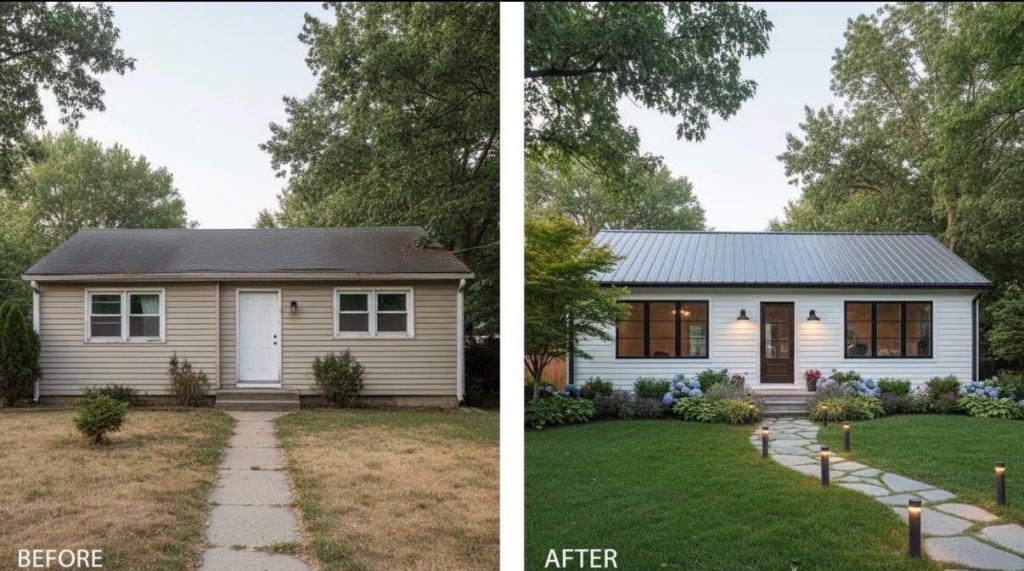
The photo on a real estate website shows a house with a manicured lawn, fancy landscaping and an updated paint job. The price is right, too, making it an apparent must-see.
However, when you arrive at the property the house doesn’t quite look right. The lawn is overgrown and brown, the shrubs are dead and there’s peeling paint.
Tiffanie Bailey-Romey, board president of the Pocono Mountain Association of Realtors, says that is a case of “housefishing” — a property-based version of “catfishing” — where real estate listings are intentionally altered to lure in potential buyers.
“It’s basically similar to the show ‘Catfish,’ ” said Bailey-Romey, referring to the TV show where people looking for romance online are deceived by fake photos of potential partners. “You see these beautiful homes that have great landscaping or the perfect colors, and then when we pull up to the property, it’s not there. It’s the science of attracting buyers by showcasing a property, but not necessarily selling that exact product.”
At the very least, it’s a way to gather contact information on home buyers for such things as email blasts. At worst, it’s a trick to entice out-of-the-area buyers who may not be able to see the property firsthand.
Manipulated images are created using artificial intelligence or software such as Photoshop, said Bailey-Romey, owner of Bairo Axen Realty in Bartonsville and also a member of the Greater Lehigh Valley Realtors. She says common changes include turning winter grass bright green, adding blue skies or removing structural defects such as foundation cracks.
“We’re in March. Someone lists the house today and the grass is superior green,” Bailey-Romey said. “If there’s no notification that says, ‘Hey, we took these pictures last summer,’ you would have to say, ‘OK, I don’t see green outside my door, so it’s probably either an AI-enhanced picture’ — or worse.”
Properties can also be “over-staged” with nonexistent fences or landscaping, and hazards such as wood rot, mold or pest infestations can be taken out.
“When someone actually changes the big crack on the side of the foundation or makes the deck look brand new and it’s wood rot … you may walk in the house and walk out the back sliding door and go through the deck,” Bailey-Romey said. “That’s dangerous.”
There are instances where using digital tools are considered ethical. Acceptable uses, according to the National Association of Realtors Code of Ethics, are only when it presents a “true picture” of the property and does not mislead potential buyers.
An example of that is putting furniture in an empty room to help visualize space. It is mandatory for the seller to note that the photo has been digitally altered.
“General industry guidance often includes clearly labeling edited images, not substantially changing a property and avoiding any concealment of property defects,” the NAR said.
The NAR reported that the use of virtual tools has been investigated by state lawmakers across the country. The New York Department of State recently issued a warning about the rise of AI-generated photos on listings that could violate deceptive advertising rules. Meanwhile, California has passed legislation that not only makes disclosures about digitally altered images mandatory, it also requires access to the original, unaltered photos.
The Wisconsin Realtor Association is urging its members to review and disclose photo alterations to protect the buyer and Realtor “from misunderstandings or from potential misrepresentation claims.” That state is also implementing a law similar to California.
“You may virtually stage it,” Bailey-Romey said. “There’s nothing wrong with doing that, giving someone ideas, but you must disclose.”
When house hunting, Bailey-Romey says to be on the lookout for:
Seasonal inconsistencies: That includes green grass or leafy trees from a winter listing. Look for a disclosure saying the photo was taken the previous summer. If it’s missing, the seller is likely hiding the home’s true current curb appeal.
The ‘too good to be true’ price gap: If you’ve been shopping at a $350,000 price point and suddenly see a home with $150,000 worth of high-end landscaping and a picket fence for that same price, be skeptical. If the price on a social media ad differs significantly from what is listed on the official multiple listing service or what the agent tells you over the phone, they are “fishing” for your contact information.
Pristine features in a low-value home: If the exterior photo shows new, gleaming windows, but the interior photos look dated or the price suggests a “fixer-upper,” those windows might be digitally added. While “blue sky replacement” is common, if every photo looks like a cartoon or a painting, it’s a sign the agent is more focused on “selling the dream” than the reality.
Missing ugly angles: If there are several photos of the interior but no photos of the backyard, the deck, or the side of the house, there may be a structural issue they are trying to hide until you get there. If a home is marketed as a “renovation opportunity” but only shows AI-generated “after” renders without the current “now” photos, they are masking the true extent of the work required.
The ‘scent’ and ‘feel’ gap: If every room is virtually staged with high-end furniture, it can hide floor damage, stains or awkward room shapes. While photos can’t show mold, pet odors or damp basements, if a listing looks perfect but has been on the market for a long time, there may be a sensory issue (smell or sound) scaring buyers away when they experience it in person.
Bailey-Romey said it’s important to use common sense.
“When it looks too good to be true, it usually is,” she said.
Morning Call reporter Evan Jones can be reached at ejones@mcall.com.