
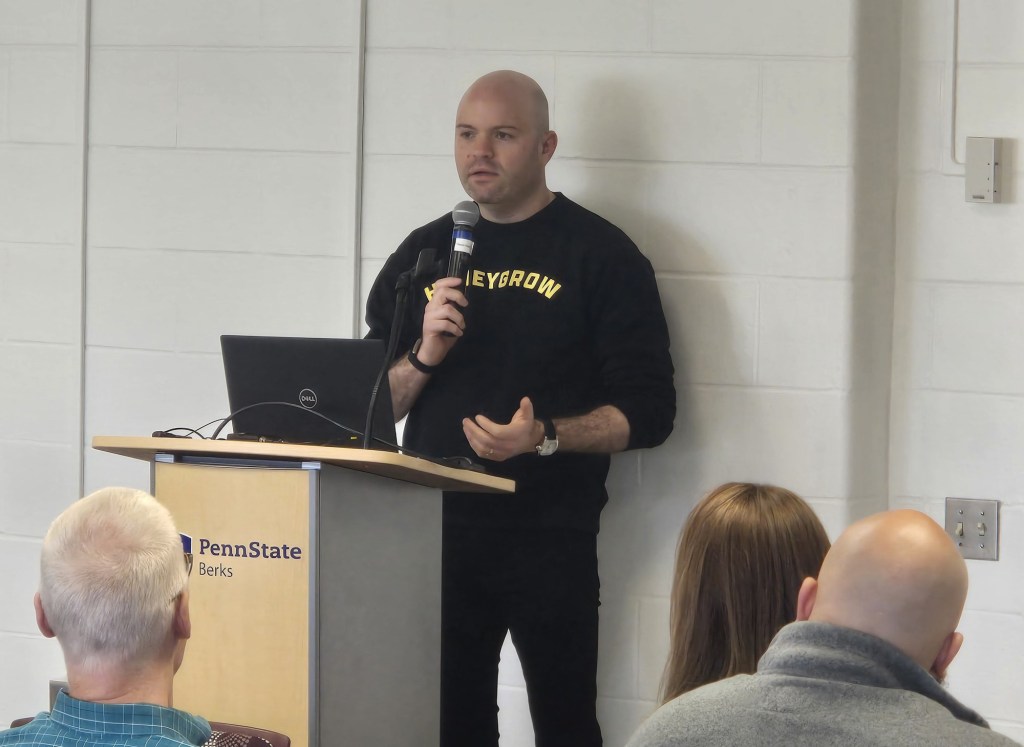
Ninety-three rejections couldn’t blur Justin Rosenberg’s vision for honeygrow.
His ironclad faith in his business plan proved well-placed — pitch number 94 landed an enthusiastic investor.
Skip forward 14 years, and Rosenberg’s fast casual stir fry and salads concept continues its conquest of the northeastern U.S. market.
Rosenberg founded the first honeygrow, which stands for “honest eating + growing local,” in Center City, Philadelphia in 2012.
His company now has 74 locations, and he plans to open about a dozen more by year end.
A Penn State alumnus, Rosenberg held a talk at Penn State Berks in March.
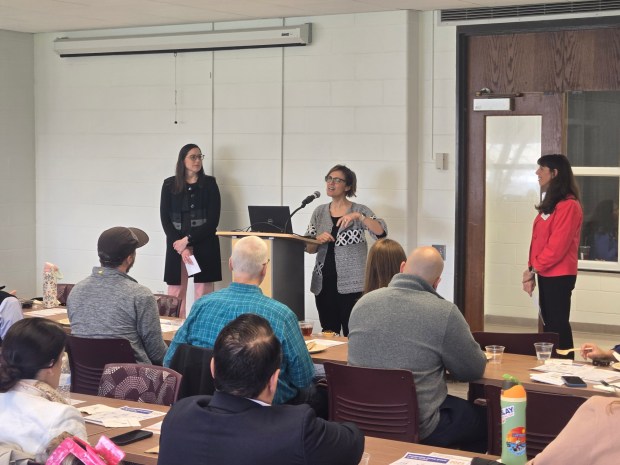 Sadan Kulturel-Konak, Professor of Management Information Systems and director of the Flemming Creativity, Entrepreneurship and Economic Development Center at Penn State Berks, introduces honeygrow founder Justin Rosenberg at a talk in March 2026. (Keith Dmochowski – MediaNews Group)
Rosenberg said the seeds for honeygrow took root when he was a history major at Penn State main campus.
He would frequent Green Bowl, a restaurant in State College known for its authentic Chinese noodles.
“Green Bowl was my jam,” Rosenberg told the audience during a public Q&A session at Penn State Berks, on March 25. “That was the genesis of honeygrow.”
Rosenberg graduated from Penn State in 2004, but his love affair with stir fry didn’t end upon leaving Green Bowl.
A quest to improve his health after having his first daughter saw Rosenberg incorporating plant-based and whole foods into his diet.
Being a full-time employee, father, and MBA student at Temple, Rosenberg was quick to realize that local restaurants didn’t have many fast options for his foods of choice — salads and stir fry.
“At the time, the fast casual landscape was Chipotle and Panera,” Rosenberg said. “You had some salad concepts in New York, burgers and Mexican, but no one doing this.”
Faced with a glaring opening in the market, Rosenberg wrote a plan for a restaurant that would offer fresh, cooked-to-order noodles.
He picked up another job at a kitchen on weekends to hone his recipe making chops.
“I had no finance experience, no entrepreneurial experience, nothing,” Rosenberg said. “Pitched 94 people, the 94th guy said yes.”
The first location was a hit, so much so that Rosenberg described its level of foot traffic as “total chaos.” Its popularity saw new honeygrows sprouting like wildflowers.
“The first four years were wonderful,” Rosenberg said. “We raised more capital and grew really quickly…Then we really had the pressure to grow.”
That pressure drove honeygrow to open locations in six new markets in major cities throughout 2017.
“We had an all-new executive team,” Rosenberg said. “It wasn’t the same honeygrow. The grit, the passion for the customer. We were getting bigger and did it in a way that wasn’t right.”
He said the restaurant soon became overextended financially, leading to a brush with near-bankruptcy in 2018.
More capital from investors carried the company to another turning point — an evaluation of priorities to ensure the budding chain could thrive on its own terms.
“By 2019, we ended up closing Chicago,” Rosenberg said. “We stopped growing, made cuts on the corporate side. We just had a great team of people and worked our butts off.”
Its customer-first strategy, along with the debut of new restaurant prototypes in 2020, positioned the company for success during the COVID-era spike in food delivery orders.
Since then, honeygrow has grown roughly three-fold.
“We’re still learning lessons as we go,” Rosenberg said. “My team is fantastic. For me (what I look for in a team member is) the right fit, right culture, right passions, right focus.”
Rosenberg noted that he’s “never sold a share” of the privately held business, and the company has avoided franchising.
“My goal is to make this a national company,” Rosenberg said. “We’re on the path to 100 (locations). But it takes a lot…We’ve got more work to do.”
Question-and-answer
Following his talk, Rosenberg took questions from the audience:
Q: Does it make more sense to cluster locations by region?
A: It’s definitely better (in terms of efficiency) to do that. From a district manager standpoint, that’s exactly what we do, but there are only so many restaurants we can open in a market.
In terms of growth, one of the mistakes I made was going to Boston, going to Chicago in the same year. It’s like pursuing a brand new company in each one of these markets. Nobody cares what you’ve done in Philly, you have to prove yourself. And we didn’t (in Chicago). We didn’t have the right real estate, the right team. Whereas Boston, we’ve been there for nine years and it’s our best market sales.
So for growth, (we’re going for) more of a concentric circle. I don’t want to fly to Dallas and start opening. Let’s do Cleveland; Cincinnati; we’re doing Columbus. We’ll get to the Detroit suburbs. What about Indianapolis? That concentric circle creep allows you to leverage your existing team.
Q: How do you choose a target market?
A: There are a lot of variables. What’s the demographic, population, income, how are other concepts doing? We look at a range from Starbucks to Chick-fil-A. Any anchor tenants in the market. We love a Wegman’s or Trader Joe’s. You would think colleges are where you’d want to be, but we’ve learned our best stores tend to be strong supermarket or Target-anchored shopping centers. We’ve learned a large percentage of our customers are moms making (food) decisions for the family. So we want to be in those centers.
Q: How is honeygrow using AI?
A: I’m still mixed on AI. I’m a liberal arts major…so that is a thing. But at the same time, analyzing data has been great. We’ve input a lot of real estate data into it. For example, we have a location in Ohio which doesn’t fit all the check boxes but does unbelievably well. Other restaurants do fit all the boxes but aren’t outperforming. The question becomes why? We (still) have to educate AI (on other variables). We’re not there yet.
But it’s been helpful. Certainly, in customer service, we’ve been using it on our website and our app. We have a wonderful person doing customer service but she’s human. She can’t work nights, and she should get her weekends off. But on weekends, (customers) should get a response as fast as possible and we should fix it as fast as possible. That’s where AI comes into play, which is pretty cool.
Q: How are you able to network and generate interest from investors?
A: I started out with my network, which wasn’t big. I then signed up for various (networking) events in Philly. I needed to figure out a way to scale it because it wasn’t happening fast enough. So I joined the Philadelphia Chamber of Commerce. They were super nice to me. I was just like ‘Hey do you mind making intros?’ They were great, I met a ton of people (through the Chamber of Commerce.) A lot of people aren’t interested, but they (introduce you) to people who are interested. So it’s kind of like God, plus luck, plus grit. Just keep going.
Q: As you’re opening more locations, do you struggle with letting go and letting your team handle things?
A: The journey of leadership is really hard. You want to be in control and do everything, but at the same time, you’re going to micromanage the team and they’re going to resent you and not feel empowered. But at the same time, you can’t let go, because it’s going to be pure chaos.
In the beginning, I had to approve everything, get my hands on everything. I drove people crazy. But in the beginning, you kind of have to do that. You are the big bang creating this universe, that’s my philosophy.
But as you begin to scale, you can’t. It’s just different skillsets. I had to learn the balance of observe, trust and value. A lot of it is finding the right person. Here’s an example: Our finance guy is wonderful, way better than me at finance. He’s very cool (under pressure) he’s super consistent. Those variables I look for (in a top performer.)
There are certain things I will do better than you. Most things you will do better than me. I can then take a step back. There’s a bit of a training wheel phase where you have to hover a bit. Then you can let go a little bit (at a time). It’s a process.
Q: If you knew then what you know now, what would you have done differently to avoid the near bankruptcy scenario?
A: I think one of the mistakes I made in that era was hiring more for resume than fit. There were certain folks involved with taking companies public that had unbelievable experience. Resume is wonderful, but not what you need at that phase. I hired way too many people, but not the right people.
I’m a firm believer of you don’t need a big team. As a company, we have maybe 30 to 35 employees in the corporate office. I have four reports now, back then I had like nine or ten, thinking I needed to know what was going on with everything. But really, I don’t need a lot of people.
Q: Do you see any other (companies) as competition?
A: In terms of direct competition or replicating our concept, we don’t really see anyone else doing salads and stir fry. (We think about) what is it going to take for someone to walk down the block and choose you over someone else? Everything matters. We want to be the best in hospitality, food, music at the right volume, clean environment, clean bathrooms, all of the above. We’re competing with everyone in that regard.
Q: Is honeygrow looking to sell frozen meals in grocery stores?
A: It’s something we’ve walked about, for sure. I just don’t think we’re ready yet. We’re so focused on restaurant growth, I think it would be a bit of a distraction today. But we talk to our noodle vendors about doing stuff like that. Maybe, down the road.
Q: Do you create your own menus?
A: I’m still involved with it, very much so. We just hired a culinary consultant. I’m excited.
Among honeygrow’s locations are one restaurant in Berks County, one in Chester County, two in Delaware County, and five in Montgomery County.