
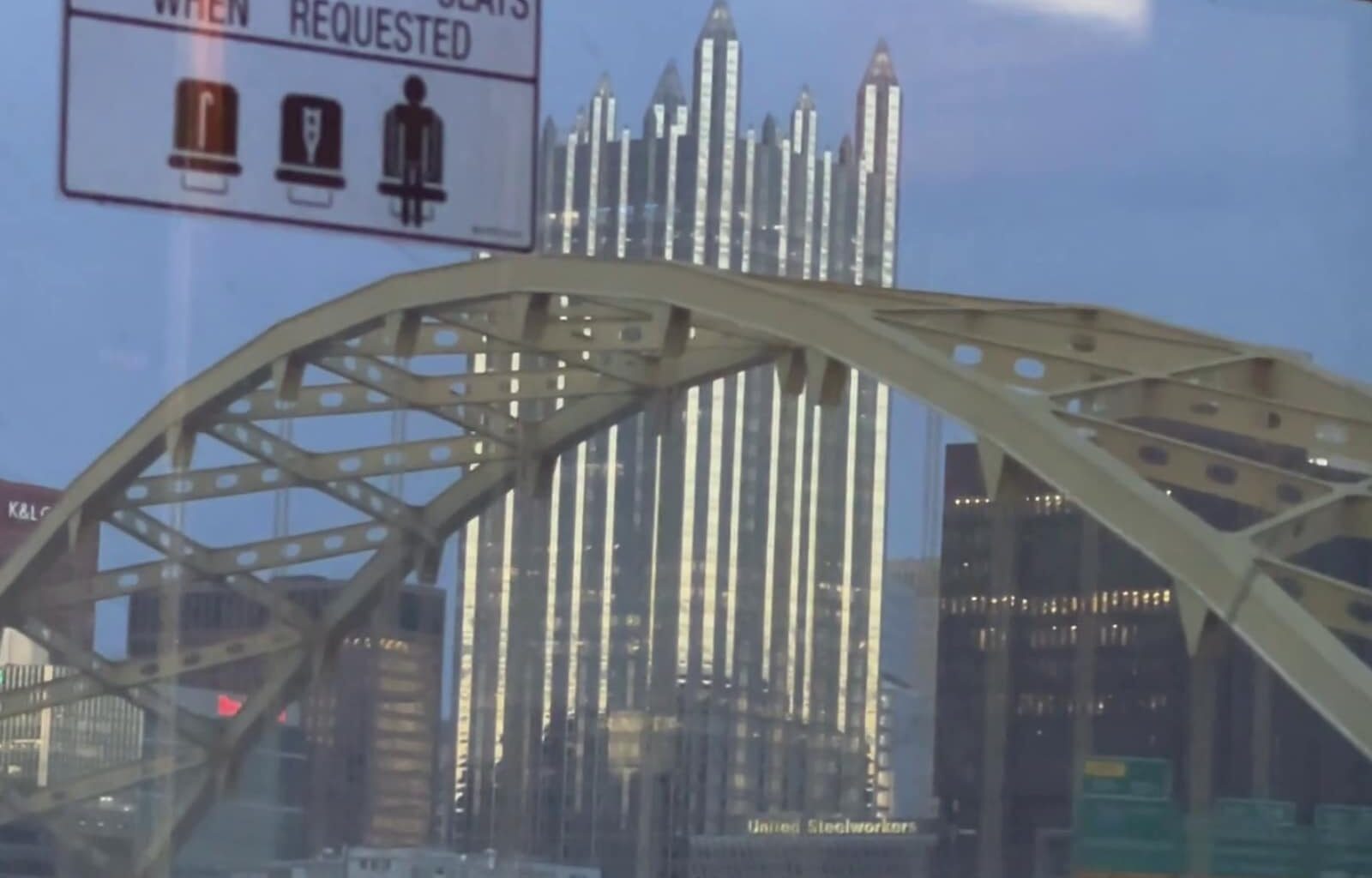
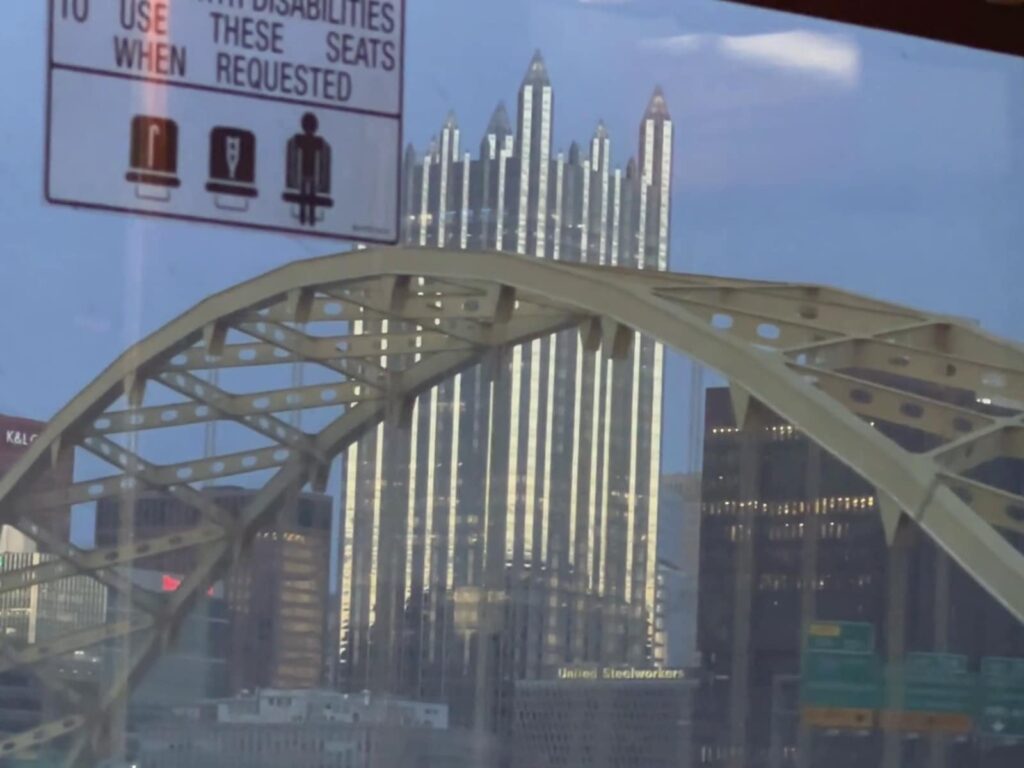
 Footage taken from a bus driving into the city, with the Roberto Clemente Bridge and PPG building in the distance, in “Limerent Pittsburgh.”
The sixth annual Midwest Video Poetry Fest (MVPF) returns to Arts + Literature Laboratory (ALL) for its most ambitious incarnation yet, on Saturday, April 4, in three separately themed 45-minute programs starting at 6 p.m.
Fest Coordinator Genia Daniels and ALL Executive Director Rita Mae Reese categorized the 30 experimental short films from neighboring cities like Milwaukee to countries as far flung as Lebanon and Benin by place and belonging (at 6 p.m.), storytelling and language (at 7 p.m.), and the more-than-human world (8 p.m.). All screenings are free, but $10 donations are encouraged.
Among the included works, MVPF veteran Anne Ciecko’s Limerent Pittsburgh (2025) prominently stands out towards the end of the opening program. Written, filmed, edited, narrated, and scored entirely by Ciecko, this two-and-a-half-minute videopoem follows in a succession of striking Pittsburgh poetry from the likes of Ali Shapiro and Jack Gilbert. Ciecko determinedly forges her own path through multimedia, and packs in a staggering amount of history in not only her vivid diction but in affectionate, architectural-focused footage around the rust belt city.
Within the spatial reality of Western Pennsylvania, Ciecko’s personal background also illuminates her videopoem, in verbal remembrances on time spent there over an eight-year span in graduate studies and arts spaces like the Brew House Association, as well as her recent return to do research at Carnegie Mellon in 2024. In a March 24 phone interview with Tone Madison, Ciecko says the words and images of Limerent Pittsburgh grew and unfolded together organically with her “reflexive desire to capture her journey back to Pittsburgh” from where she now lives in Amherst, Massachusetts. “[The city] became a limerent fantasy space for me,” she says.
Ciecko entwines and elevates that perception with the folkloric figure of Joe Magarac, whose eccentric statue can be seen outside the U.S. Steel Edgar Thomson plant in Braddock, Pennsylvania. Though branded as “the Paul Bunyan of the steel industry,” Ciecko in conversation likens him more to the ideal immigrant laborer and a literal man of steel, evoking the moniker for Jerry Siegel and artist Joe Shuster’s iconic comic superhero—both enduring symbols invented in the 1930s.
The seven-foot Magarac, as glimpsed at a shadowy angle one minute into Ciecko’s videopoem, becomes a salve for grief, a romanticized object-turned-subject “who would save me from a 50-ton crucible, / from the crushed dreams from the pain / of my Old Country grandparents and their labors of domesticity and mills and factories / hopes and disappointments and all that followed,” she relates.
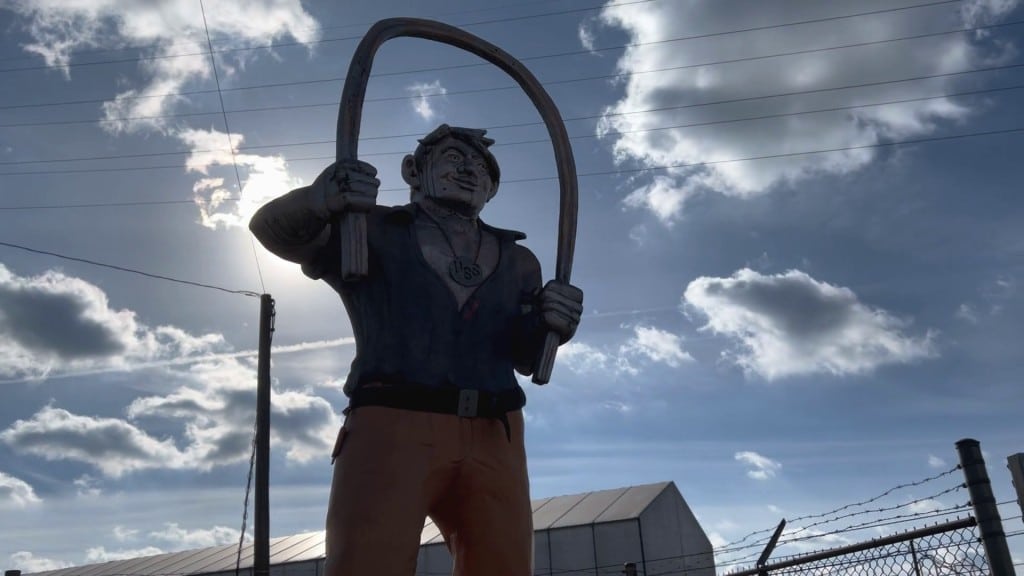 The eccentric statue of Joe Magarac in Braddock, Pennsylvania, in “Limerent Pittsburgh.”
But the staunch steel frame of Magarac is far from the most arresting scene in Limerent Pittsburgh, as Ciecko frames the “plate glass cathedral” skyscraper of PPG (Pittsburgh Plate Glass) Industries at mirrored, canted angles so it resembles a brutalist, synthetic ice citadel out of high fantasy. Moments prior, while skating across the actual ice rink at the adjacent Wintergarden, Ciecko’s third-person shadow, narrated as a mental projection, glides along and scorches a new self on the textured surface surrounding her.
The deepest sense of connection is also channeled through modes of transit, in the first seconds of Ciecko’s videopoem on a bus and later from a window seat of an airplane descending into Pittsburgh International Airport (PIT). In these moments, she is struck by all that’s transitory and irreparable: “…beautiful blighted bridges to nowhere, as everything / and everyone I once knew in Pennsylvania / is disappearing.”
Hailing from Central Pennsylvania, and as the lone person among a small, aging family who ventured out of the Mid-Atlantic region, Ciecko’s framing about her own familial ties unraveling through the relentless passage of time are, in simplistic terms, a bridge to my own. “But even if [the viewer] doesn’t know Pittsburgh,” she says, the film is structured so that “they might feel nostalgia, sentimentality, or grief or other feelings conjured up by [its] sense of place” in the harmony of superimposing footage and Ciecko’s distinctive cadence and piping tone.
The use of a murmuring accordion melody also acts as a key component to the videopoem’s heightened yearning that flits between a focus on the city’s eminent industry and the crux of memory. Ciecko calls herself an autodidactic player, and sees the trans-cultural instrument serving as another voice along with her speech in Limerent Pittsburgh, complementing the folkloric elements extracted through the multiplicity of images and words.
“I like the way you can attenuate or extend or sharpen the notes on an accordion and the way it sounds like a breath,” Ciecko explains, while self-deprecatingly adding that the wheezy sound of the accordion emulates her own voice. “It’s breathing there with me,” she adds, suggesting the transportive power of timbre in the grand art of sound design.
In the past year, Ciecko has been hard at work on two additional films that complete a trilogy to further explore regional Pennsylvania industry and family biography. “A tiny piece,” Taconite, about a metal byproduct of the steel industry, was filmed in Bethlehem, Pennsylvania, and the multi-faceted Keystone Limestone “brings together live action docu-style footage with almost every frame in the film featuring animation,” she describes. Shot throughout the Lehigh Valley—another familiar landscape due to my 2000s college tenure in Kutztown—this longer film explores domestic labors like baking in relation to the cement industry.
Ciecko wears a myriad of hats, as evidenced in the autonomous creation of Limerent Pittsburgh (and these other works), saying that, for her, “video poetry is the sweet spot.” Its composite of mediums allows for “amplification or transformation when the images and text meet each other,” which speaks to her enthusiasm for the entirety of the MVPF and why she’ll be visiting ALL in person on April 4.
 A still from Ajanaé Dawkins’ “Author’s Note.”
The Fest’s greater Midwestern footprint includes an array of inspired impressions, like the six-minute Upon Landing (2025) by Milwaukee-based Damien Gonzalez. He conveys a Cuban immigrant’s trials and tribulations in America “to become somebody,” in his own words. And Charli Brissey’s leading four-and-a-half-minute short in that program, Anything With A Switch (2024), foregrounds mesmerizing music-video-like choreography and pantomime synced to their inner monologue on queer lustful fixation.
Elsewhere, in the second block, Ajanaé Dawkins’ three-minute Author’s Note (2025), is utterly beautiful. Moved by the works of Black women writers like Maya Angelou, Dawkins’ videopoem encapsulates such salient emotion in the unconditional love between a daughter and mother, similar to Gabriella Cisneros’ Impermanence from the fifth MVPF in October 2024.
The five-minute finale of the third program, A Vernacular Of The Numinous (2025), from M. Freeman, reckons with the distortions of the modern era and tensions between the quotidian and the peculiar that produce the stuff of life—a nod to the slices of life of the video poetry form itself that Daniels, Reese, and the Midwest Video Poetry Fest are exhibiting the virtues of from multimedia artists here in the U.S. and throughout the world.