
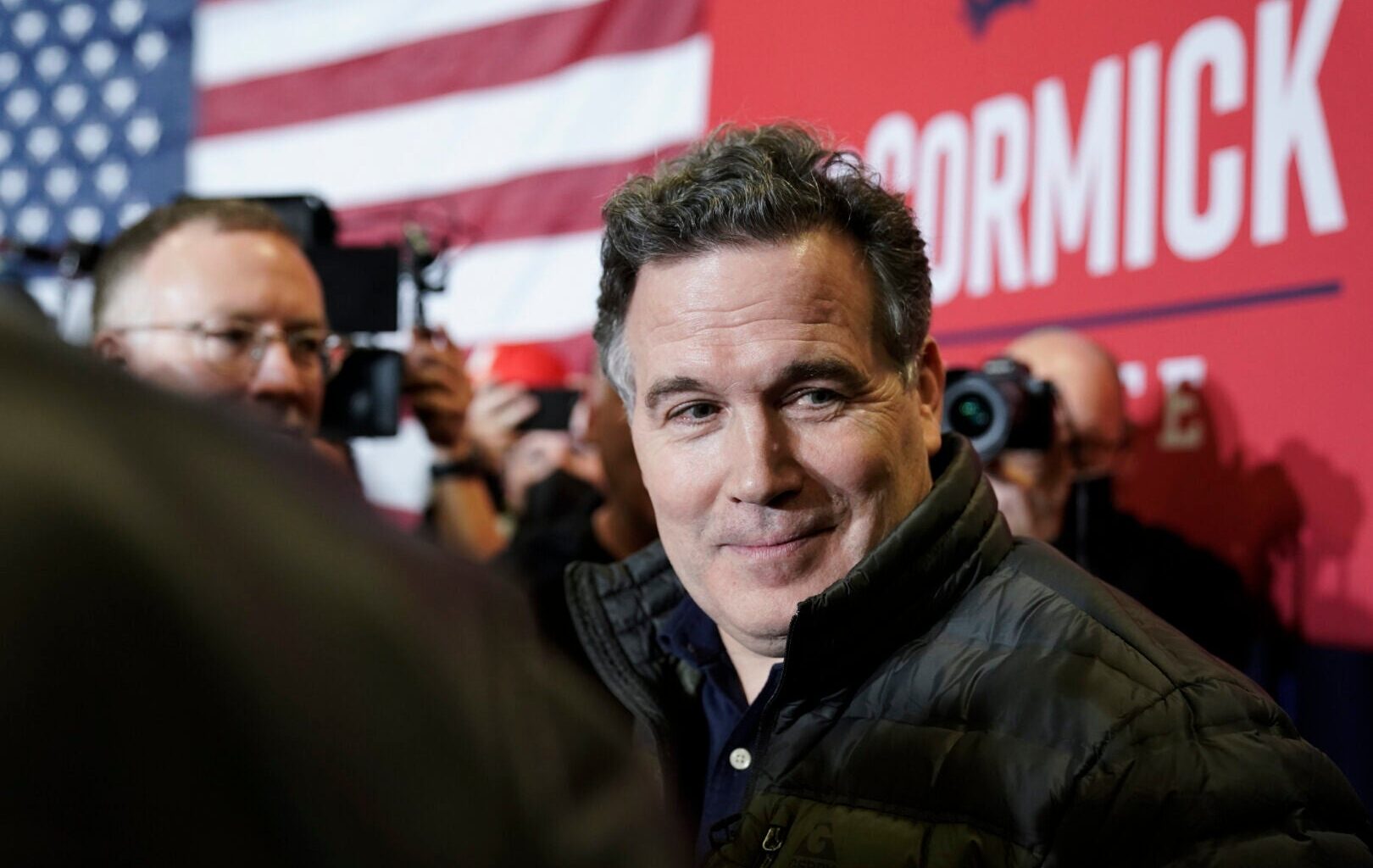
The future of NIH funding
The visit also comes as questions swirl around the future of NIH funding. A recent report indicated the president may propose a 20% reduction to the agency’s budget in 2027, though the White House has disputed that.
Tuesday, McCormick said he would oppose any new cuts, pointing to Congress’ recent move to increase NIH funding by 2% this fiscal year.
“I will be a strong advocate of maintaining and increasing NIH funding and reforming NIH, as the director has laid out, in a way that makes sure that those dollars have the highest impact for the country and for Pennsylvania,” he said.
A broader proposal to cut NIH funding by roughly 40% last year was ultimately rejected by Congress, with some Republicans, including McCormick, pushing back against that.
“I don’t agree with what the policy has been on this,” he said at the time. “We should probably increase the funding for NIH, not lessen it.”
During the press conference, Bhattacharya noted that NIH funding actually increased by 1% last year. However, some researchers have noted that the increase was less than inflation and increasing lab costs. Recent data suggests that gap and uncertainty among labs have already significantly impacted the research landscape.
An analysis by the American Association of Universities of NIH data found that the agency issued 66% fewer grant awards through February of fiscal year 2026 than during that same period in the prior three years. The monetary value of those awards has also declined by 54%. A national survey of scientists reported by STAT found that disruptions to NIH funding have led some labs to delay experiments, scale back projects and lay off researchers.
Bhattacharya said he expected that the “upheaval” was behind them and that the agency worked to “get all of the money out” to the “excellent science” done by “brilliant scientists.”
“And we achieved that,” he said. “This year, we’re a little bit behind things, so the government shut down, but we’re going to do the same thing. I’m fully confident that we will be able to identify excellent science. We get 100,000 proposals a year. The job is to find the 10,000 or so we have to fund.”
However, Dr. Ezekiel Emanuel, an oncologist who serves as vice provost for global initiatives at the University of Pennsylvania and chair of the Department of Medical Ethics and Health Policy, says that the situation is still causing too much uncertainty, which is turning away researchers.
“The most talented people have choices in their life,” he said, “They have choices of, I could go into biomedical research or I could do something else, go into finance, go into AI.”
Emanuel applauded McCormick’s pushing back against the president but added that Republican immigration policies are doing more damage to the talent pipeline.
“I absolutely admire the senator and I think his standing up as a Republican for biomedical research, for its importance, is absolutely pivotal,” he said. But “one of the things which has been great about the United States is year after year, we pull from all over the world. To stay the best in the world, you have to recruit the best in the world and we’ve told the rest of the world, ‘We don’t want you. Don’t come.’”