
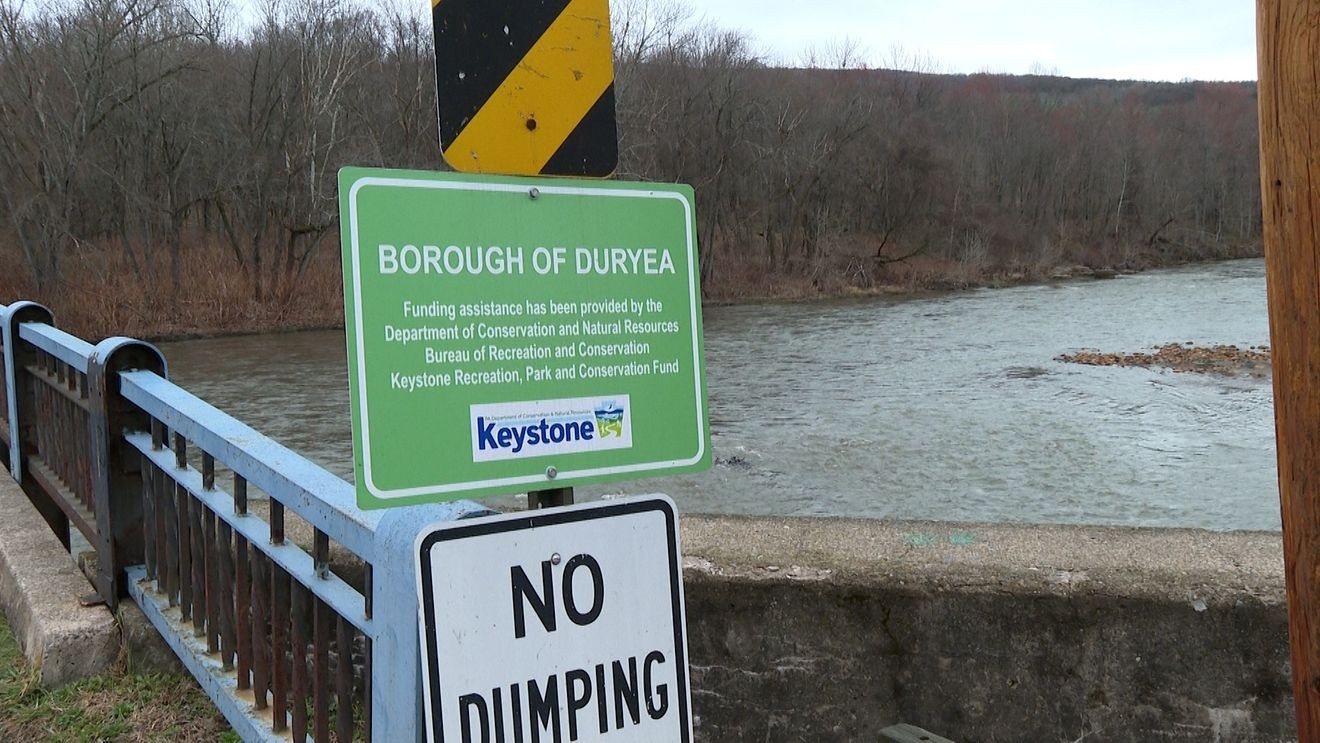
DURYEA, LUZERNE CO. (WOLF) — As spring rain ramps up across northeastern Pennsylvania, flooding concerns are once again front and center in Duryea, a community still waiting on critical federal funding to strengthen its flood defenses.
Local leaders say the borough is at a standstill, caught between the reinstatement of a key federal program and an ongoing partial shutdown of the Department of Homeland Security, which oversees FEMA.
The FEMA Building Resilient Infrastructure and Communities program, known as BRIC, had been paused last year, cutting off a major funding source for projects like levee improvements. A court order recently restored the program, but with DHS unfunded for nearly seven weeks, that money is still not flowing.
“We’re still trying to go further to raise our levee system more to keep us from flooding because it just seems like the waters keep getting higher instead of going down,” said Duryea Emergency Management Coordinator Keith Moss. “We’re trying to get a BRIC grant to cover that.”
Duryea’s levee system stretches about a mile and protects roughly 1,200 residents and more than 600 properties. The full project, including bridge repairs, that the county owns, and levee upgrades, that the borough owns, could cost up to $9.5 million.
Without federal support, borough officials say the project is financially out of reach.
“We’d never be able to afford a project like this if we never got a grant, because it’s just way too much money,” Moss said. “The BRIC grant is through the federal government, and it was done away with not too long ago, but we have gotten word lately that they’re bringing the BRIC back, which is absolutely wonderful news for us here in Duryea and the rest of the Wyoming Valley.”
The urgency is rooted in history. In 2011, floodwaters overtopped the river, inundating 139 homes in Duryea, including Holy Rosary School.
And while levees are designed to reduce flood risk, federal officials warn they are not foolproof.
According to FEMA, levees are built to provide a specific level of protection, but they can be overtopped or fail during larger storms. Over time, they can also deteriorate without proper maintenance and upgrades, raising the risk of failure. In some cases, FEMA notes, damage from a levee failure can be even more severe than if the levee had not existed.
Data from FEMA shows, about 597 structures sit within the levee impact area, roughly 1,221 people live behind the levee, there are 69 active flood insurance policies in the borough, and the average annual premium is about $1,031.
Officials say strengthening the levee could not only better protect homes but also help reduce flood insurance costs.
In the meantime, borough leaders are relying on monitoring systems and preparation.
“It’s always on your mind with flooding,” Moss said. “We have a river gauge that we got a grant for several years ago, and we watch that, along with 21 other gauges. If they’re getting flooding up north, that means we’re getting flooded down here. We can prepare for a flood.”
For now, until federal money flows again, the levee fund remains dried up.