
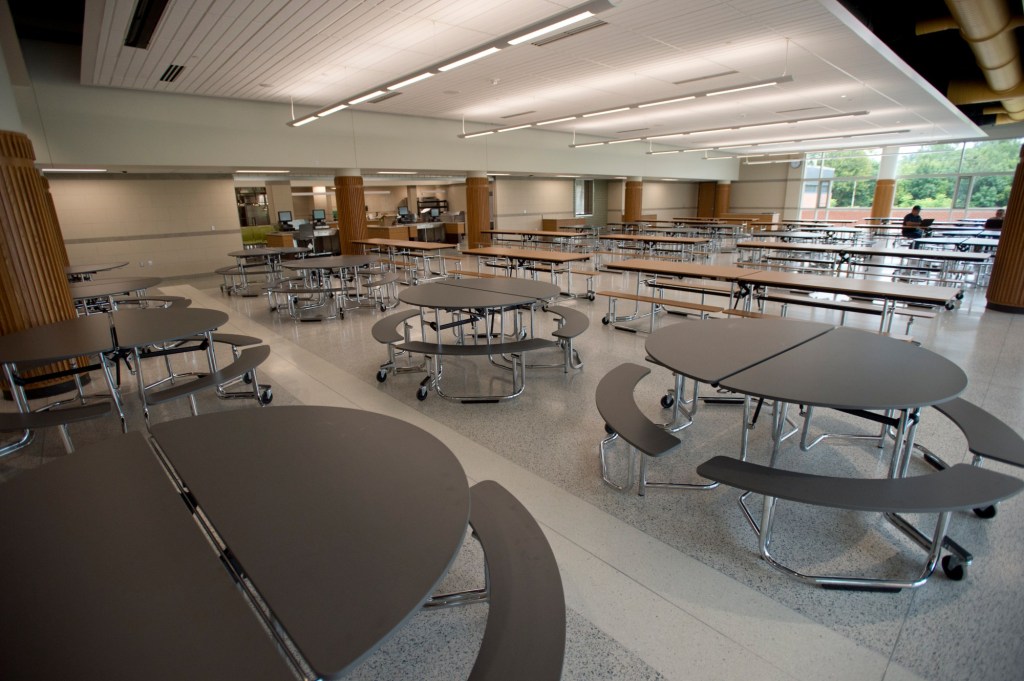
School board members and local activists agree that Bethlehem Area students in need deserve easy access to school lunch, but how to achieve that goal and who should pay for it are complicated questions.
Local clergy and organizers from the Lehigh Valley Democratic Socialists of America have pushed universal free lunch onto the school board’s agenda, but the district’s latest budget projections include an $11.7 million deficit, and board members remain largely focused on the cost-cutting needed to reach a balanced budget by June.
The federal government makes free and reduced-price lunches available to all students who meet income thresholds, and who fill out annual paperwork to enroll. But a handful of Lehigh Valley districts have gone a step further, taking advantage of federal funding to provide free lunches to all students, regardless of their ability to pay. That program is open to districts that meet certain demographic profiles, but it covers the cost of meals on a sliding scale that leaves participating districts responsible for varying portions of the tab.
BASD Chief Financial Officer Harry Aristakesian has estimated that cost would be $500,000 a year if universal free lunch were offered in all Bethlehem schools.
School board President Michael Faccinetto told The Morning Call that lunch programs would be discussed at the board’s April 20 finance committee meeting, which is open to the public.
Recently, parents and Bethlehem Area taxpayers packed the school board’s March meeting and offered testimonials in favor of funding free lunch for all the district’s students.
The Rev. Eileen Edwards, a BASD parent, said supporters of universal free lunch believe it’s a use of taxpayer money that reflects the values of Bethlehem Area residents.
“Budgets are moral documents,” Edwards said.
Fellow BASD parent Brittany Wuest spoke about her own experience with school lunch, saying she remembers being embarrassed about the food her family could afford to pack.
“I look back at that 8-year-old, and my heart hurts for her,” Wuest said.
After her parents’ divorce, Wuest said, she lived with a single parent and qualified for reduced-price lunch but often skipped the meal, as grabbing change was not always a priority as she prepared for school.
Kids would ask why she wasn’t eating, said Wuest, who was one of many speakers who emphasized the shame and stigma that can surround school lunch access, even when systems are in place to help families cover the cost.
“We as a district have the heart to see it done,” Wuest said of universal free lunch.
BASD policy means every student who goes through the lunch line is fed, even if they do not have money in their accounts. However, that could leave some students with a negative lunch account balance.
BASD calculates families’ lunch debt, but officials said the district is not actively collecting that debt. Those unpaid lunch charges have become another cost the district must consider as it works through the annual, legally mandated process of reaching a balanced budget.
The U.S. Department of Agriculture administers the federal programs that provide free and reduced-price lunch to families, through the National School Lunch Program.
To qualify for free and reduced lunch, families must fill out a form each year. The district is only reimbursed for the cost of free and reduced-price meals when families do their paperwork.
Rather than having individual families enroll, the district could apply for a different reimbursement mechanism called the Community Eligibility Provision.
CEP enrollment would mean no more annual forms for families. Instead, the district would apply — either for all its schools or for selected, qualifying schools — and the federal government would pick up a portion of the tab.
CEP is separate from a universal free breakfast program supported by state dollars.
Enrolling in CEP would mean participating schools do not charge any families for lunch and all students would be eligible for a free lunch. However, the district would still be on the hook for covering the balance between what the federal government provides under CEP and the total cost of provided meals.
Districts have until June 30 to enroll schools in CEP.
Organizers and their allies argue this is an easy win for the district: No families get charged, no families have to fill out paperwork, all students who want school-provided lunch get it — and the federal government picks up most of the tab.
However, BASD’s financial situation makes that a more difficult question for district leaders.
Faccinetto questioned whether or not a half-million-dollar annual cost would be worth it as the district confronts an $11.7 million gap between projected revenues of approximately $383.2 million and projected expenses of approximately $394.9 million.
“If the deficit wasn’t so large, I think it would be a non-issue,” he said.
Recent adjustments to the federal eligibility formula make most school districts eligible for districtwide enrollment, but reimbursement rates vary widely across districts and from school to school.
In Lehigh and Northampton counties, Southern Lehigh is the only public school district that doesn’t meet the districtwide eligibility threshold, according to a 2025-26 school year report from the Pennsylvania Department of Education that estimates program eligibility.
Six Lehigh Valley school districts are enrolled in CEP as a district: Allentown, Catasauqua Area, Easton Area, Northern Lehigh, Salisbury Township and Whitehall-Coplay.
Bangor Area, East Penn, Northampton Area, Parkland, Pen Argyl, Saucon Valley and Wilson Area are eligible for districtwide enrollment but not enrolling any schools.
Nazareth Area and Northwestern Lehigh enroll at least one school in their district, according to the state report.
Bethlehem Area would be eligible to enroll in CEP districtwide, according to the report.
To save costs, however, BASD could choose to only enroll schools that qualify for 100% federal reimbursement. Every school in the district is individually eligible for at least some reimbursement except Hanover Elementary, whose demographics place it above the eligibility threshold, the report shows.
Faccinetto told The Morning Call that he doesn’t believe that option would create an equity issue, noting that many district programs focus on supporting the communities with the greatest needs.
How does BASD budget?
Aristakesian projected an $11.7 million deficit based on the assumption that the district will raise its local property taxes by 3.5%. In this budget cycle, state law allows the district to raise those taxes up to 4.2%.
To close the deficit, the school board must first determine how stable the district’s funding streams are and then assess where cuts can be made.
Local taxes form the majority of school districts’ revenue. For BASD, that portion is 65%, with another 33% coming from state funds.
The state has so far delivered on its promises to increase “adequacy funding” for districts, such as BASD, that have historically been underfunded, Aristakesian said at Monday’s budget workshop, adding that the state’s long-term financial outlook raises questions about whether or not that commitment will persist.
Federal education funding, which is only 2% of Bethlehem Area’s projected revenue, mainly aims to boost support for underserved students. The most well-known federal programs provide extra money for school districts with a high percentage of low-income families, support special education and offer extra funding for programs that aid English learners and their families.
Those programs, known collectively as “Title funds,” are administered through the U.S. Department of Education (although the Trump administration has repeatedly expressed a preference for moving as many programs as possible out of the department’s overview in an effort to shrink it).
At Monday’s budget workshop, Aristakesian said he’s still concerned that Title funds could be cut.
CEP falls under the federal Agriculture Department, an agency that has faced less federal pressure to downsize than the Education Department. However, the Trump administration’s budget slashing efforts also left popular USDA programs on the chopping block, including the Local Food Purchase Agreement program that helped connect farmers, food pantries and schools.
Another complicating factor in determining if federal funding will remain stable is the fact that eligibility guidelines for CEP rely in part on calculating the number of students whose families qualify for the Supplemental Nutrition Assistance Program.
SNAP has faced its own budget headwinds, and the number of Pennsylvania families who qualify for the program is set to drop as a federal budget act passed in July reduces eligibility, particularly for certain immigrant families.
With fewer district families set to qualify for federal food assistance, school meals become more central to the goal of feeding all children, but CEP rules could then leave the district picking up more of the tab.
SNAP participation and CEP reimbursement rates do not rise or fall in lock step (CEP includes a formula to push a school’s eligibility higher to account for families that don’t qualify or enroll in federal assistance programs but are still food insecure), but if SNAP participation falls, CEP reimbursement rates fall as well.
The district is also confronting rising charter school enrollment, which pushes up the amount owed in tuition payments.
BASD has more than 12,500 enrolled students. As charter school participation approaches 2,500 students, district leaders said they are ramping up recruitment efforts to try to keep families enrolled in BASD schools.
Mandated charter school tuition payments will top $50 million for the first time next school year, Aristakesian said at the budget workshop. Those payments are now 13% of the district’s projected budget, the third-largest expense category after salaries and benefits.
Salaries and benefits make up the majority — more than 60% — of the district’s projected expenses. Union-negotiated raises and escalating health care costs mean the only way to reduce these expenses is to cut positions. At Monday’s budget workshop, district leaders said that could be necessary but would be a last resort.
There are “hard decisions to be made,” Faccinetto told The Morning Call.
“The money in education is in buildings, bodies and books,” Faccinetto said. “So, we’re not cutting curriculum. We’re not closing any buildings. So, you know, you have people — who do you shift around? What positions do you not fill?”
Learn more:
Read the letter local clergy wrote endorsing universal free lunch:
View the BASD budget projections presented at Monday’s workshop (this information was discussed at the meeting; additional slides were attached to the board’s online agenda):