
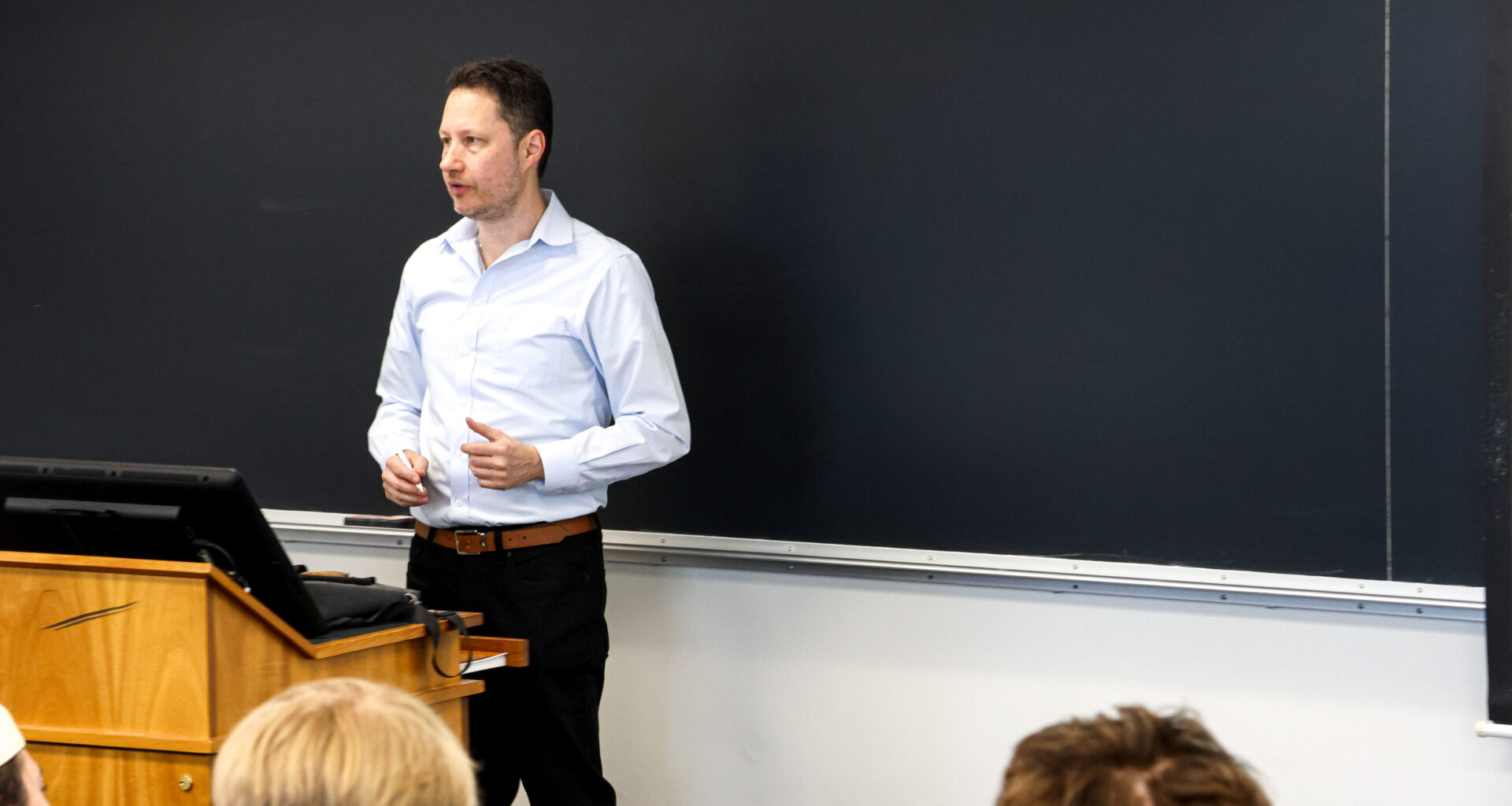
For three years, economics professor Yuval Erez followed orders with little room for independent thinking while serving in the Israeli military.
The experience, he said, made him appreciate the freedom he now has in the classroom to teach students how to think creatively and critically.
After his service, he took a gap year before attending Tel Aviv University. Initially, Erez planned to study marketing and communications, but after missing the registration deadline, the university placed him in an economics class.
Little did he know that mishap would eventually lead him to teach economics at Lehigh.
Erez found economics more interesting than marketing and was later asked to work as a grader for the class.
“My professor told me that the teaching assistant didn’t want to do their job anymore and that it would be a good position for me to take,” he said. “ I said no way. I’m shy. I’m an introvert — that’s impossible.”
He said the decision was a battle, and said his professor was very persuasive despite his hesitation. Eventually, he decided to try the role.
“My first class was in the summer, and for the first five minutes, I couldn’t speak,” he said. “I wasn’t able to control my breath. But after about five minutes, I started to relax, and over time, I realized I actually started to enjoy it.”
By the end of the summer, he discovered his passion for helping students succeed and began to imagine a future in academia.
Erez said if he hadn’t taken that economics class, he might never have “accidentally” discovered his love for teaching. He earned his bachelor’s degree in management and economics from Tel Aviv University and set his sights on earning a Ph.D. and becoming a professor.
That goal is what brought him to the U.S., where he earned his doctorate in economics from Cornell University. He said the experience was difficult but ultimately rewarding because it opened up many professional opportunities.
Despite missing home and facing a language barrier, Erez decided to interview at Lehigh when he saw a job posting. He’s been teaching at Lehigh since 2019.
During the interview process, he taught a class of 200 students while faculty assessed his performance. Aside from the nerves, he said he loved the experience. During the lecture, he presented a problem that one student solved — even though the faculty couldn’t.
“I felt so good because teaching is in my soul,” Erez said. “It’s what I enjoy doing. It’s like a form of art. I have the urge to make students know how to think, not what to think.”
He believes students should learn how to use their minds effectively because he sees the brain as a person’s greatest asset. The body, he said, can only take someone so far before it gives out, but the mind can continue much longer.
“I always tell my students, I’m going to make sure you know how to think so when you go into a job interview and you cannot use ChatGPT, you will get the job anyway,” Erez said.
Victor Colliluori, ‘28, took statistical methods with Erez and is now enrolled in his microeconomics class. He said he immediately noticed Erez’s magnetic and “ridiculously positive” energy.
“It was kind of a lot at first, because he’s really energetic,” Colliluori said. “He starts talking fast. He doesn’t go slow with anything. And he’s ridiculously passionate about students doing well.”
In a world where technology is easily accessible and students are often distracted by their devices, Colliluori said Erez makes class engaging enough that students don’t want to use their phones — even though technology is allowed.
“I feel like out of all the classes I’ve taken so far at Lehigh, this has been the most where students will pay attention on their own (will), because his energy is so high,” Colliluori said.
To prepare students for their careers, Erez gives “mental break questions” that he pulls from job interviews. Collullouri said he enjoys these questions because they provide a fun break while encouraging creative thinking, and still enforcing the mathematical and scientific aspects of economics.
Neil Malhotra, ‘29, is another one of Erez’s students. He said Erez encourages participation by rewarding students with extra credit points through games.
“I think overall, Erez has gotten me to be more comfortable talking in class,” Malhotra said.
When he first arrived on campus in the fall, he said he mainly participated in his teaching assistant’s lectures or sat in the back of large lectures. Now, he participates more in every class, not just Erez’s.
He also said Erez is eager to help students outside the classroom, no matter how long it takes.
“He may not always remember your name, but he cares a lot,” Malhotra said. “And if he doesn’t remember it, he’ll ask on the way out when you’re leaving class.”