
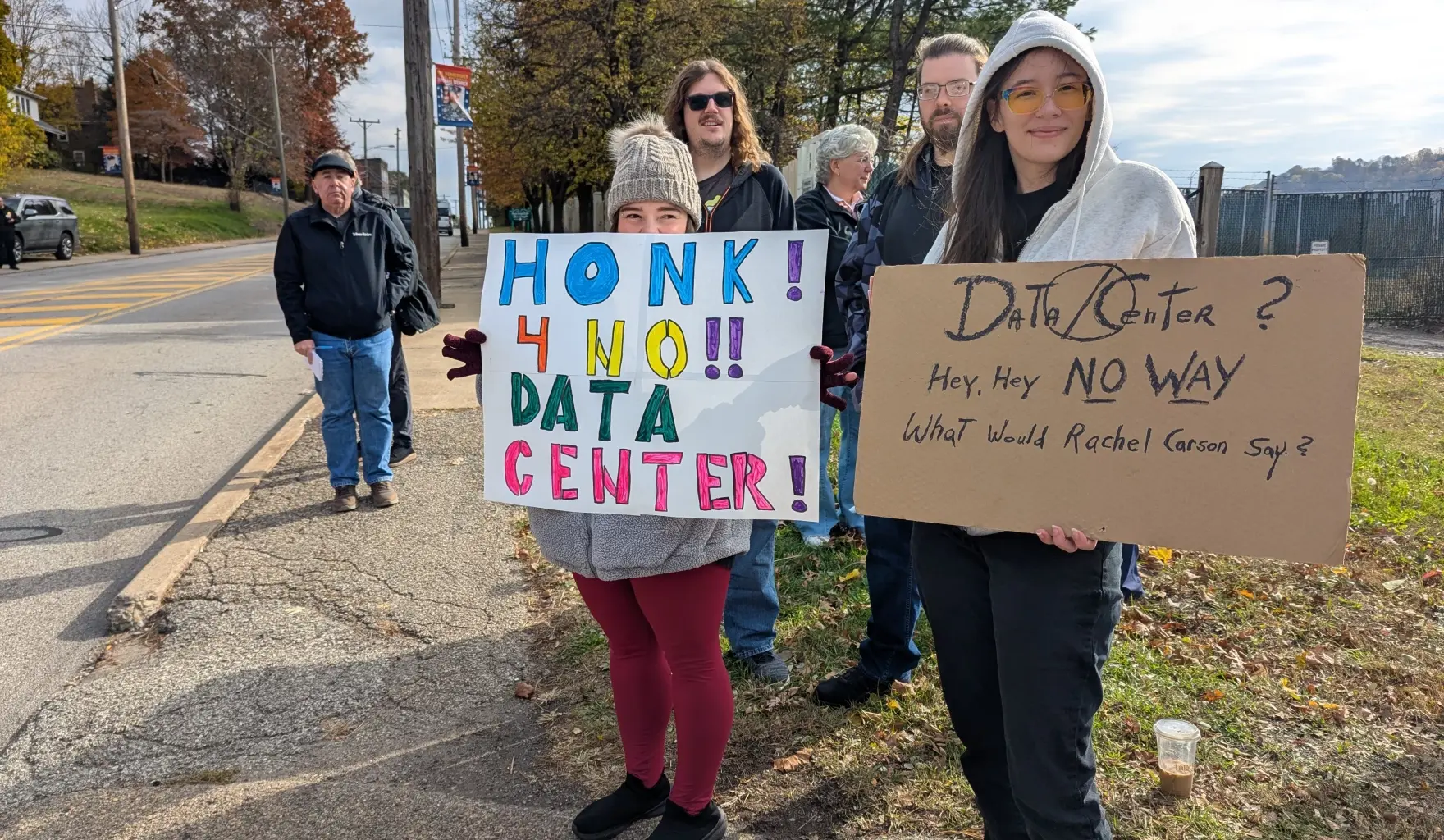
Dozens of new data centers have been proposed in Pennsylvania. Some residents and local governments in those communities are struggling to handle the boom with existing ordinances and little information. The group Community Action Works is holding an organizing summit about data centers in Pittsburgh on April 18.
The Allegheny Front’s Kara Holsopple spoke with Max Haworth at Community Action Works about it.
LISTEN to the interview
https://s3.us-east-1.amazonaws.com/media.alleghenyfront.org/AF040326_KH_DataCenterSummit.mp3
Kara Holsopple: First, what does Community Action Works do?
Max Haworth: At Community Action Works, what we do is we work directly with community members, providing training, support, ongoing resources, anything they need to address environmental threats at the local level. We started as a group back in 1987 in the New England area, working with thousands of communities and trained over 20,000 community members.
Kara Holsopple: What are some of the issues that your organization has taken on over the years?
Max Haworth: Lately, in terms of issues that community members have been coming to us, issues like PFAS contamination in water, forever chemicals that don’t break down and are linked to things like cancer and developmental problems. Other campaigns we do are helping with landfill expansions — basically helping community members how you navigate that and being able to get some sort of resolution at the local level. Another big issue is that a lot of communities are coming to us, dealing with the environmental and public health impacts of data centers.
We got into this issue with some residents in the Georgia area. Particularly, there was a type of data center called cryptomines. These types of facilities have been linked to big noise pollution problems. They have some of the sites measured as high as 93 decibels, which is the equivalent of a chainsaw going off in the next room. A community member there literally moved from their dream house because it was just so loud.
There were also concerns about electricity and water usage. That community member we were working with, she ended up moving to another part of Georgia where another cryptomine set up shop. But the really cool thing is she was really effective in organizing her community. She got over 900 residents to show up to a public hearing and did an excellent job just organizing people in her neighborhood. She’s now a part of what’s called the National Coalition Against Cryptomining.
Her name is Cynthia Robertson, and she’s doing a lot of really awesome work of just exporting that work to other communities across the country. She’s been a really great resource to help, someone that we helped bring into a lot of our conversations in these types of fights.
Grassroots resistance to data centers rises in Pennsylvania
Kara Holsopple: What are some of the specific issues about data center development that you’ve heard from people in Pennsylvania?
Max Haworth: Folks are concerned particularly around air pollution that is coming from these proposals. There had been some proposals in Pennsylvania where they’re connecting some of these data centers to diesel generators that output harmful air pollution in particular. Folks are also concerned about the water consumption. So, in particular, like in the Middlesex, Pennsylvania region, there’s a community member who was just really concerned about the amount of water in that area. Some of these data centers consume as much as 5 million gallons of water per day.
Kara Holsopple: How has your work in other parts of the country on this issue informed your work in Pennsylvania? What are some of the main things that you’ve learned that you’re bringing to Pennsylvania?
Max Haworth: The biggest factor is organizing. I think when people hear about the issue, folks are just really interested in learning about what’s happening. Anytime a data center thing comes up, a lot of people will just show up because there’s a lot of buzz on the issue.
I think the next factor is that when people are organized and show up to public hearings, that’s when a lot of progress happens, that is when we tend to see proposals start to, not just back down, but you tend to see a lot more of that dialogue happening. I think when more people are speaking out about what they’re concerned about, that’s when I start to see towns responding and really just rethinking, does this project make sense? Or even coming up with ways to make these projects work better.
For instance, a group in Mountain City, Tennessee, there was a proposed data center there, and the community was just really concerned about it opening up shop. The noise pollution, I think, was the top concern there. Another concern was flooding. So in Tennessee, they experienced the horrific effects of Hurricane Helene, and the proposed data center would be in an important flood zone. The community really rallied around that particular concern. I think the big difference in what made that project stop was a bunch of people just continuously showing up at public hearings. I just think when people are showing up, making their voices heard, it really makes a big difference.
Why a Pa. environmental group wants to press pause on data center development
Kara Holsopple: When you say organizing, that’s not just a bunch of random people showing up to a public event. What are some of the specifics that make it more successful?

Max Haworth: I think what I mean by organizing is when a group of people come together and create a unified strategy and message, that’s when things really start to snowball in a way that’s really positive for the community. Making sure there are opportunities for folks to be able to meet on a regular basis. When they start a local community group, it helps build a lot of credibility and also allows you to recruit folks with a lot of different backgrounds and different expertise.
I think what I mean by organizing is when a group of people come together and create a unified strategy and message.
When you have a lot of different people coming together, it helps build their access to different parts of the community. How do you make an issue visible, on message, and then also just really compelling to get folks on board so that we’re all listening and able to come to some sort of consensus, some sort of solution that will help benefit the community overall?
Kara Holsopple: Your group is organizing an event in Southwestern Pennsylvania later this month about data centers. Who is this event for?
Max Haworth: We are hosting what is called a community organizing summit. It’s a free, day-long conference or summit, basically where we’re bringing together community leaders, nonprofit organizations, community members, student leaders, student activists, and anyone who wants to make a difference on this particular issue.
There are three goals for the summit. One is to learn about some of the biggest emerging issues facing our communities. We’ll be hosting briefings, a panel and workshops for folks to learn about this particular issue, what the impacts are and what are some of the solutions that folks can take back to their community. The second goal is to share organizing stories, strategies, and creative ideas. We’ll have some networking built into the event.
Lastly, it’s just getting and learning organizing skills. You’ll get the help you need to effectively organize your community and grow as a leader. We’ll run workshops, focus on various critical community organizing skills, like how to create an effective campaign plan, understanding things around like local permitting and zoning, mapping and tracking data center project proposals, thinking about how to tell a really powerful story on social media and how to recruit more people into your group and your campaign. Basically, through these workshops, folks will be able to hone their abilities to mobilize their neighbors and take on powerful special interests.
Kara Holsopple: What do you hope the participants will take away with them?
Max Haworth: I hope folks are just coming out of the day feeling inspired and learning more about the issue in itself. And I want people just to feel like they are empowered to make a difference in their local spaces. I know that in these times, there are definitely lots of things happening nationally, but the biggest place where we can make the biggest difference is right in our own backyards, right? I just want everyone to feel more connected, less alone in their own work that they’re doing in their communities. And I hope they just meet a lot of new people in these types of spaces.
Max Haworth is a community organizer with Community Action Works. Their community data center summit is on April 18 at the Cooper-Siegel Community Library in O’Hara Township, Allegheny County.