

In his insightful biography of author John Updike, Adam Begley begins with a chapter he called “A Tour of Berks County.” A freelance writer, William Ecenbarger, has arrived in Shillington, Updike’s former hometown. It is 1983 and he wants to get a feel for the place that shaped the fiction of the man regarded at that time by many as the leading author in America.

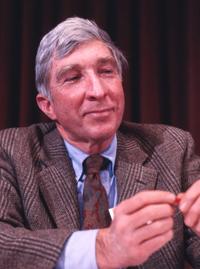
John Updike in 1986
Library of Congress: P&P
As all good freelancers must, he goes to the public library and hopes to gather suggestions and ideas from the reference desk there. But the words were barely out of his mouth when he felt a tug at his elbow. Looking behind him, Ecenbarger sees an elderly woman in tortoise shell glasses. “I know all about him,” she says. “He’s my son.”
With that, Linda Updike, after a restaurant lunch, took the writer on the grand tour of her son’s growing up. “She took him to Plowville and showed him around the small sandstone farmhouse familiar to all devoted Updike readers,” writes Begley.
“The key sights in the cramped interior were young John’s narrow bedroom at the top of the stairs and the downstairs, long white shelves devoted to the books he had written.” His mother recalled that before he left for Harvard, he said one day he was going to fill those shelves. “There’s only room for one or two more,” she said.
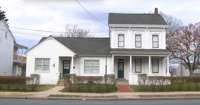
John Updike’s childhood home in Shillington, Berks County
WFMZ
Later, thanks to Updike’s mother, Ecenbarger gets a chance to interview the author himself. Riding around to look at the sights, Updike takes the wheel of the freelancer’s Volkswagen. “I’ve never driven a Rabbit before,” says the author and creator of Harry “Rabbit” Angstrom as they drive off.
All goes well and Ecenbarger’s story is a success. But on July 4th he opens his New Yorker to find an Updike short story titled “One More Interview.” It is full of fictionalized details about an actor being interviewed while driving a car. At first Ecenbarger was a little miffed but then he realized while he was interviewing Updike he was being interviewed as well. It was a dazzling tour-de-force by the author of his interviewer.
Since his death in 2009, Updike, if still respected as a chronicler of a slice of life of mid-to-late 20th century America, is on the shelf himself. The nation he depicted through the voice of “Rabbit” and others, if still audible, is fast disappearing over the cultural and economic horizon. Other concerns are being voiced, shoving those of his generation off the stage.
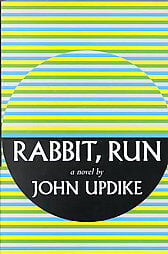
Cover of Rabbit, Run
But one thing that is still generally respected is Updike’s view of the southeastern Pennsylvania of his day. Contributors to Wikipedia have included in the 27 pages they have devoted to Updike’s biography the comments of many other students of the author’s life and the links reflected in his prose of his native state and how it is seen in his writing:
Several scholars have called attention to the importance of place and especially southeast Pennsylvania in Updike’s life and work. Bob Batchelor has described “Updike’s Pennsylvania sensibility” as one with profound reaches that transcend time and place, such that in his writing, he used “Pennsylvania as a character’’ that went beyond geographic or political boundaries.
SA Zylstra has compared Updike’s Pennsylvania to Faulkner’s Mississippi: “As with the Mississippi of Faulkner’s novels, the world is fictional (as are such small towns as Olinger and Brewer) while at the same time recognizable as a particular American region.” Sanford Pinsker observes that “Updike always felt a bit out of place’’ in places like Ipswich, Massachusetts, where he lived for most of his later life. In his heart —and more important in his imagination—Updike remained a staunchly Pennsylvania boy.” Similarly, Sylvie Mathe maintains that “Updike’s most memorable legacy appears to be his homage to Pennsylvania.”
It is understandable that critics focused on the Pennsylvania in Updike’s fiction. The son of Linda Grace Hoyer and Wesley Russell Updike, he was to spend most of his early years in Shillington outside of Reading. His mother always had hopes of becoming a writer and as a youngster he remembered it. “One of my earliest memories,” he later recalled, “is of seeing her at her desk…I admired the writer’s equipment, the typewriter eraser, the boxes of clean paper. And I remember the brown envelopes that stories would go off in —and come back in.”
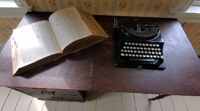
Interior of John Updike’s childhood home in Shillington
WFMZ file
That home was 117 Philadelphia Avenue in Shillington. Here young Updike lived with his family until 1945 when they moved to a family farm property in Plowville. His father was a math teacher at Shillington High School and worked part time as a Lutheran minister. Updike is said to have modeled a character in his book “The Centaur” around his father.
In the last several years the Shillington house has been converted into the John Updike Childhood Home, a museum recognized as a National Historic Place with a Pennsylvania State Historic Blue Marker. It is owned and operated by The John Updike Society, a non-profit organization. The museum is open most Saturdays from 12-2 pm and to groups by special arrangements.
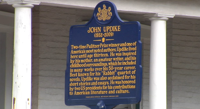
Sign outside John Updike’s childhood home in Shillington, Berks County
WFMZ
When Updike graduated from Shillington High School with honors he received a full scholarship to Harvard. At the college he graduated summa cum laude in 1954 with a degree in English and was President of the Harvard Lampoon. A stint at the Ruskin School of Art at Oxford was followed by hopes of becoming a cartoonist.
Updike moved with his family to New York and for two years was a contributor to the New Yorker before undergoing a spiritual crisis, coming under the influence of Christian theologians Soren Kierkegaard and Karl Barth.
“As to my critics, it seems to be my fate to disappoint my theologian friends by not being Christian enough, while I am too Christian for (critic) Harold Bloom’s blessing. So be it.” Later with the publication of “Couples,” a novel of adultery in suburban towns, Updike found himself denounced from suburban pulpits,
Updike had long since moved with his family to Ipswich, Massachusetts, and his Rabbit novels made him famous and well-off. By the time he died America had entered a new century and he had made his contribution to world literature, Pennsylvania and her people.