
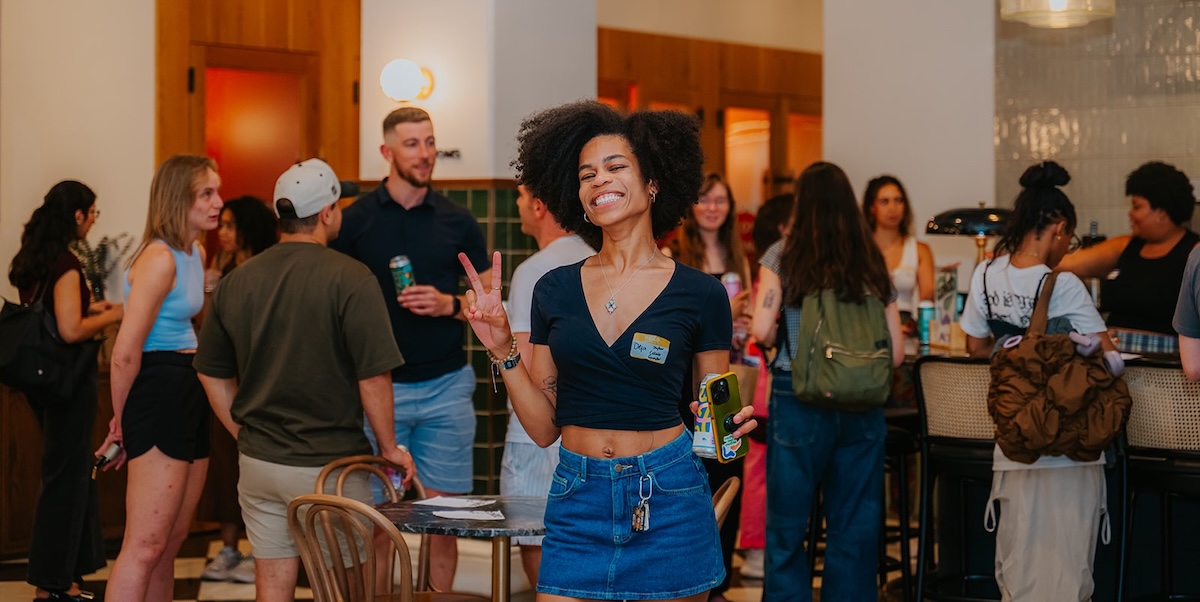
A year ago, Deja Lewis, a graphic designer at Triple Bottom Brewing, was feeling isolated. When Lewis joined the Spring Garden brewery, she admired the Spring Garden brewery’s do-good mission, but was working hybrid, the only employee in a fully creative role.
“I felt alone and lost … by myself on an island creatively,” she says. Maybe Philly wasn’t the place for her, she thought. Maybe she should move to New York City.
But then a fellow graphic designer and friend gave her an idea: What if Lewis herself grew the community she was seeking? What if she hosted her own mixers? After all, she already worked at a popular brewery known for caring about all kinds of people and causes in Philadelphia.
In the summer of 2025, Lewis founded Collab, a social and networking club for both seasoned and just-starting-out creatives — and has held at least one event per month since. Along the way, she’s helped make connections between photographers, designers, musicians, writers, fine artists — about 300 people since she began organizing the gatherings. What’s more, she doesn’t feel lonely anymore.
A growing need for creative connection
Collab is not Philly’s first social or networking club. Recent years have seen the emergence of interest-centered, get-out-of-the-house-and-get-together locally-based app Playdate and the pop-up gather-and-craft girly groups Dessert Before Dinner and Let Me Know, to name a few. Social clubs have been rapidly rising in popularity across the nation over the past few years in response to a rampant post-Covid loneliness epidemic.
But clearly, there’s a need for more. The 2024 U.S. Census found that 40 percent of U.S adults felt lonely. But making like-minded friends in adulthood hasn’t ever been easy — especially not for creatives, who, after leaving school settings, often work alone and struggle to find both jobs and friends. Lewis remembers returning home to Philly from college, and “something didn’t feel right.” She was hanging out with acquaintances just to hang out, not because she felt close to them, or because they helped each other creatively or professionally. “I didn’t really have anyone,” she says.
Worsening the situation for local artists and artist types are the recent closures of University of the Arts and the creative coworking space RecPhilly — and the cost of renting a studio or joining a communal workspace.
“The true, true spirit of community is leaning on each other.” — Monique Means
“There are gaps to be filled in a lot of ways,” says Ariel Shelton, c0-executive director of external relations and community impact at CultureWorks, a grant-funded, accessibly priced Center City co-working space founded 15 years ago aimed at emerging nonprofits. Shelton believes the City of Philadelphia and large funders should do a better job funding smaller arts initiatives. Organizations like hers, and dedicated spaces for emerging artists such as Forman Arts Initiative or the Bok building, can do only so much on their own.
Local visual artist Rachel Headlam agrees. Headlam is an animator, a career she finds to be “really insular and isolating in Philadelphia.” Although three bookstores in Philly carry her coloring books, she, like Lewis, still found herself struggling to find her people.
A gathering space for all creatives
Luckily, people know people — after all, we’re basically ground zero for six degrees of Kevin Bacon. To create Collab, Lewis reached out to creative-minded contacts she’d made through the past few years. Everyone seemed interested. And, she had examples to follow.
Monique Means, founded the Let Me Know Club, which puts on moveable crafting workshops in 2024. Let Me Know partners with small artists to teach the workshops and small businesses to host them, often in independent coffee shops with an extra room. The partnership almost always pays off: Local venues tend to be less expensive, attract more artists, and just feel more meaningful, and, somehow, more real places to make connections.
“The true, true spirit of community is leaning on each other,” says Means. Another word for leaning on each other: collaboration. (Hence the name: Collab.) Lewis already had the friendly venue: Triple Bottom Brewery. She just needed to work on expanding her contacts.
For that, she’s been intentional about including a broad swath of creatives from different fields and levels of experience, so people have something to give each other, be that knowledge, direction, opportunity or inspiration. You’ll find students looking for work, but also established professionals, folks who work alone and others who work in teams, people who throw pottery, boutique owners, and corporate graphic designers.
“There’s something about learning from people that don’t do just what you do that is really inspiring to me and being able to start finding the people you can network and rely on,” she says.
And with Collab’s frequent events, connections have started to grow. At the first ever Collab mixer, Lewis met Ryder Griffith, a local photographer and videographer and brought him the idea of doing a “photo walk,” taking people to different sights around the city for them to photograph. They are currently working on their first such event, with Griffth as a guide.
“As long as you know there’s someone out there who can help you and support you, as long as you have community, you can grow and make this happen together.” — says Deja Lewis
Madasyn Andrews, also a photographer, met a model at a Collab event for a photo shoot. So far, Collab participants have gone to each other’s gallery openings, pop-ups and DJ sets.
Moreover, there’s an ethos of support. “I promise — I promise,” Lewis says in an Instagram post promoting a Collab event, “it will not be clique-y. It is always so welcoming. … I’ve gone to other networking events, they’ve been quite clique-y and just unwelcoming. We do not play that at Collab.”
Collabing
Each event is laid back, but there is a structure. Lewis stocks a table with printed-out, to-the-point conversation starters, such as: What’s a creative project that you’re working on right now that excites you? And: Is there a type of collaborator you’re looking for right now? And everyone wears a name tag.
In advance of the winter holidays, Collab upped its game with a pop-up market. So, in addition to networking, people got some shopping done.
In February, Collab hosted a market called “By Any Means,” referencing the Malcolm X quote, “by any means necessary,” paying homage to Black artists during Black History Month. On this particular afternoon, Triple Bottom Brewing was packed. The brewery’s walls displayed paintings by Collab participants. Shelby Brisbane, owner of Sankofa Floral Design, was there, selling lush little arrangements. Jordan Plain displayed his colorful abstract prints featuring his poetry. Frederick Scott was there with his signature boxy, striped rugby shirts.
Once again, connections were made Olive Adams, the founder of the Analog Lovers Club signed up for Join Philly, a social club connector. Guests approached Lewis about using their spaces to host future Collabs.
“[To] further uplift each other — that’s what progress is. It’s not just about how high can I get but about: How can I bring the community up with me? Even if I don’t sell a single stem, making the connections I have already is already worth it,” says Brisbane.
“As long as you know there’s someone out there who can help you and support you, as long as you have community, you can grow and make this happen together,” says Lewis, “As someone who was born and raised here in Philly, I truly believe that Philly creatives should not have to leave and go to New York or L.A. to fulfill their dreams … We’ve got the grit, we’ve got the talent, and we have the drive to build something powerful right here at home.”
Adds Headlam, “Going out to the community and meeting people … it’s very healing.”
 MORE BUSINESS FOR GOOD
Deja Lewis, founder of Collab.