
The Scranton City Council plans to ban the sale and possession of kratom, a substance that officials portrayed Monday as increasingly addictive and potentially deadly.
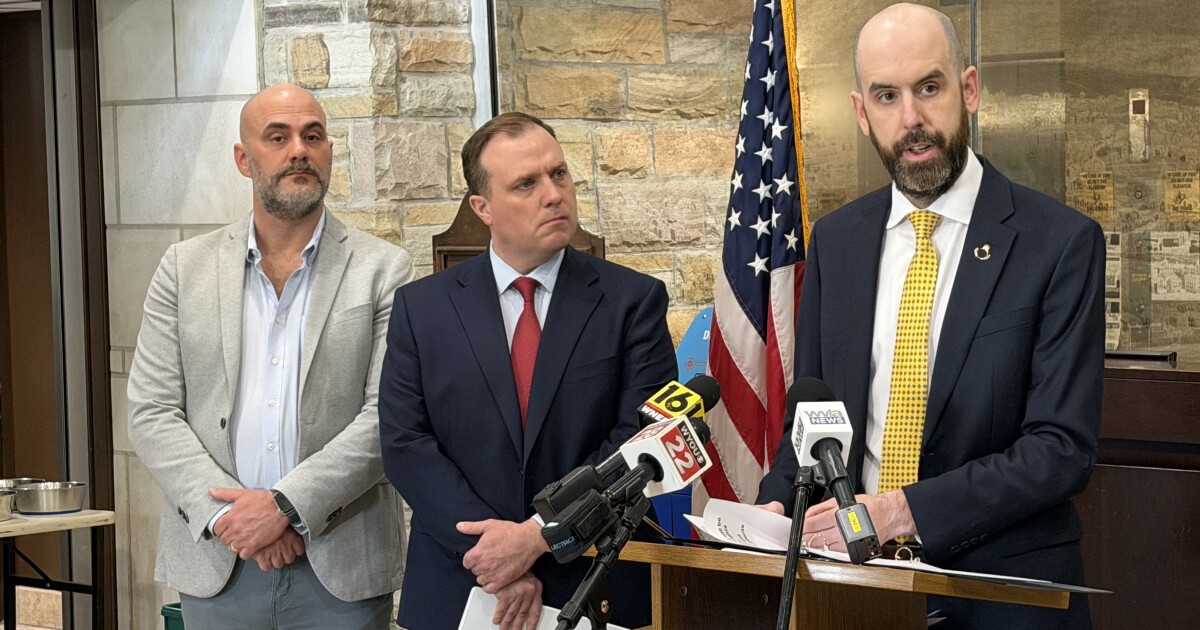
At a Lackawanna County Courthouse news conference, City Councilman Patrick Flynn, the chief advocate for banning kratom sales locally, joined District Attorney Brian Gallagher and other officials to announce two ordinances to ban sales and possession in the city.
“More and more treatment providers are reporting cases of people struggling with kratom dependence,” said Flynn, himself 11 years into recovery from addiction to other drugs. “Treatment providers are seeing it, families are seeing it, and unfortunately, people in or seeking recovery are sometimes encountering it when they least expect it. As a city, we have a responsibility to get ahead of problems before they become full blown crises.”
Kratom, largely unregulated nationwide, is widely available in local vape shops and convenience stores, officials said.
What the laws would do
One ordinance would ban the possession, delivery, manufacture, production and retail and wholesale sales of kratom and its derivatives to anyone within city limits. The other bans sales to minors, possession by minors and helping minors get kratom.
Both define violations as summary offenses, punishable by a fine of up to $300 and 90 days in jail for each offense.
Flynn said the council will introduce the ordinances Tuesday with hopes of final passage a week later. Efforts to reach Mayor Paige Cognetti were not immediately successful.
Kratom dependency growing
Joe Van Wie, founder and CEO of Olyphant-based Fellowship House, an addiction treatment provider, said many young people are among the kratom-dependent.
The dependent endure “severe withdrawal symptoms, lasting 30, 40, even 60 days, and requiring medical interventions that rival and exceed traditional opioids,” Van Wie said. “We are also seeing increasing reports of overdose and toxicity tied to high dose and synthetic kratom products. This is no longer a plant discussed in closed circles. This is a multi-billion-dollar industry producing concentrated, engineered substances designed for maximum effect and maximum dependency.”
No data on addiction
Van Wie and Gallagher did not cite statistics on how widespread kratom addiction has become, though Gallagher noted the death of one person in Carbon County last year.
The Carbon County coroner determined a resident died of kratom toxicity in January 2025, according to a coroner’s office Facebook post.
“We’re seeing widespread reports of its addictive properties. We’re seeing withdrawal symptoms. We’re encountering it among individuals under court supervision, where it undermines rehabilitation and compliance with the terms of their probation,” Gallagher said. “We’ve had overdoses in Pennsylvania, and we’re responding to real incidents here in the city of Scranton and Lackawanna County, including numerous emergency calls from parents whose teenagers have suffered the adverse medical reactions of products purchased openly at retail settings. This is not a benign substance, as Pat described. It presents a legitimate, growing public safety concern.”
What the FDA says
Kratom comes from the leaves of a plant native to Southeast Asia. Though the United States Food and Drug administration acknowledges kratom “is often used to self-treat conditions such as pain, coughing, diarrhea, anxiety and depression, opioid use disorder, and opioid withdrawal,” the agency warns against its use for medical purposes because of the lack of testing. The FDA considers a kratom derivative known as 7-OH as an “emerging opioid threat.”
About 1.7 million Americans 12 and older acknowledged using kratom in 2021, according to a federal Substance Abuse and Mental Health Services Administration survey.
Van Wie said gas stations, vape shops and convenience stores sell kratom “often without age restrictions, labeling standards, or meaningful oversight.”
“It has moved faster than regulation, faster than awareness and faster than protection,” Van Wie said. “This is not about criminalizing individuals. It’s about protecting communities, especially our youth, from an unregulated market that has outpaced science policy and common sense.”
Flynn said kratom’s widespread availability and growing potency amid packaging “that makes it seem harmless” create a danger.
“We’ve lived through the devastation of the opioid epidemic. We’ve lived through the crisis that bath salts became. We’ve lost far too many neighbors, members, friends and family members,” Flynn said. “We cannot afford to ignore warning signs when they begin to appear.”
‘First pin to drop’
Flynn and Gallagher called on the leaders of other cities, boroughs and townships to enact similar bans.
Gallagher likened the proposed regulation to a local ban on bath salts years ago.
“Obviously, we’re hoping that this is the first pin to drop in a long line of municipalities, and then hopefully our state representatives, our state senators and federal senators get on board,” Gallagher said.
Efforts to obtain comment from the American Kratom Association, an industry trade group, were not immediately successful.
On its website, the association invites readers to report attempts at regulation. It advocates for more research about kratom’s effects rather than for regulation.