
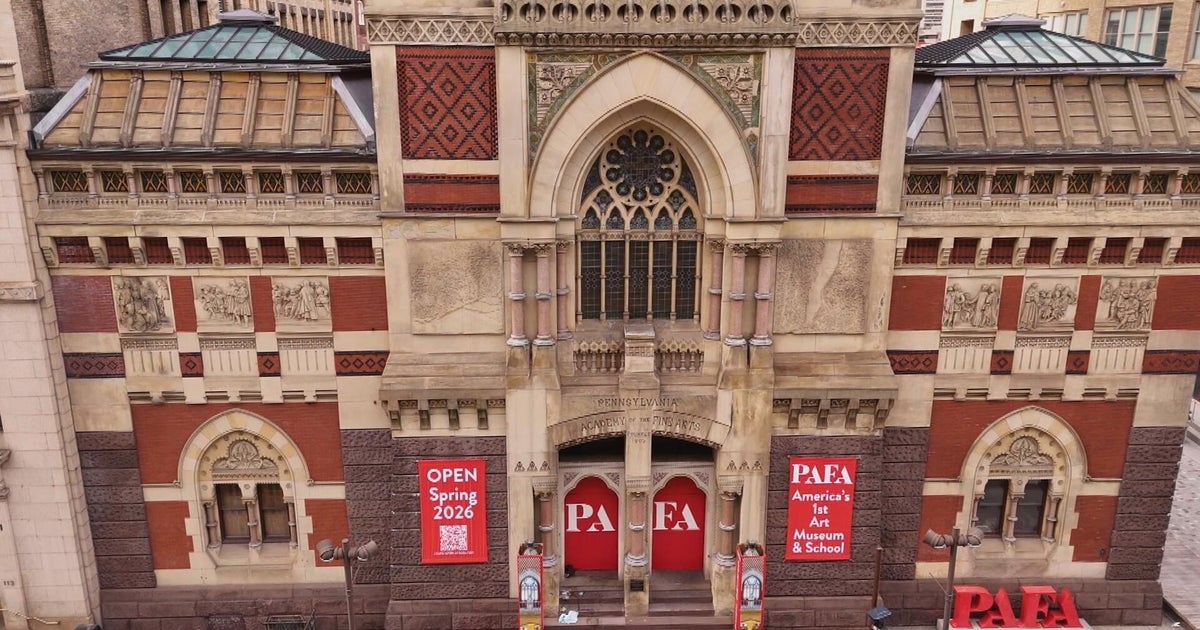
Philadelphia is proud to be the home of the nation’s first art school and museum of fine arts.
Founded in 1805, Pennsylvania Academy of the Fine Arts (PAFA) has lived many lives — surviving fires, moving buildings and adapting to a changing art world. 2026 marks 220 years for the institution, and the people behind the easel say their work is far from done.
“We are probably one of the only schools left that still do this,” Al Gury, professor of painting and drawing at PAFA, said.
For more than 20 years, Gury’s worked at PAFA. Using one of the antique casts as a guide, Gury is working out of the famed Cast Hall, a place that houses an impressive collection, including a model of Michelangelo’s “David.”
“There’s something about this place that is almost has a spiritual feel to it,” Gury said. “And we’re very, very proud of that.”
More importantly, PAFA is a place that’s molded countless great American artists, Gury stresses.
“We’ve been doing it for 220 years,” Gury said, “and we’re still pumping.”
PAFA can claim several other “firsts” too.
One of those firsts, an artist named Robert Douglas Jr., came along in 1834, said Hoang Tran, Director of Archives, Library and Collections at PAFA.
“We believe from our research over the years, he was the first African American artist to exhibit at a professional museum,” Tran said.
Pointing at another photograph, Tran added, “The Pennsylvania Academy of Fine Arts allowed women — or permitted women, female students — to work from what we call antique, which is a historical cast collection, starting in 1844.”
In 1876, PAFA moved to where it stands today on North Broad Street.
“We’re in the front entrance, coming up the grand staircase,” Ed Poletti, Special Project Manager, said. “Our second floor is all our gallery spaces.”
Last year, Poletti showed CBS News Philadelphia the facelift happening inside the Historic Landmark Building.
“Our project renovation right now involves replacing all our HVAC equipment, heating ventilation, air conditioning,” Poletti said.
The multi-million-dollar project is outfitting the famed Frank Furness-designed building for the next generation.
“It’ll look 100% better. The lighting will be better,” Poletti said. “I think they’ll be really impressed with the place.”
Just this week, our cameras were allowed back in to show off the completed work, days before reopening to the public.
While the gallery space might look different, the passion and legacy remain.
As Gury notes, PAFA is building towards its future.
“We somehow found a way to balance the legacies, the traditions, the really beneficial, solid earlier forms,” Gury said, “and wed them to what’s going on in the world now.”
The Historic Landmark Building reopens to the public on Saturday, April 12.