
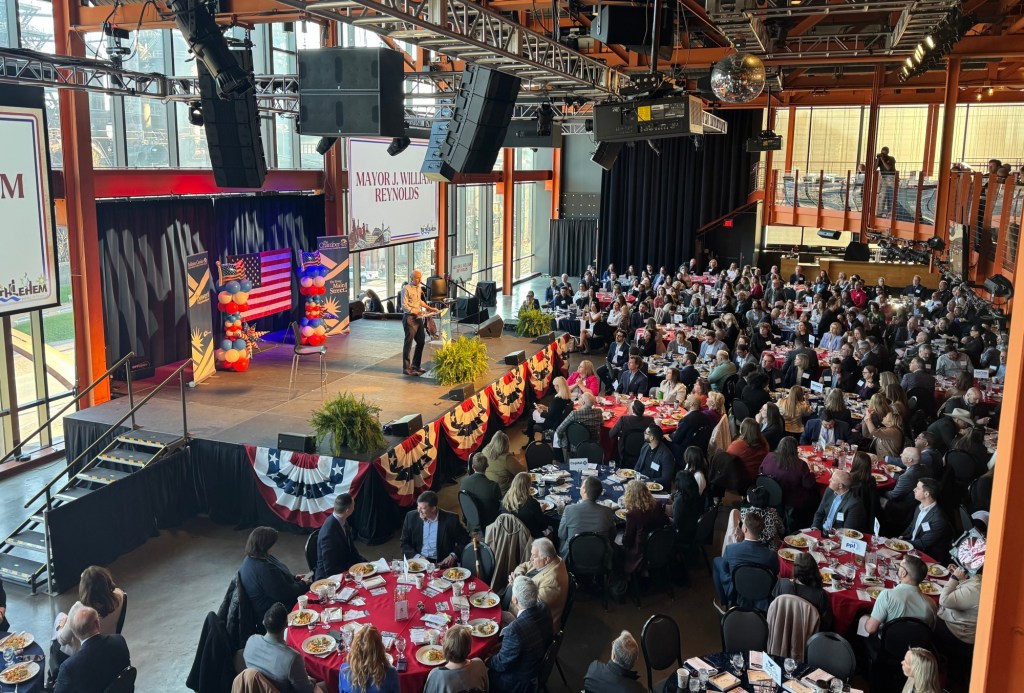
For the 250th anniversary of the United States, it made sense for Bethlehem Mayor J. William Reynolds to talk about the “American Dream” — what it meant for one’s ancestors, the people who prosper under and struggle with it today, and the children with uncertain futures.
The message of the American Dream, Reynolds said, matters less than the mission. His State of the City address made clear that, like the country itself, Bethlehem has seen great successes in the last few years. But with challenges like poverty and the housing crisis, those successes won’t continue on their own. The story is incomplete.
“This country has given us so much, it builds itself on this idea: it’s not about what we say, but it’s about what we do,” Reynolds said. “And we are incredibly fortunate here in Bethlehem to have so many people that are doing those things. Our city has seen a financial revitalization like no other. I’ve been here all 44 years of my life. You’re nowhere where we were 20, 30, 40 years ago. There’s a sense of optimism around here that there didn’t used to be.”
The mayor and his administration used the Wednesday morning address to highlight the city’s accomplishments and goals to over 400 attendees within the ArtsQuest Center in Bethlehem. Here are the main takeaways.
The growth of Bethlehem
The city has enjoyed several kinds of growth and financial benefits within the last couple of decades, Reynolds said.
Median income increased from $35,815 in 2000 to $75,194 in 2024; the city has had no new capital borrowings since 2019; and its debt decreased from $170.9 million in January 2015 to $77.7 million as of January 2026.
Property taxes have increased at a smaller rate than before — average property tax increases were 1.1% for 2020-2026 compared to the 2.6% rate for 2011-2019 and 2.7% rate for 2001-2010.
“We’re in a financial position where I’m able to make promises and keep promises the ways that mayors couldn’t do 20, 30 years ago,” Reynolds said. “Not through any fault of their own, but because we didn’t have the financial growth and the revitalization that we have seen — a story that we’ve heard many, many times.”
Laura Collins, the city’s director of community and economic development, also highlighted growth, such as construction valued at $264 million last year with over 4,400 permits issued. The city also issued 150 new permits last year for new businesses and businesses’ relocations and expansions.
“Barbershops, salons, cafes, coffee shops, yoga studios, a recording studio, a vintage shop, small retailers and all the restaurants that make our neighborhoods come to life — these are the dreamers who make up the fabric of Bethlehem,” Collins said.
Challenges ahead
Bethlehem hasn’t reached all of its goals yet, Reynolds said.
The city’s overall poverty rate went from 15% in 2000 to 14.9% in 2024. However, for the same time range, the poverty rate increased from 20.7% to 24% for people under 18, and from 8.8% to 14% for people over 65.
Housing remains a challenge as well. Bethlehem’s median housing cost went from $97,400 in 2000 to $289,200 in 2024. The Lehigh Valley itself is short by over 9,000 housing units, as previously reported.
Sara Satullo, the Bethlehem deputy director of community development, said the keys to address the crisis include the Lehigh Valley Housing Supply and Attainability Strategy from the Lehigh Valley Planning Commission; providing resources like legal support and rental assistance through partnerships with New Bethany, North Penn Legal Services and Community Action Bethlehem; exploring a revolving loan fund to support developers; and projects like the 120 units from Gateway on Fourth and creating 456 units in the Pembroke public housing neighborhood.
“Still, this is not a challenge Bethlehem can solve alone,” she said. “If America is serious about tackling this crisis head-on, we need large-scale government investment in housing, just as we did after World War II. Housing must be treated as essential infrastructure and of human rights.”
Improving parks and community connections
Other projects the city is working on is its “40 in 10” plan and the South Bethlehem community center, the latter of which the River Crossing YMCA and United Way of the Greater Lehigh Valley are partnering with the city to build.
The 40 in 10 plan would see the city improve 40 of its parks over the next 10 years, including Clearview, Madison and Bernie Fritz by the end of next year.
“When you go to any of our parks … you don’t walk onto the Greenway and get charged money,” Reynolds said. “You don’t walk on the Sand Island and get charged money. They are for everybody, no matter if you’ve been here for a week or you’ve been here for 50 years. They’re a place for us to share, and they’re a place for us to build connections and build empathy with each other.”