

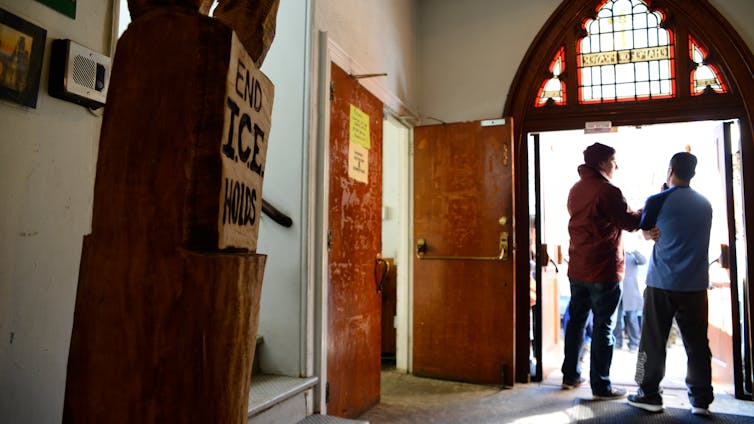
Supporters visit Javier Flores, right, while he lived
in sanctuary at Arch Street United Methodist Church in downtown
Philadelphia in 2017.
Bastiaan Slabbers/NurPhoto via Getty Images
Menika
Dirkson,
Morgan State University
In the midst of a civil war, married couple Ernesto and Linda
Fuentes fled
their home country of El Salvador and headed for Philadelphia,
via Mexico, in November 1983.
Ernesto was an activist who dispensed food and medicine in
Salvadoran
refugee camps. Linda was a union organizer for banks and
clothing factories.
The Salvadoran government viewed activists, especially suspected
guerrilla fighters and union leaders, as threats to its regime. It
placed activists’ names on “death
squad hit lists.” The couple decided to leave after receiving
threatening letters and phone calls.
With false documents and the help of a humanitarian church
group, they arrived at the Tabernacle United Church in West
Philadelphia on May 12, 1984. The congregation
declared itself a public sanctuary for undocumented refugees
from El Salvador and Guatemala. An estimated 500,000 undocumented
Salvadorans lived in the U.S. around that time.
The Fuenteses used the pastor’s
office as their bedroom. Church members were instructed to keep
the doors locked and not admit strangers, including the Immigration
and Naturalization Service.
As a historian of
race and policing in Philadelphia after the Civil Rights
Movement, and the daughter of an immigrant, I’ve been exploring
Philly’s history of sanctuary and how religious
congregations,
activists and city officials have supported local refugees over
the past 40 years.
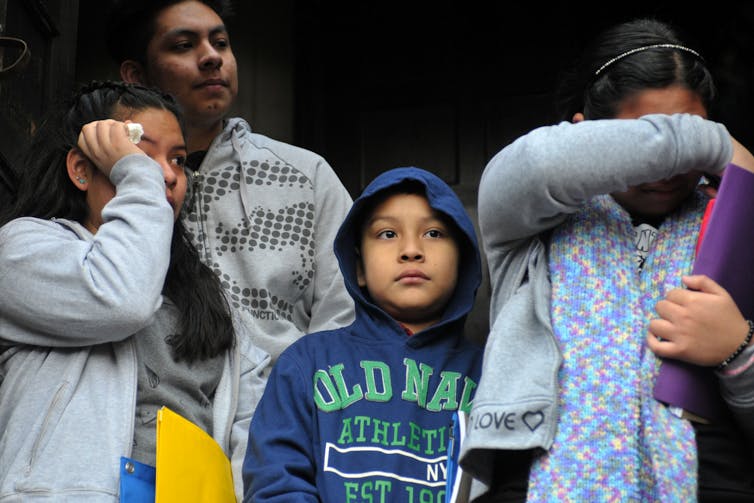
Accompanied by elected officials,
clergy and community activists, the four undocumented children of
Carmela Apolonio Hernández step out of sanctuary at the Church of
the Advocate in North Philadelphia in 2018.
Bastiaan Slabbers/NurPhoto via Getty Images
A ‘welcoming city’ for immigrants
Philadelphia Mayor Cherelle Parker has emphasized since May 2025
that Philadelphia is a certified “welcoming
city.” She notably does not call Philadelphia a “sanctuary
city.”
Welcoming cities have
immigrant-friendly initiatives that make education, housing,
workers’ rights, legal aid and language services
accessible to immigrants and refugees without using the term
“sanctuary
city” in their laws and policies.
The presumed goal of this phrasing is to keep Philadelphia off
the Trump administration’s radar and protect its
US$2.2 billion in federal funding for health and human
services.
However, Philly was, at various points, an official sanctuary
city.
In 2014, then-Mayor Michael Nutter signed an
executive order detailing that local police were not required
to assist Immigration and Customs Enforcement unless the case
involved a warrant or violent felon.
Nutter later rescinded Philadelphia’s sanctuary city status in
an effort to
dissuade congressional Republicans from passing a House bill
that would deny sanctuary cities federal money earmarked for law
enforcement and recidivism reduction. However, the next mayor, Jim
Kenney,
reinstated the order on Jan. 4, 2016.
Throughout 2017, President Donald Trump and Attorney General
Jeff Sessions used executive orders, speeches and the
immigration raid Operation Safe City to force Philadelphia
officials to assist ICE
or lose federal grants.
In 2018, Philadelphia won a lawsuit against the Trump
administration that denied ICE access to
police databases to find undocumented immigrants and prohibited
city employees from assisting ICE.
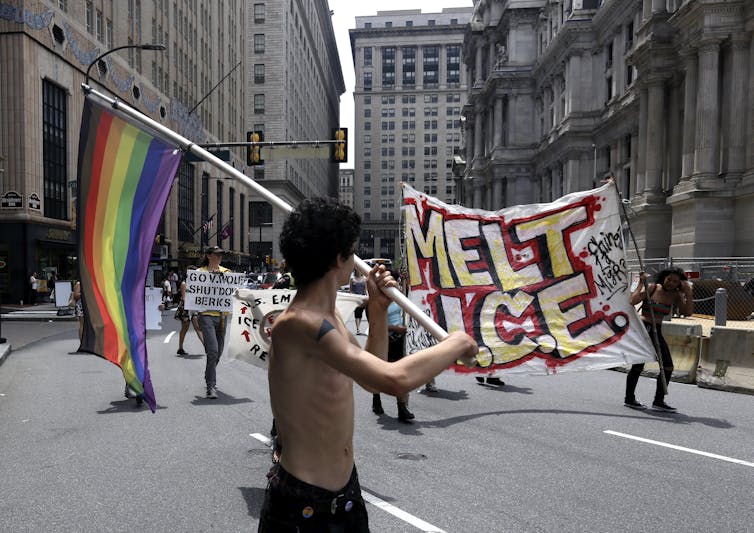
Protesters camped outside
Philadelphia City Hall march in July 2018 after Mayor Jim Kenney
announced that Philadelphia would stop giving ICE access to a
real-time arrest database. Kenney accused the agency of misusing
the information to target people who were in the country illegally
but were otherwise not accused of any crimes.
AP Photo/Jacqueline Larma
Roots of sanctuary cities
The sanctuary movement started back in the 1960s. But it wasn’t
immigrants who were seeking sanctuary. It was Americans.
Around 1968,
drafted resisters who were opposed to fighting in the Vietnam
War sought refuge in churches in the U.S. Northeast. One of the
earliest cases involved
Robert Talmanson, who received sanctuary in Boston’s Arlington
Street Unitarian Church. He was later arrested by U.S. marshals and
local police and incarcerated in Virginia for three years.
In November 1971,
Berkeley, California, became the first sanctuary city in the
country when
12 local churches inspired the
City Council to pass a resolution offering sanctuary to draft
resisters. It also banned city employees from “assisting in the
investigation or arrest of any sanctuary seeker.”
In the two decades that followed, several Quaker, Presbyterian,
Catholic and Jewish
congregations across America and Canada used their houses of
worship as sanctuaries for Central American refugees who were
fleeing civil war,
government repression and genocide.
Philly joins national movement
Frustration and outcry over the United States’
low acceptance rates of Central American asylum-seekers sparked
Philadelphia’s sanctuary movement.
In January 1984, members of Tabernacle United Church, where the
Fuentes couple would soon take refuge, voted to join the national sanctuary
network. As
the Rev. James MacDonald explained at the time, the
congregation chose to “violate
a human law in order to respond in obedience to God’s law.”
By May, the
First United Methodist Church of Germantown also became a
sanctuary church. A few months later, the church sheltered a
young Guatemalan couple, Joel and Gabriela, and their
3-year-old daughter, Lucy.
Joel, an activist who worked with unions and student groups,
had been tortured by Guatemala City police.
On Jan. 14, 1985,
INS staged nationwide raids of sanctuaries and arrested 60
undocumented immigrants and 16 sanctuary workers – including
pastors, nuns and priests – for violating immigration laws.
Joel and his family were among those seized. They were released
when church members bailed them out as they awaited deportation
hearings.
A new pathway to citizenship
By the mid-’80s, 42,000
people from
2,000 religious institutions in 60 cities nationwide had joined
the sanctuary movement.
On Nov. 6, 1986, President Ronald Reagan signed into law the
Immigration
Reform and Control Act. It granted undocumented immigrants who
arrived in the U.S. before 1982 one year to apply for amnesty. If
eligible, they would begin a five-year pathway to citizenship.
Approximately
3 million people successfully became naturalized citizens
through the amnesty program.
In the Philadelphia area, at least 5,000 to 7,000 people were
undocumented in 1986. Advocates at the nonprofit Nationalities
Service Center and American Friends Service Committee noted that
many immigrants wanted to apply for amnesty but
feared the program was a trick.
A decade later, immigration enforcement got tougher.
Local police assist ICE
In 1996, Congress passed
Section 287(g) of the Immigration and Nationality Act. This
granted local police the right to
assist immigration officials in arresting and detaining
unauthorized immigrants.
As of April 2026, over 1,600 law enforcement agencies in 39
states and two U.S. territories have a 287(g)
agreement with ICE. The
program offers local police free training in ICE procedures
along with funding for equipment, vehicles and overtime pay.
While the Philadelphia Police Department has never signed a
Section 287(g) agreement, about
68 Pennsylvania agencies have, including in neighboring
Delaware County.
But these agreements aren’t always long-lasting. Between January
and March 2026, two departments in
Bucks and
Chester counties
rescinded their agreements with ICE to make residents feel safe
after American-born protesters Renée Good
and Alex Pretti were killed during ICE operations in
Minneapolis.
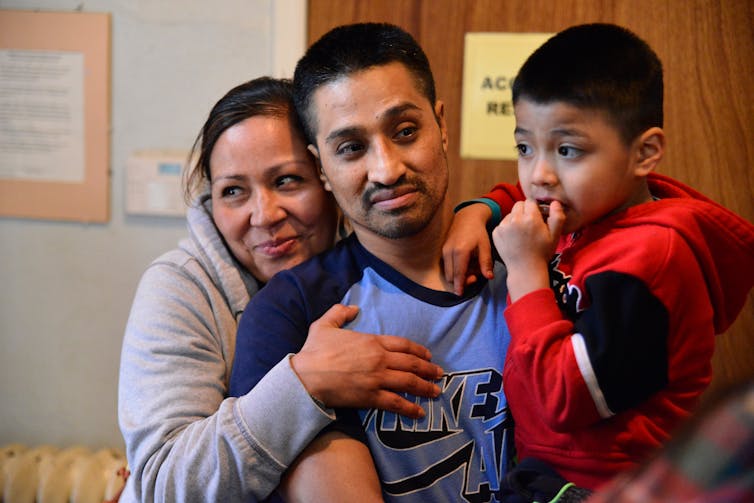
After a 16-month detention,
Javier Flores, a father of three, went into sanctuary at Arch
Street United Methodist Church in Philadelphia in 2016. He spent
nearly a year in sanctuary before his visa request was approved and
ICE waived his previous removal orders.
Bastiaan Slabbers/NurPhoto via Getty Images
Community activism continues
According to Pew Charitable Trusts,
nearly 16% of Philadelphia’s
1.6 million residents are immigrants, largely from Asia and the
Caribbean.
The exact number of undocumented immigrants in Philadelphia is
unknown. However, the Migration Policy Institute estimates that
250,000 immigrants in Pennsylvania –
1.5% of the state’s total population – are undocumented.
Since January 2025,
ICE crackdowns in sanctuary cities such as
Los Angeles,
Portland,
Chicago and
New York have resulted in the number of people held in ICE
detention jumping from
40,000 to 73,000 people in January 2026.
Citizens and advocacy groups have stepped up to protect
immigrants from ICE. The Party for Socialism and Liberation and the
AR-12-toting members of the
Black Lion Party for International Solidarity participated in
protests
in Philadelphia. Public school students from
Northeast and
Edison high schools have led
anti-ICE walkouts.
On Jan. 29, 2026, City Council members Kendra Brooks and Rue
Landau introduced an “ICE
Out” package. The bills aim to codify the right of police to
not share immigration, citizenship and personal data with ICE, or
detain and hand over arrested individuals to the federal
agency.
The legislation also proposes a ban on ICE agents who wear masks
or hide their badges, use unmarked cars and city vehicles, or use
municipal spaces as staging areas for enforcement and raids. And it
would prohibit city employees from giving ICE access to libraries,
shelters, health centers and recreation centers without a judicial
warrant.
Community activists have long used civil disobedience and
humanitarian aid to protect undocumented immigrants who are
searching for a fresh start in the U.S.
An interfaith network inspired Philadelphia to become a
sanctuary city. Today, churches such as Center City’s Arch Street United
Methodist Church and North Philly’s Church of the
Advocate,
along with other congregations, uphold this tradition while a
multicultural community across the city continues that fight.
Read more of our stories about Philadelphia
and Pennsylvania, or sign up for our Philadelphia newsletter on Substack.

Menika
Dirkson, Associate Professor of History,
Morgan State University
This article is republished from The Conversation under a Creative
Commons license. Read the
original article.