
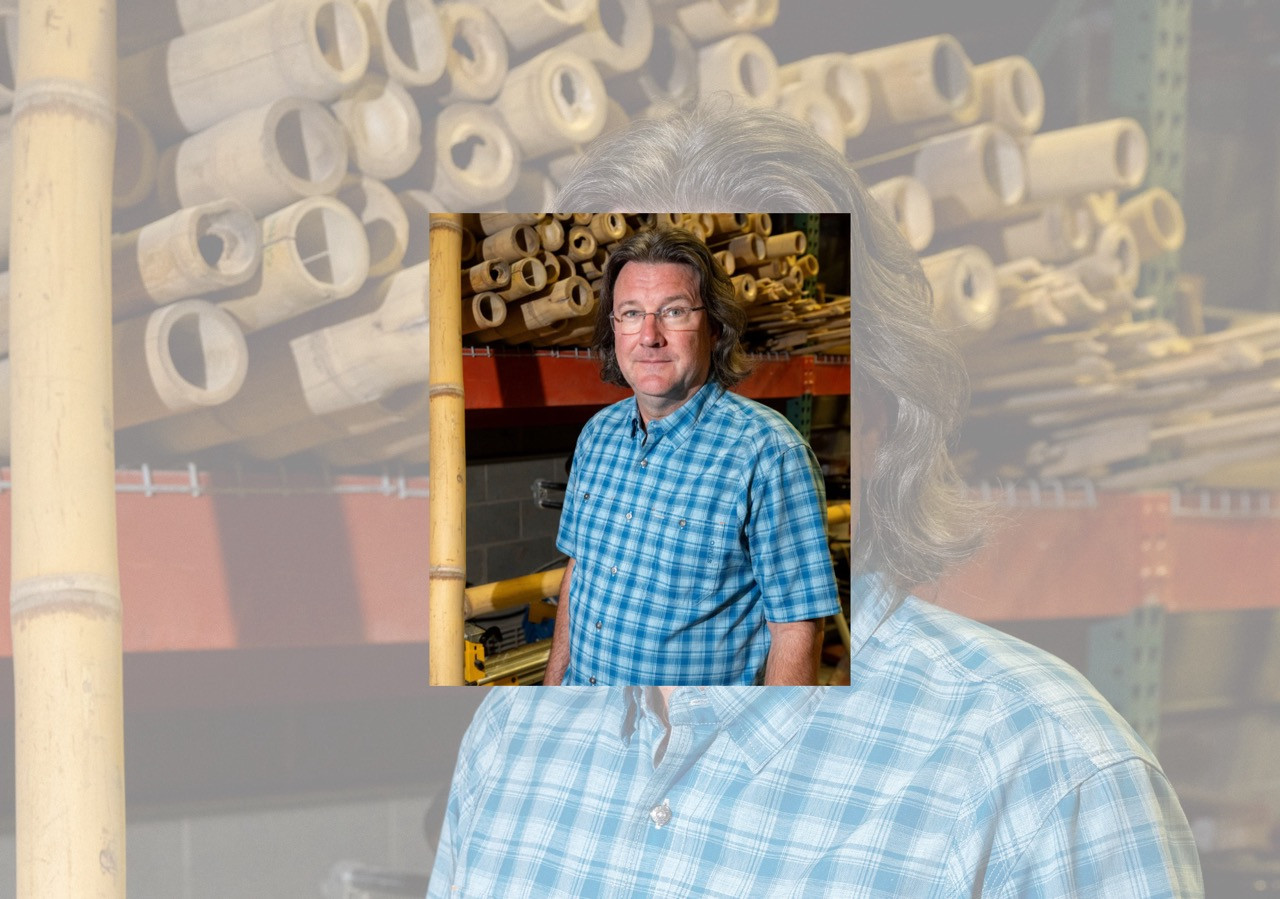
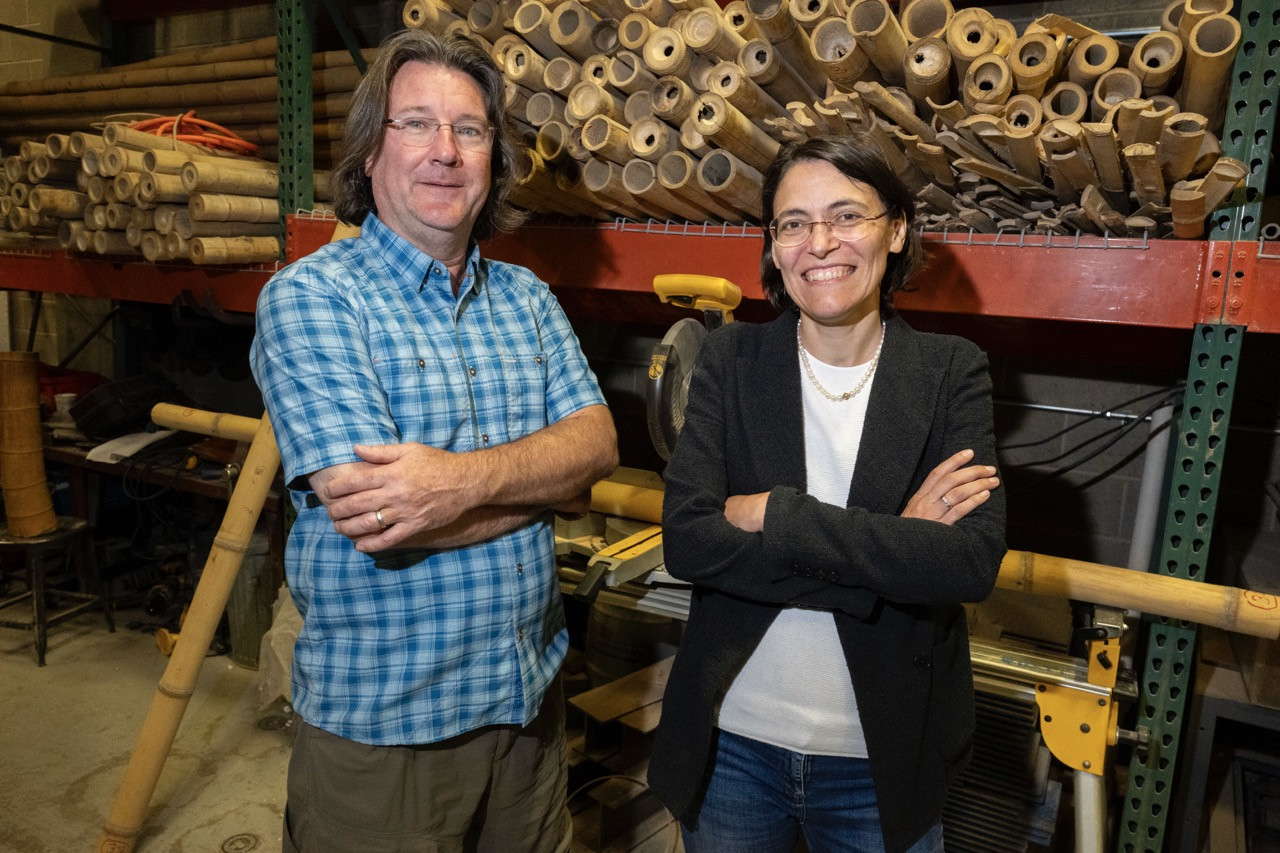
Harries_Molari Fulbright
In 2025, he welcomed Italian researcher Luisa Molari, from the University of Bologna, to spend a semester at Pitt on a Fulbright grant. The two collaborated to model bamboo and standardize how it is tested.
Toward stronger, clearer codes and standards
Although bamboo has been used as a building material for thousands of years, only recently have researchers developed international standards. In 2000, Dutch researcher Jules Janssen’s “Designing and Building with Bamboo” was published, and the first technical standards were adopted by the ISO in 2004.
“It’s important to get those first standards, the ‘version zero,’ published. They provide the jumping-off point to begin developing stronger ones,” Harries said.
With longtime collaborator David Trujillo, an assistant professor of humanitarian engineering at the University of Warwick in England, Harries did just that. The two revised the test method and design standards for bamboo, which were published by ISO in 2019 and 2021, respectively.
While working on them, Harries applied another of his research areas: understanding and mitigating complexity in building codes and standards. “Codes are hugely important,” he said, “but if builders can’t understand them, they start to lose their efficacy.”
Harries used these bamboo standards as a case study to investigate the importance of producing clearer, more concise specifications. The research led him to revise his own work.
In addition to revising the standards, Harries and Trujillo, along with engineers Sebastian Kaminski and Luis Felipe Lopez, set to work developing the first structural engineering manual for bamboo, which was first published in November of 2025. The four experts, all members of the International Bamboo and Rattan Organization (INBAR), provide detailed information about bamboo and guidance for building with it.
“The manual explains where these revised standards come from and how they can be used,” Harries said. “It also provides a roadmap for the next iteration of the standards.”
Rhizomes
Bamboo, which belongs to the grass family, is rhizomic, spreading underground and popping up new shoots. Anyone who has grown bamboo in their backyard, or who has lived next door to someone who has, knows this well. And just as bamboo will spread, Harries’ research has grown and created opportunities for his students.
“There have been about 40 Pitt undergraduate students who have traveled abroad for bamboo-related research projects,” Harries said. “There have been multiple PhDs, and I’ve even had high school students work on bamboo research.”
The projects have built community worldwide, improved international bamboo standards, and created first-of-its-kind guidance. They have shed new light on a sustainable material that has been an essential building block in many countries for centuries.
On January 1, 2025, LEGO launched its first bamboo kit. The set, with its many curved pieces, hardly captures the kind of LEGO Harries grew up with. Yet the existence of such a set speaks to bamboo’s current cultural cachet, one that Harries is excited to help spread.
‘;