
The Wildcat Ridge Data Center Campus launched a public relations campaign this week touting its economic benefits and questioning the motives of its opponents.
Residents throughout Archbald received a 12-page booklet in the mail this week from the borough’s largest proposed data center campus, coinciding with a newly launched website promoting Wildcat Ridge. Brooklyn-based Cornell Realty Management LLC applied with the borough in December to build 14 two-story data centers, each up to 80 feet tall with a 202,340-square-foot footprint, plus commercial and office space, across 574.2 acres along Business Route 6 and Route 247, or Wildcat Road.
Wildcat Ridge became Lackawanna County’s first proposed data center campus when officials approached Archbald during a January 2025 council work session. The 777-page conditional use application filed Dec. 15 initiated a public hearing process where hundreds of residents twice filled the Valley View High School auditorium in opposition of the campus. Council has yet to vote to approve or deny the application following hearings on Jan. 28 and March 10.
Wildcat Ridge’s third hearing will be Monday at 5 p.m. at the Valley View High School auditorium, 1 Columbus Drive, Archbald.
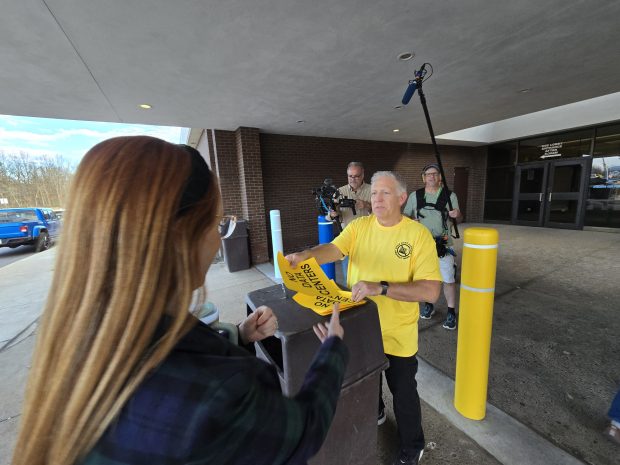 Archbald resident David Polansky hands out “NO DATA CENTER” signs outside the Valley View High School in Archbald on Tuesday, March 10, 2026. Polansky said he was handing out his third batch of 500 signs.
(FRANK WILKES LESNEFSKY / STAFF PHOTO)
Wildcat Ridge has been an especially contentious proposal due to its water and electricity demands. The campus would use a maximum of just over 3.3 million gallons of water per day during the hottest summer weather while requiring 1.6 gigawatts, or 1,600 megawatts, of electricity to power its data centers. In addition to data centers, Cornell Realty Management plans to build 316,000 square feet of commercial space, including a 50,000-square-foot grocery store with 1,800 square feet of retail space; two four-story, 85,000-square-foot buildings, with one mixed use and the other an office; and a 96,000-square-foot surface parking lot with about 360 spaces.
The campus is now one of six proposed in Archbald, amounting to 51 individual data center buildings in the borough, and one of 12 proposed across Lackawanna County in Clifton and Covington townships, Dickson City, Jessup, Olyphant and Ransom Twp.
The campaign
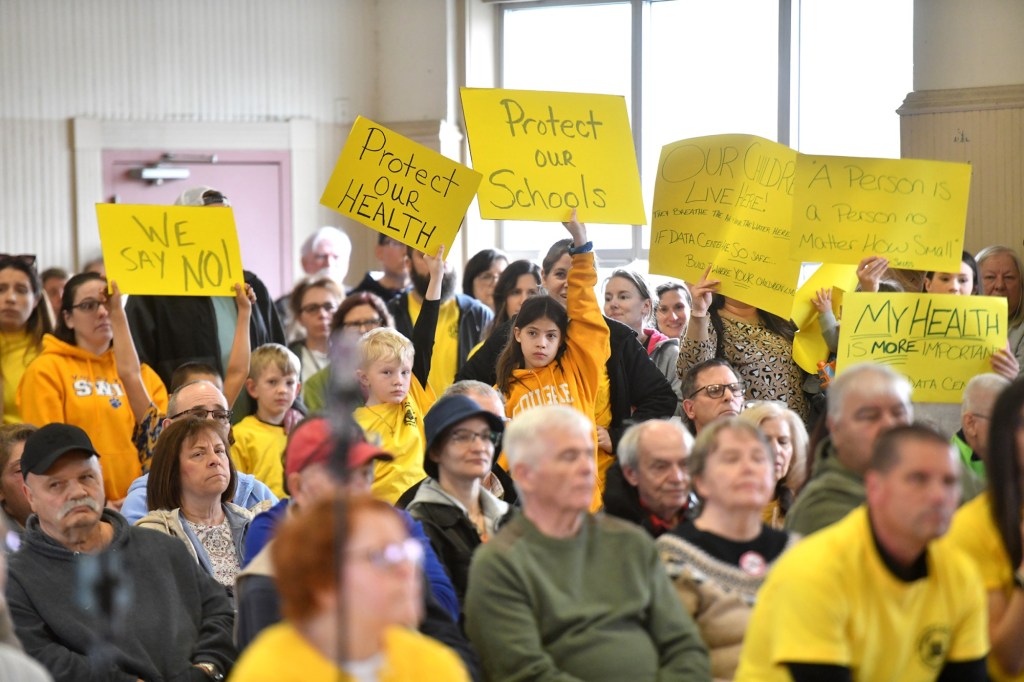
During Wildcat Ridge’s last public hearing in March, a raucous crowd drowned out testimony from company representatives as they attempted to testify on their project. Shouts of “Go home!” and other jeers erupted from the crowd of 400-plus throughout the night, with many of those in attendance wearing bright yellow “Stop Data Centers Protect NEPA” T-shirts while holding matching “NO DATA CENTERS” signs throughout the night.
Wildcat Ridge’s new campaign aims to change that public opinion. The 12-page booklet, titled “Myths vs. Facts,” with the tagline “Revealing the truth and dispelling rumors about data centers,” emphasizes the benefits and minimizes the impacts of the development. The cover directs readers to WildcatRidgeDataCenter.com — a website registered March 17, according to the Internet Corporation for Assigned Names and Numbers. The website’s homepage depicts a rendering of a data center with the text, “A New Era of Economic Growth for Archbald.”
“The Wildcat Ridge AI Data Center Campus is a major economic investment creating an estimated 1,280 permanent jobs and delivering a net of more than $45 million in local tax revenue each year,” according to the website.
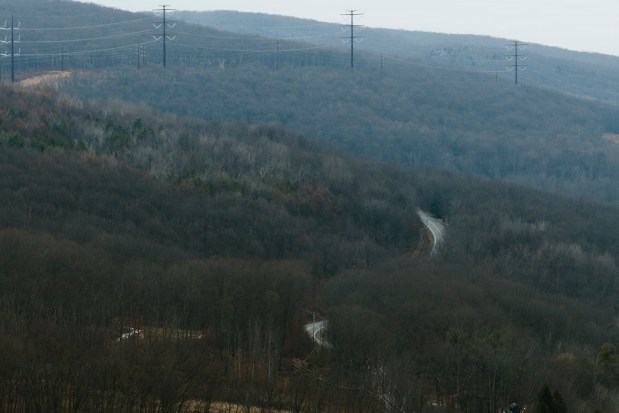 Wildcat Road winds up the mountain looking north towards a section of power lines in the Eynon section of Archbald Friday, January 9, 2026. (SEAN MCKEAG / STAFF PHOTOGRAPHER)
Both the website and booklet use data from a community impact analysis from planning consultant Thomas Shepstone of Honesdale-based Shepstone Management Co.; Shepstone presented an overview of the analysis during the March public hearing, with the analysis also included in the conditional use application.
The campus projects more than $46 million in annual tax revenue, with $7.15 million going to Archbald, $15.19 million to Lackawanna County and $23.81 million to the Valley View School District. Both the website and mailer also reference aesthetics, describing it as an ultra-modern facility with 200-foot wooded buffers.
It also projects 1,280 permanent jobs — 688 data center jobs and 592 commercial jobs — paying an average salary of $71,000.
In one of its “Myths vs. Facts” breakdowns, the campus addresses its impact on power bills, contending energy prices in the state are regulated by the Pennsylvania Public Utility Commission. It notes that Pennsylvania’s electricity generation regularly exceeds its power consumption, and that the state sends more electricity outside its borders over the regional grid than any other state.
Last month, Archbald council invited officials from utility companies to discuss the impacts of data centers. At that meeting, PPL Electric Utilities’ manager of transmission siting, Doug Grossman, noted the same excess capacity at the meeting but said PPL is “cognizant that there may be a shortage in the future.”
The website and booklet both minimize the campus’s water demands, labeling as a myth, “The Wildcat Ridge Data Center will require 3.3 million gallons of water daily to cool the equipment.” Instead, the campus contends it would use a state-of-the-art system using considerably less water, with the 3.3-million-gallon figure being a “worst-case scenario during the hottest days of summer.”
“The system is designed to use an average of 50,000 gallons a day during most months,” according to both the website and booklet.
However, in its conditional use application, Wildcat Ridge includes a will-serve letter from Pennsylvania American Water including a breakdown of its monthly water demands with an annual average of 598,519 gallons per day. While Wildcat Ridge’s low flow rate from October through March is 53,553 gallons per day, those demands significantly increase during the summer, peaking in July before tapering off into September. Between May and September, the daily water demands average 1.36 million gallons per day, with a maximum of 3,310,149 million gallons per day in July, according to the will-serve letter.
The campus contends typical data center designs aim for sound levels of around 55 decibels at the nearest property line during normal operations, with ambient noise from traffic helping to mask Wildcat Ridge’s sound.
It also defends Archbald’s zoning standards for data centers, which council adopted in November. The booklet notes that the ordinance contains many more restrictions than the borough’s original zoning. While the ordinance did apply a slew of additional restrictions to data centers, it applied an overlay district that allowed Cornell Realty Management to apply for data centers on the land. Without the zoning amendment, Wildcat Ridge couldn’t be developed.
The public relations campaign drew backlash on social media and prompted the firm that produced the campaign, Ryan Leckey Media, to issue a statement.
“My business is all about public relations. When we take on a client, our job is to act as a bridge for communication. It’s a business transaction, not a sign of support. It is a lot like when a TV station, newspaper, or billboard company accepts advertising from a client that many of its viewers/readers don’t agree with,” Leckey wrote in a statement on Facebook. “Taking on a client does not mean that I, my employees, or my organization are taking a stance on the project; rather, our job is to act as a bridge between the client and the public. We were hired to provide the client’s side of the story. It’s up to the readers to decide on the value of that information.”
Wildcat Ridge attorney Edmund J. Campbell Jr. did not respond to emailed questions by press time Thursday.
‘Points to ponder’
Although it is not included in the booklet mailed to residents, Wildcat Ridge’s website directly targets its opposition. Under a “Questions Worth Asking” section on a “Points to Ponder” page, it lists five questions apparently directed at the Stop Archbald Data Centers movement and one of its founders.
“The concerns of many residents are understandable, but is it possible that a few of the more vocal data center opponents are being supported by interests from outside the area?” the website asks. “Are a certain few people making the most noise, trying to drown out the real feelings of the residents who really want what is best for the entire community?”
Borough residents Tamara Misewicz-Healey and her husband, Justin, founded the Stop Archbald Data Centers opposition group on Facebook, growing to more than 8,000 members since October, while also launching a GoFundMe campaign to pay for legal fees to oppose Archbald’s data center zoning. As of Thursday afternoon, the campaign had raised $36,158 across 699 donations.
The website also questions the source of funding for the “high priced law firms being used to oppose the data centers,” who pays for the production costs of the No Data Center T-shirts and signs, and whether the “chief opponents” live near data centers. Wildcat Ridge’s attorney objected to Misewicz-Healey being a party to its conditional use application because she lives more than 200 feet from the campus. The borough noted the objection but allowed Misewicz-Healey, who lives on Main Street about 2 miles from the campus, to proceed as a party, allowing her to cross-examine the developer during hearings.
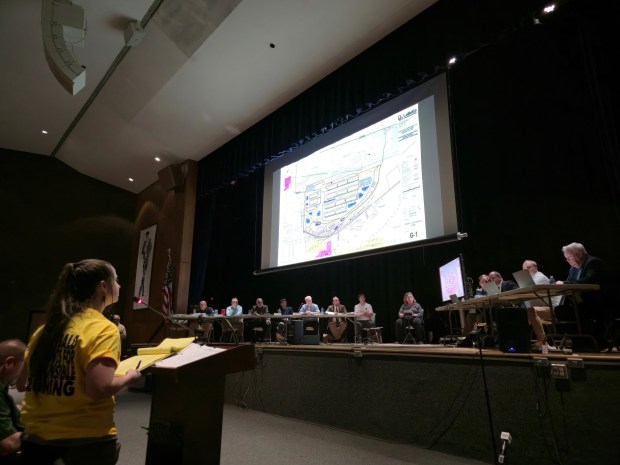 Archbald resident Tamara Misewicz-Healey cross-examines representatives from the Wildcat Ridge Data Center Campus during a public hearing at the Valley View High School in Archbald on Tuesday, March 10, 2026. (FRANK WILKES LESNEFSKY / STAFF PHOTO)
Misewicz-Healey heard about the booklets on Facebook, and when she checked her mailbox Wednesday morning, she rolled her eyes and laughed.
“I look at it, and all I see is propaganda,” the mother of three young children said in a phone interview. “Every day it’s something, and to see this coming in the mail is just like, ‘Here’s the next punch.’”
Characterizing residents’ concerns as myths felt degrading, she said.
“It felt like it was mocking us and mocking the community, mocking the community concerns, and just like kind of disrespect toward the community that they want to be a part of,” Misewicz-Healey said.
When she checked the website, she felt appalled seeing the “Questions Worth Asking” section, calling it a personal attack.
“A personal attack on a vulnerable community already fighting with everything they have for their future, and then a personal attack at me, of course, as somebody who has been leading this community movement,” she said. “I feel like they’re pushing people to question my integrity.”
Misewicz-Healey said she has not received any financial support “by interests outside the area” — or from any organization, nonprofit or business, though an Eynon resident sent her husband a $100 check written from the resident’s landscaping company. Their organization has spoken to outside groups like the national environmental nonprofit Sierra Club asking for advice, but they received no funding, she said.
Residents have helped make signs and T-shirts, whether it’s making it themselves or finding the cheapest places to produce them, she said. Members also donate their own money to pay for things like a billboard in Eynon, she said.
“To just tell people to question our integrity, when they’re not being transparent and they’re not answering our questions … it’s just really exhausting and disheartening,” Misewicz-Healey said.
Stop Archbald Data Centers provided The Times-Tribune with a funding breakdown of all T-shirts and signs, producing the shirts at about $8.53 and selling them for $10 each. If they sell all 220 shirts, they will have a $323 profit that will go to the legal fund, according to the breakdown by group member and resident Megan Farrell. The signs cost $5.30 each to produce with sales tax, and they sell each sign for $5, distributing about 700 of the 1,100 ordered.
Addressing the contention of a minority drowning out the real feelings of residents, Misewicz-Healey said she hopes for a large turnout at Monday’s public hearing at 5 p.m. at the Valley View High School auditorium.
“I hope that people show up, that this is the largest crowd that we have gotten yet at a conditional use hearing,” she said. “This thing is growing, and it’s one of the biggest community opposition groups that I have ever seen in Northeast PA.”