
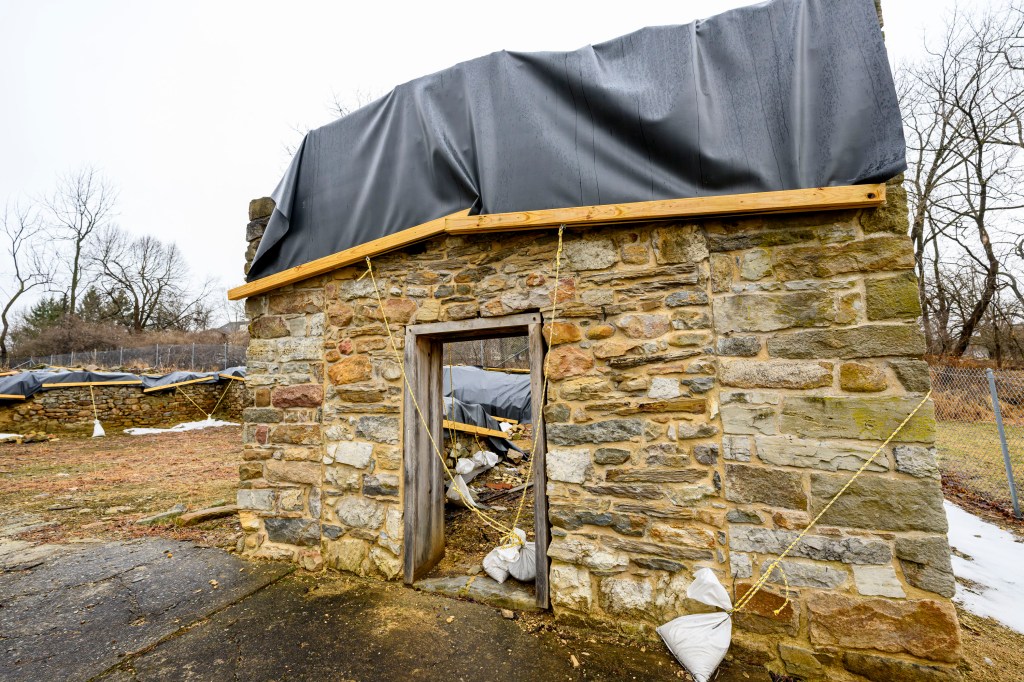
The roof is gone. The timber frame is gone. A couple of walls are gone, too.
And yet, Historic Barn and Farm Foundation President Priscilla deLeon said, the Heller Barn, which has sat on a Lower Saucon Township property along the Saucon Creek since the 1790s, “still speaks.”
“Every barn tells a story,” said deLeon, who is also a Township Council member.
The story of the Heller Barn, to deLeon, is one of “what not to do to a barn.” Earlier investment in preservation, she said, could have saved the barn from ruin before it passed a point of no return after heavy rain in 1998.
The barn’s story is one of 10 across the commonwealth that will be featured in the Historic Barn and Farm Foundation’s upcoming documentary, “PA Barn 250.” Created in part to honor the nation’s 250th birthday and in part to highlight its oldest — and often most overlooked — barns, it includes several structures more than 250 years old.
“I love barns and I love this project,” deLeon said. “To me, they’re magnificent castles in the field. They’re the heart of the family. When families immigrated over here on bare land, they had to build something.”
“How do you explain that to the next generation if it’s not there anymore?” she asked.
The documentary, which is expected to be available at no cost on YouTube at the end of the summer, will be split into episodes, each focused on a different aspect of barns, including the settlers who built them, building style, decoration and preservation. Interviews with local historians, experts and present-day residents will make up much of the series.
The project’s creators said they hope the final product will give viewers an appreciation of, or at least an acquaintance with, the barns around them.
“Hopefully, when you drive down the road or on the turnpike, and you see a barn in the distance or whooshing by, you’ll know a little bit more about it,” said Curtis Vreeland, the primary organizer of the documentary and a member of the Historic Barn and Farm Foundation’s board.
Made in collaboration with several student interns from Franklin & Marshall College, the project’s creators also hope the documentary might generate some barn-related enthusiasm in a younger crowd.
“It’s all kind of bottled up in people who are 70 years old,” Vreeland said.
Eli Gregoris, a Franklin & Marshall senior who worked as the documentary’s interviewer and script writer while interning with the foundation, said the project combined his passions for storytelling and history.
“If we want to know where we’re going, we have to learn what’s influencing us,” Gregoris said. “What’s the knowledge you want to pass on?”
The senior said he didn’t have much barn-related knowledge when he joined the team, though Vreeland called this one of his biggest strengths.
“They’re asking questions which are very astute, and ones which I wouldn’t have thought of,” Vreeland said of the interns. “That viewpoint from a beginner is going to make the documentary more approachable to laypeople.”
“The people who love history and love agriculture, they were going to watch it anyway,” Gregoris said. “We want other people involved.”
The 10 barns are from five counties. There’s not much left of some, like the Heller Barn, while others still boast livestock residents and an intact roof.
In some ways, Vreeland said, barns can function as a “canary in a coal mine.”
“If you see a barn well maintained, then you know that the local agricultural community is somewhat … prosperous,” he said. “You see one falling down, that land may have been sold to a corporation who’s getting ready to put in a warehouse.”
Vreeland has a barn dating to the Civil War on his property. His day job planning the recovery of disaster-struck communities at the Federal Emergency Management Agency doesn’t leave much time for farming, though the barn still sees use. Vintage automobiles are stores on its upper floor, which was made to bear heavy loads.
When the idea for the documentary struck him, Vreeland only planned to include barns that predated the Revolutionary War, but he said the team quickly felt it was excluding other interesting barns.
“You can’t just stop at the Revolutionary War,” deLeon said. “The country didn’t stop at the Revolutionary War. We went through all the other wars to become who we are today.”
The team is slated to complete filming for the documentary in mid-April; editing comes next, and with hundreds of hours of footage, Vreeland said the team will stay busy through release.
Elisabeth Seidel is a freelance writer.
HIGHLIGHTED BARNS
Bartram’s Garden Barn — Philadelphia
Beiler Barn — Martic, Lancaster County
Heckler Barn — Lower Salford, Montgomery County
Heller Barn — Lower Saucon, Northampton County
Hoffman Barn — Nockamixon, Bucks County
Isaac Long Barn — Lancaster, Lancaster County
Kepler Barn — Ferguson, Centre County
Landis Valley Log Barn — Lancaster, Lancaster County
Pennypacker Mills Barn — Perkiomen, Montgomery County
Stenton Manor Barn — Philadelphia