
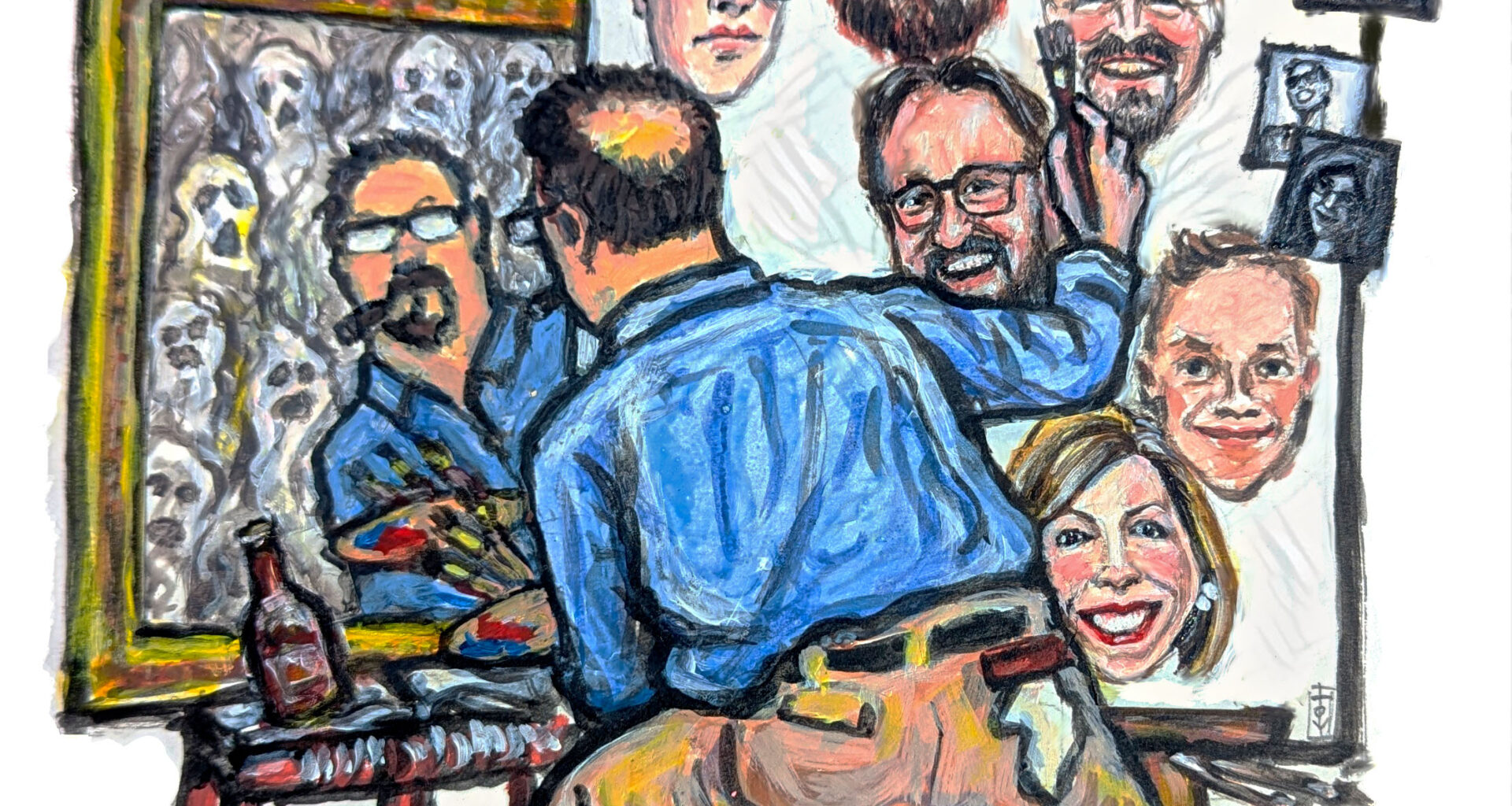

Bryan Toy
In this custom illustration created by Bryan Toy, the Erie Reader’s very first comic contributor, he recalls the ghosts of Erie Readers Past while Ben Speggen, the Erie Reader’s very first managing editor, catches up with a few of them (specifically Cory Vaillancourt, Alex Bieler, Jay Stevens, Jaimen Gallo, and Rebecca Styn).
*Scroll below this article, which appeared in the April 2026 issue, for an extended Q&A
On Monday, March 28, 2011, a launch party in Downtown Erie welcomed people in to get a sneak peek at something brand new: The Erie Reader. The first issue of the new independent paper was being passed around – an alternative publication, featuring blues legend Buddy Guy on the cover, who would soon be in town to perform at a packed Mary D’Angelo Performing Arts Center auditorium on the campus of Mercyhurst University a few days later. That issue would hit stands throughout the region that coming Wednesday.
What would come next? Would people pick up a new, free newspaper when they stopped by a café to grab their morning coffee? Or when they popped into a gas station for a bag of chips? Or when they hit a bar or restaurant for a beer and bite after work? The spirits in the air that night – perhaps lifted by the spirits in clinking glasses – seemed to suggest yes, but truthfully, while we’d hoped for yes, we didn’t know. Those imbibing and cheering were right: 15 years later, there’s still an issue of the Erie Reader in your hands and on your screens.
The Reader has, of course, changed and evolved along the way – from website updates, to introducing full-bleed covers, to adding pages, to adjusting publication. That it remains – and has evolved to meet the challenges and opportunities along its journey – is thanks to many.
The list starts at the top with Adam Welsh and Brian Graham, who dreamed up the vision and the plan and remained at the helm, continuing to push it forward. It’s thanks, too, to Jaimen Gallo, who developed the very first Reader website, the first print cover in March 2011, and those that followed in the Reader’s infancy – and plenty more.
“The good surprise was how much we were able to pull off with a small crew and an even smaller budget,” Jaimen told me. “Looking back, it’s wild what we managed to do on 13-inch MacBooks, working random hours in whatever spots we could find. The not-so-good surprise was realizing I wasn’t sleeping enough, knowing it, and still pushing through to the launch party.”
Jaimen, who has since departed the Reader but remains in Erie, working as an instructional developer at Penn State Behrend, told me, looking back, he’s got “a lot of proud moments – from the lead-up to launch. But the biggest thing, for me, is just being a part of it from the start. We were figuring things out as we went, learning on the fly, and still managed to bring it all together.”
The list continues with Reader readers, advertisers, and supporters – whether they’ve been there since the first Issue, or are picking up, getting in, or being featured in an issue today.
And, of course, the writers.
Erie has the good fortune of being a place full of stories to tell, news to report, and events, films, music, and food to promote and review. It also has had the good fortune of having storytellers eager to be a part of the Erie Reader to tell those stories.
As the Reader’s first managing editor, I had the benefit of working with the early-days contributors and adding to the stable. Celebrating the 15th anniversary occasion, my editor, Erin Phillips, who’s helped continue the Reader’s growth and is presently guiding it into the future, asked if I’d catch up with some of the “Ghosts of Erie Reader Past.”
This brings us to the snapshot update on several of those folks with accompanying artwork done by longtime Reader cartoonist Bryan Toy that put a heavy lump in my throat for all the best reasons.
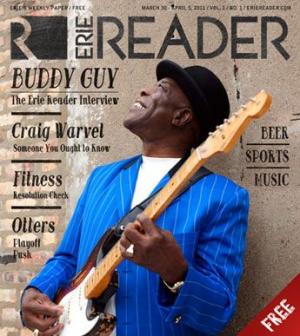 The first issue of the Erie Reader was published in March of 2011, 15 years ago, featuring Buddy Guy, who was coming to Erie to perform at Mercyhurst, on the cover.
There are, of course, never enough column inches to feature all the folks I wanted to catch up with. Nor is there enough space to relay all that was shared with me. If you’re reading this in print, I hope you’ll head to ErieReader.com for an expanded, tell-more version. Perhaps, too, you’ll (re)connect with their work that remains available online. Writing, and being published, I believe, is a lot like the often-quoted line from “Hotel California:” “You can check out any time you like, but you can never leave…”
Among the earliest contributors were Jay Stevens, Rebecca Styn, and Cory Vaillancourt. Not long after, Alex Bieler joined the crew. They all routinely churned out copy, had recurring series, and served as editors inside the once-plucky newsroom that indelibly helped raise up the Reader to where it is today.
Where are they today? What do they remember from their days at the Reader?
Like Jaimen, Rebecca Styn has remained in Erie. She “retired” from the Reader in 2015, but returned in 2018 – around the same time she opened Room 33 Speakeasy bar and restaurant. She’s since launched Blind Tiger Spirit-Free Cocktails and sold the restaurant.
“I wrote a few more columns during that time but ‘officially retired’ with my final piece on Oct. 6, 2021 – an interview with bestselling author Sandra Brown, whose novel Blind Tiger had just been released. It felt like a fitting note to go out on,” she told me.
Alex Bieler headed west from Erie to Cleveland to be closer to his then-girlfriend. “Given that we’ve been married for eight years, I’d say that it was a good call,” he told me. They have a “rather energetic” toddler, Noah, and a pair of kittens, Rose and Zoey. “I word good so our clients do good,” Alex jokingly explained of his work now as the senior content marketing manager at Aztek Web, a digital marketing and web development agency.
Jay Stevens moved further west to Minneapolis, where he got a job at Medtronic working as a technical writer and dipped his foot back into politics but put the focus of his energies on his kids, coaching baseball, and robotics.
Cory Vaillancourt headed south to Waynesville, North Carolina, taking a job at The Smoky Mountain News, a free weekly with a hard-news focus that covers four mountainous, rugged counties immediately west of Asheville. But before departing Erie, he “checked out” of the Reader in late 2014 to write a biography of longtime former Erie Mayor Lou Tullio for the Jefferson Educational Society. “But apparently I could never leave,” he told me. “Shortly into the project, my Erie Reader editor became my book editor.” (Contributor’s note: That was me…)
Jay came to the Reader with a lot of writing experience, “mostly as a political blogger around the 2006 and 2008 elections,” he reminded me, which then reminded me how much the then-26-year-old me was intimidated by him. “I had also written a bunch of elections-related magazine pieces for The American Prospect and The Guardian, done book reviews for newspapers, etc.” His kids and Adam’s kids were going to school together, and word spread fast of a new newspaper about to launch. Jay wanted in.
Cory remembers “having a cocktail with Rebecca in probably January 2011” during which she told him of Adam and Brian’s plan to launch the Reader. “It’s all Styn’s fault, really,” he credited her.
Alex, like me, has Frank Garland, the then-head of Gannon University’s journalism program, to credit. Soon after reaching out to me, as Alex recalls it, “We happened to cross paths at Gannon’s Schuster Theatre – and by crossed paths, I heard you were in the building and chased you down in the alley to reiterate my interest. Whether it was my passionate monologue or the fact that a hirsute, 6’5″ individual just cornered you in an alley – that encounter led to a coffee shop conversation and eventually a gig with the Reader.” Hirsute myself but barely 5’11,” who am I to argue…
What might surprise Reader readers to learn about these folks today?
Alex saves his wordsmithing for Aztek these days, but did write for, and later serve as the editor of Cleveland’s PressureLife, a casualty of the pandemic, and wrote for the Our Towns Civic Foundation (where our paths crossed again). “I wouldn’t count something out in the future if the right opportunity comes around for some work on the side,” he told me.
Jay got back into table-top role-playing games during the onset of the COVID-19 pandemic, has a “real-play” podcast, where he and some gamer friends “play Pathfinder 2e in a homebrew campaign about urban heroes who battle against corruption and more. The show’s called The Minus 20 podcast. Because it’s cold here.”
“I chose to start a non-alcoholic line of cocktails during COVID – in a brand-new market segment, with no background in consumer packaged goods,” Rebecca shared. “I now wake up every day responsible for whether something works or doesn’t. Entrepreneurship is a lot less romantic than it sounds. And a lot more addicting.”
One might say Cory was known as “a man about town” at the height of his Reader tenure. “I don’t get around much anymore. I’m no longer in with the ‘in crowd,'” he told me. “Most nights during my time in Erie, I could be found catching a late show at the Crooked i, or closing the Oasis, or Scotty’s, or Greengarden, or eating a meatball omelet at Dominick’s at some vulgar hour.”
What made them know that they wanted in at the Reader, beyond a piece here or there?
Alex reminded me of his first cover feature on the film There Are No Goodbyes. Many more followed, including the cover story on MoreFrames Animation, which, is, if forced to pick, the one “he might be most proud of,” because “it was just an absolute blast to interview that group and turn that whole experience into a story showcasing the outstanding work they did – and still continue to do.”
Jay reminded me of the first piece of his that really wowed me: his version of method acting in which he profiled the late Rich Hodges, the then-chef of Avanti’s, by washing dishes during a shift, and then sitting down after to interview him. The two drank whiskey while they talked, but the writing couldn’t have been clearer. “It opened the door for me at the Reader,” Jay told me. “After that piece, you let me write about anything I wanted.”
We did. Jay penned cover features on smoking bans and the Crooked I, Occupy Wall Street in Erie, the Roller Derby, the Sandusky scandal and Erie’s involvement, the school budget cuts of 2012, the GAF property, raw milk, geocaching, the 2012 JES Global Summit, fracking, the SeaWolves, and the anniversary of the Battle of Lake Erie.
“I learned so much about the City of Erie, and the people that inhabit it by doing these stories,” Jay told me. “Being a journalist is an honor – to bring to light important issues and critical people who make the community tick; it’s really an awesome task, and you guys just let me go at it – writing for the Reader opened up Erie for me. It’s amazing the places they’ll let you into if you tell them you’re working on a piece from the Reader.”
Cory holds the record for lengthiest cover feature – one we spent months developing: “The Weight of War,” published in September 2012. “It ended up being like 8,000 words — by far the longest story I’d written. I think it still might be,” Cory recalled. “It was about an Erie native who acquired PTSD in the Navy, returned home and self-medicated with alcohol until he could no longer hold off his demons. I’m quite proud that I could shed some light on the alarming and evolving trend of suicide among veterans – something that I, and I think most people, didn’t know about or didn’t want to know about at that time. Still don’t, maybe. I walked away with a solid base of knowledge on the issue, knowledge that still serves me to this day in my continued reporting on psychedelic therapies for PTSD. In another sense, the way I approached that difficult, emotional story became sort of a structural blueprint for the same kind of long, sad feature stories I’m still writing 14 years later.”
Rebecca will always have the bragging rights for penning the Reader’s first cover feature: an interview with the aforementioned blues legend Buddy Guy. “I interviewed him by phone before the event, and had the extraordinary opportunity to spend a few minutes with him backstage before his show,” she recalled. “If memory serves, I even imbibed in a little cognac with him.”
Writing, no doubt, has perks.
“I always wanted to be more than an occasional contributor, and I think I was in damn near every one of the first hundred issues,” Cory reminded me. “Most issues I just did my recurring ‘Upfront’ column, which was tons of fun to write. I always got great feedback from Reader readers – when I wasn’t getting death threats.”
Writing also comes with occupational hazards.
If they could use only six words to tell their story of their Reader experience, what would they be?
Alex: Long nights. Good times. Stories told.
Jay: I can’t work with that word limit.
Rebecca: I would steal the wise words of Jimmy V, Never give up. Never ever give up. (Related: I can’t count).
Cory: Good friends doing good work for good people and breaking lots of stupid, stupid rules all along the way.
Five years from now, when the Reader turns 20, I’m looking forward to seeing what another group is up to – because, I have no doubt: The Reader will still be around.
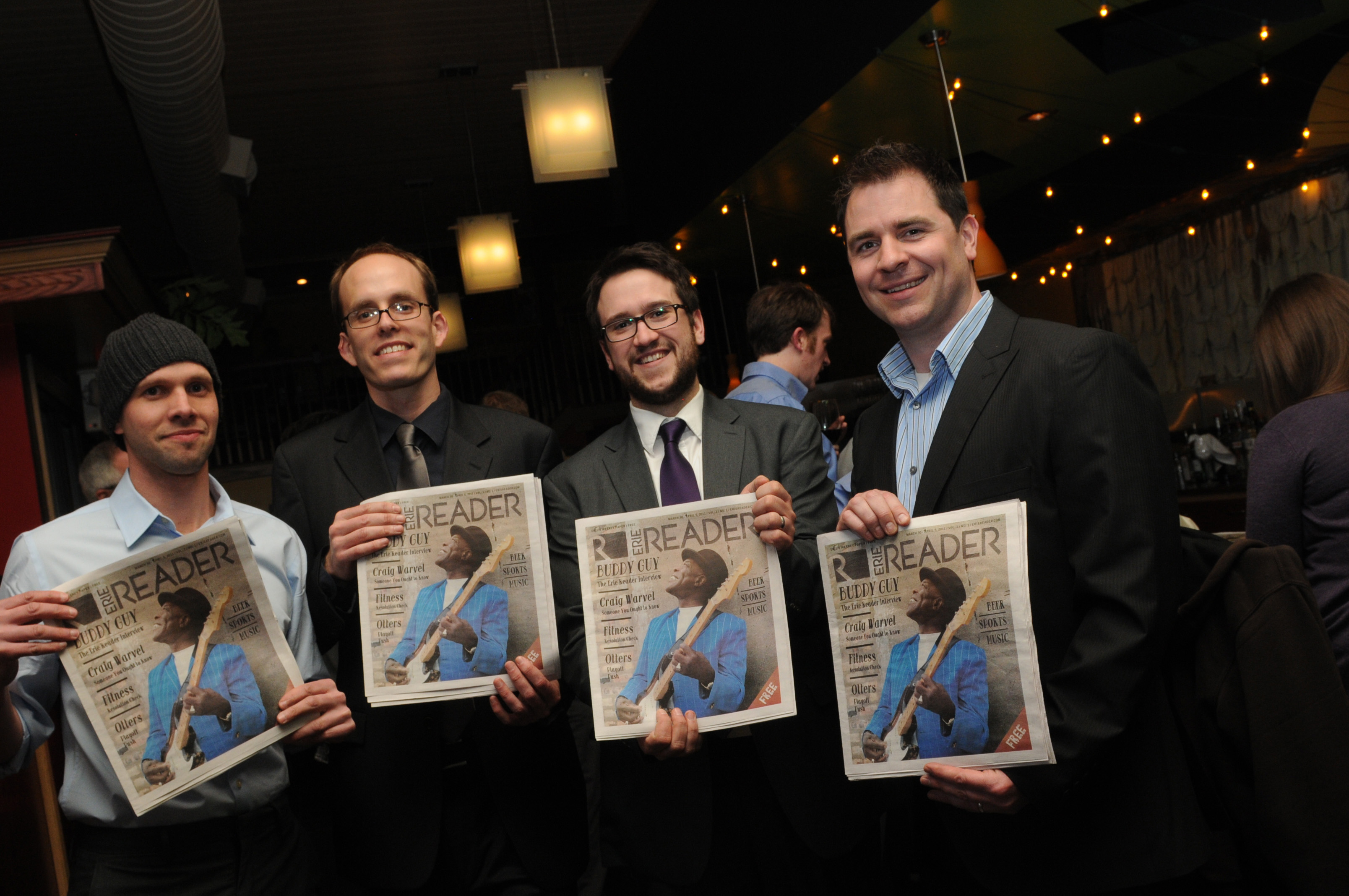
It has been 15 years since this photograph was taken at the launch party for the Erie Reader’s first issue, which took place on Monday, March 28, 2011. From left to right: Jaimen Gallo, Publisher Brian Graham, Managing Editor Ben Speggen, and Publisher Adam Welsh.
FULL INTERVIEW VERSION
For the issue marking and celebrating the Erie Reader’s 15th year of publishing, my editor, Erin Phillips, who’s helped continue the independent, alternative publication’s growth and is presently guiding it into the future, asked if I’d catch up with some “Ghosts of Erie Reader Past.”
As I wrote in that piece, which you can read in print issues out now and check out online here: There are, of course, never enough column inches to feature all the folks I wanted to catch up. Nor is there enough space to relay all that I did feature shared with me. If you’re reading this in print, I hope you’ll head to ErieReader.com for an expanded, tell-more version. This is that expanded version – because, for better, or for worse, the internet hasn’t run out of space.
In case you didn’t read the shorter version, or don’t click on the link, it’s worth noting that this companion piece features Jay Stevens, Rebecca Styn, and Cory Vaillancourt, who were among the earliest contributors. Not long after, Alex Bieler joined the crew.
They all routinely churned out copy, had recurring series, and served as editors inside the once-plucky newsroom that indelibly helped raise up the Reader to where it is today, and were among the many contributors I had the good fortune of working with and learning from as the Reader’s first managing editor.
Following Bieler, Stevens, Styn, and Vaillancourt’s responses are those of Jaimen Gallo, who I also featured in the print-version of this catch-up story. Jaimen, in addition to Adam and Brian and me, was part of the original four, who were huddling up in coffeeshops, our houses, bars, anywhere with a reliable internet connection, getting the Reader started and then rolling thanks to the help and support and readership of many, many others.
Gallo, like Bieler, Styn, Stevens, and Vaillancourt, departed the Reader, but remained in Erie, working as an instructional development at Penn State Behrend. He developed the very first Reader website, the first print cover in March 2011, and those that followed in the Reader’s infancy – and plenty more.
I ended the print piece with the line: In five years from now, when the Reader turns 20, I’m looking forward to seeing what another group is up to – because, I have no doubt: The Reader will still be around.
For now, here is what these five are up to now, what they remember, advice they have to give, and a look at how (some) still bend the editorial direction.
Where did the road take you after the Reader, and where you are now?
Alex Bieler (AB): I am back home in Cleveland. I spent a good seven years in Erie, but made the move back to my home city to be closer to my girlfriend and family. Given that we’ve been married for eight years, I’d say that it was a good call.
Shortly after I moved back to Cleveland, I got a job at Aztek Web, a digital marketing and web development agency, and I’m still there. I’m currently the senior content marketing manager and craft compelling content so that our clients can use both longform and shortform content to achieve their marketing goals. In short, I word good so our clients do good.
I also had the good fortune of joining another alternative publication after I left the Reader. I served as a writer and eventually as the managing editor for *PressureLife, a publication that was beyond gorgeous and put a spotlight on the movers, shakers, and “what the fucks” of Cleveland. I had the pleasure of working with a talented, albeit raw, group of writers and thinkers, and it’s a damn shame that the pandemic put an end to that journey. I also had a short stint writing and editing for the Our Towns Civic Foundation, where I happened to work with a former Reader colleague (but I can’t recall their name). (Contributor’s note: It was me…)
Outside of work, I’m now a dad. We’ve got a rather energetic toddler named Noah, and it’s an absolute joy spending every day with him and my wife, Carly. Noah also has a pair of kitty sisters in Rose and Zoey, and the five of us are chugging along in Cleveland.
Jay Stevens (JS): After moving to Minneapolis, Minnesota, I got a job at Medtronic working as a technical writer, but the focus of my energies after I left Erie was on my kids. I coached baseball and robotics. I also dipped my foot into politics again, became a precinct chair for the state Democratic-Farmer-Labor Party and ran a caucus. I’m working on campaigns this summer. I want to do some writing work around this activism, but the fun creative side of me is wrapped up in this podcast.
Rebecca Styn (RS): I originally “retired” from the Reader in 2015, stepping away to run for local office (again), lost (unfortunately, or fortunately), and found my way back in 2018 – around the same time I opened Room 33 Speakeasy and started leaning even more into entrepreneurship. In March 2020 during COVID, I was forced to make a decision about Room 33 – and that “pivot” became the thing that now consumes nearly every aspect of my life: Blind Tiger Spirit-Free Cocktails. I wrote a few more columns during that time, but officially retired with my final piece on Oct. 6, 2021 – an interview with bestselling author Sandra Brown, whose novel *Blind Tiger had just been released. It felt like a fitting note to go out on.
In 2022, I sold Room 33 to our team and stepped fully into what has been an incredibly chaotic, often humbling, and consistently relentless path: building Blind Tiger. What started as a forced pivot – when we were takeout-only, 90 percent of our revenue came from the bar, and we couldn’t legally sell alcohol to go – has long since outgrown the word “pivot.”
It’s become the thing. The one that quietly (and not so quietly – especially to my husband) consumes every waking moment – and, if we’re being honest, a fair share of the non-waking ones too. I like to think I’m currently in year five of a 10-year overnight success.
Cory Vaillancourt (CV): I checked out in late 2014 to write a biography of longtime former Erie Mayor Lou Tullio for the Jefferson Educational Society, but apparently, I could never leave – shortly into the project, my Erie Reader editor became my book editor (contributor’s note: It was me…).
Months after the book’s November 2015 release, I took a job as politics editor at The Smoky Mountain News, in Waynesville, North Carolina. SMN is a free weekly with a hard-news focus that covers four mountainous, rugged counties immediately west of Asheville, not far from the Great Smoky Mountains National Park. Our coverage also includes the tribal government of the Eastern Band of Cherokee Indians in their ancestral homeland, known as the Qualla Boundary. Over the 10 years I’ve been in North Carolina, I’ve had a number of what some might call adventures.
I’ve covered the last three presidential inaugurations from Washington and the front lines of the Ukraine war from Kherson. I’ve weathered a deadly tropical storm and a devastating hurricane three years apart. In the mountains. More than 3,000 feet above sea level.
I snuck into an employee meeting to report the announcement of a century-old paper mill’s closing, with the loss of roughly a thousand jobs, and also snuck into a makeshift Hurricane Helene “relief camp” where all manner of scams and crimes were alleged.
I published the identity of a sovereign citizen who threatened elected officials with “bounties” one day before the FBI arrested her.
I did the “undercover homeless” thing for three days, sleeping in shelters and boxcars, eating at soup kitchens.
I’ve also spent untold thousands of hours in local government meetings, which isn’t adventurous at all, but this type of immersive, expansive newsgathering has made me the most heavily awarded public affairs reporter in the North Carolina Press Association over the past decade.
I have written for the Washington Post, appeared nationally on NPR, Discovery, and CNN as well as internationally on PRX – all dreams come true for a guy like me, doing what I love to do.
What’s something new, or different, about you now that Reader readers from years ago would be surprised to learn?
AB: The biggest difference would probably be that I’m currently not active in the journalism scene. After writing and editing for PressureLife and Our Towns, I’ve largely stuck with digital marketing through Aztek and a few freelance projects. Although I wouldn’t count something out in the future if the right opportunity comes around for some work on the side.
JS: In Minneapolis during COVID, I got back into TTRPGs – table-top role-playing games, like D&D. So, I now have a “real-play” podcast, where me and some gamer friends play Pathfinder 2e in a homebrew campaign about urban heroes who battle against corruption…and more. The show’s called *The Minus 20 podcast. Because it’s cold here.
RS: I think Reader readers from years ago might be surprised to learn that I’m still alive… which, now that I say it out loud, feels like a terrible joke – but also not entirely inaccurate given a few chapters in between. More realistically though, they’d probably be surprised to learn that Vaillancourt is still alive. Still a joke. But maybe one with a little more statistical backing.
I would think Reader readers would be surprised that I chose to start a non-alcoholic line of cocktails during Covid – in a brand-new market segment, with no background in consumer packaged goods. Instead of meeting and interviewing interesting people, or sharing interesting stories, I now wake up every day responsible for whether something works or doesn’t. And there’s no editor, no boss, only self-imposed deadlines, and no one telling me if I’m getting it right – and to compound that, oftentimes, no paycheck.
Entrepreneurship is a lot less romantic than it sounds. And a lot more addicting.
CV: I don’t get around much anymore. I’m no longer in with the “in crowd.” Most nights during my time in Erie, I could be found catching a late show at the Crooked i, or closing the Oasis, or Scotty’s, or Greengarden, or eating a meatball omelet at Dominick’s at some vulgar hour.
What drove you to want to be involved in the Reader, and how do you remember it happening?
AB: I knew pretty early on in college that I wanted to write. I started off as an engineering student at Gannon and decided during my freshman year that I hated the idea of money and switched to journalism. While my 401(k) may not be happy about that decision, it was the right call for me.
As for the Reader itself, I was fresh out of college and looking for the next opportunity. I had learned about the Reader through Frank Garland, my advisor at Gannon, and reached out to you (Ben Speggen) about my interest. Soon after, we happened to cross paths at Gannon’s Schuster Theatre – and by crossed paths, I heard you were in the building and chased you down in the alley beside Schuster Theatre to reiterate my interest. Whether it was my passionate monologue or the fact that a hirsute, 6’5″ individual just cornered you in an alley, that encounter led to a coffee shop conversation and eventually a gig with the Reader.
JS: So, I came to the Reader with a lot of writing experience, mostly as a political blogger around the 2006 and 2008 elections. I had also written a bunch of elections-related magazine pieces for *the American Prospect and *the Guardian, done book reviews for newspapers, etc. When I heard that Adam – whose daughter was in the same class as my kids – was starting a newspaper, I was definitely looking for a writing gig – as one always is in this business – and I thought I’d see if he needed writers. He did.
RS: I don’t remember exactly how it started, which feels like either a red flag or a very accurate representation of most things I’ve done over my lifetime. I’d like to say I had a good reason (alcohol, drugs) but sadly, I don’t. What I remember is the launch at what was 1201 Kitchen at the time, and being excited to be a part of bringing an independent voice to our community.
CV: I remember having a cocktail with Rebecca Styn in, probably, January 2011. Styn told me about these two guys who were starting an alt weekly and suggested I meet with them. So, one day I met with Adam and Brian at the Starbucks there on Fourth Street, and we talked about my experience as a campaign consultant and that was pretty much that. It’s all Styn’s fault, really.
When, or what piece, made it click that you wanted to be more than an occasional contributor?
AB: I was pretty sure that I wanted to do more than just the occasional piece from the start. I knew writing was what I loved to do and the Reader was an exciting opportunity to turn a passion into a real career. However, that desire turned into a serious reality around the time I got a chance to write my first cover story on *There Are No Goodbyes. I had largely done event previews and shorter profiles before then, so that opportunity was an exciting step into a more regular role with the Reader.
JS: I never had a doubt I wanted to be more than an occasional contributor. At first, I felt like I had to prove to you guys that I was worth carrying in print. The first piece I remember knocking out and impressing the gang with was my profile of Rich Hodges, the chef of Avanti’s. It was my written version of method acting – I washed dishes in the kitchen, then sat down to a meal after my shift and drank whiskey with Hodges while interviewing him. It was a good piece! You loved it! It opened the door for me at the Reader; after that piece, you let me write about anything I wanted.
RS: Hell, somehow, I got the cover story interviewing blues legend Buddy Guy for the Reader’s inaugural issue. Could that even be topped? The full piece is no longer online, but I saved all the copies of issues I was published in (because I’m egomaniacal?). I only regret not getting that issue signed and framed. Although I didn’t interview him in person – it was by phone – I did get the extraordinary opportunity to spend a few minutes with him backstage before his show. And, if memory serves me correctly, I even imbibed in a little cognac with him. I’d like to believe it was Rémy Martin – though I suspect my editors might remember it being something slightly less refined.
CV: It didn’t happen for me like that – I always wanted to be more than an occasional contributor, and I think I was in damn near every one of the first hundred issues. Most issues I just did my recurring “Upfront” column, which was tons of fun to write. I always got great feedback from Reader readers – when I wasn’t getting death threats.
Sometimes, I’d write other stories too, but people seemed to really like that column, so I kept writing it.
From the editing process, what helped you improve your craft?
AB: Learning that editing is more of a conversation than just tracking changes in a Microsoft Word document. It can be easy for young writers to think of editing as just catching typos, fixing style issues, and the minutiae of the ren pen. Instead, I discovered that the greatest lessons came through a discussion of why you took a certain approach, or the reasons why an editor recommended a change. Those discussions helped me learn a lot more about the process of writing and logic behind my choices.
JS: OK, clearly a humble brag, but you never touched any of my pieces. I don’t think I ever got a substantive edit from you or a request to rewrite or rework any part of my work.
RS: There was this literary genius we worked for. You might remember him – Ben Speggen was his name. And he essentially held our feet to the fire. You didn’t edit our work – you made us improve it. You sent back your thoughts, suggestions, and required us to fix, rewrite, rework, etc. It was exhausting (laughs). But, in hindsight, it’s also why I eventually became one of the editors – and got to inflict that same experience on others.
CV: I don’t think I ever published anything that hadn’t gone through at least three or four rounds of edits. Sometimes, my first draft of a 2,000-word story would come back with, like, 50 comments on it. I would work through some of them and protest others and then send it back, and we would repeat the process until they were all resolved. But I paid attention. Essentially, I had a one-on-one working relationship with a masters-level writing instructor, for free, for about four years. I learned what shit would and wouldn’t fly. I learned to kill my darlings.
Not only did you drill those AP Stylebook considerations into my brain, but you also helped me understand the underlying implications of structure and asked deeper questions about my work – ‘what are you trying to accomplish here, exactly?’ I’ve since told you, who I now call ‘sensei,’ that everything I’ve gone on to do since leaving Erie is grounded in what I learned from you during that time. I’ve learned from others and grown in other ways, but it was a tremendous luxury for me to benefit from your experience and insight.
What Erie Reader story are you most proud of, and why?
AB: I loved doing stories that showcased some of the truly tremendous people who lived and worked in Erie. If I was forced to pick one, it’d probably be the cover story on MoreFrames Animation because it was just an absolute blast to interview that group and turn that whole experience into a story showcasing the outstanding work they did (and still continue to do).
I also have a soft spot for a few different Q&As and profiles stories like a Bobcat Goldthwait Q&A – He was so laid back and gave me maybe my favorite quote I ever got to print (“for the money they’re paying me, I will f— a Snickers bar on camera.”) You Ought To Know: Gerry Urbaniak – I loved talking food with him so much that I made it a point to go to his Eighth Street Deli whenever I was back in town until it closed (which is still a damn shame). The 2012 Parade of Horribles – it was an absolute pleasure to embrace both Cory’s set of rules and the madness required to draft this piece.
JS: Dang. Good question. Here’s what I’;ll say: Not any one piece, but the cover stories you trusted me with. I’m just going through the archives now – smoking bans, and the Crooked i, Occupy Wall Street in Erie, the Roller Derby, the Sandusky scandal and Erie’s involvement, the school budget cuts of 2012, the GAF property, raw milk, geocaching, the 2012 JES summit, fracking, the SeaWolves, the anniversary of the Battle of Lake Erie… man. I am so thankful I got to write for the Reader and pursue these pieces. I learned so much about the city of Erie, and the people that inhabit it by doing these stories. Being a journalist is an honor, to bring to light important issues and critical people who make the community tick. lt’s really an awesome task, and you guys just let me go at it.
I think I did all right – although in each and every piece I see gaps where I could have asked better questions or added another interview, or holes where my understanding didn’t reach. For all those words I wrote, too, I still feel like I didn’t quite get it – if that makes sense.
Also looking at the archives, you let me write a lot. I wrote a lot. The blog, the column. The profiles. Insane. And writing for the Reader opened up Erie for me. It’s amazing the places they’ll let you into if you tell them you’re working on a piece from the Reader
I think the two pieces outside of the cover piece were my farewell column: A Fond Farewell, and Batting Lessons, about the death of my father.
RS: I don’t know that I have one single story. I learned something from almost everything I wrote – with the exception of a brief and ill-advised self-inflicted stint writing a social column, which I did not love.
The pieces I’m most proud of were the ones that actually mattered – covering societal issues, political tensions, economic development challenges – stories that extended beyond my own perspective and, hopefully, made me a better writer in the process.
But I also have a deep appreciation for comedy, so interviewing Jim Gaffigan – and then meeting him after his show, where I somehow ended up with his phone number in a way that was completely accidental on his end but felt slightly stalker-adjacent on mine – is definitely up there.
CV: “The Weight of War,” published in September 2012, ended up being like 8,000 words – by far the longest story I’d written. I think it still might be. It was about an Erie native who acquired PTSD in the Navy, returned home and self-medicated with alcohol until he could no longer hold off his demons. Red flags were everywhere. He had no help. You know how it turned out for him. I’m quite proud that I could shed some light on the alarming and evolving trend of suicide among veterans – something that I, and I think most people, didn’t know about or didn’t want to know about at that time. Still don’t, maybe. I walked away with a solid base of knowledge on the issue, knowledge that still serves me to this day in my continued reporting on psychedelic therapies for PTSD. In another sense, the way I approached that difficult, emotional story became sort of a structural blueprint for the same kind of long sad feature stories I’m still writing, 14 years later.
If you had the chance to revisit a piece you wrote for the Reader, what would it be, and why?
AB: My Q&A with John Darnielle of The Mountain Goats. Without a doubt. It’s by no means a bad piece, but I think about how much more I could have done with it if I hadn’t been so nervous. John is really the only person I interviewed where I got nervous like that because his music meant so much to me. Hell, two songs by The Mountain Goats were read at my wedding.
I still absolutely adore The Mountain Goats, and I know I’d do a better job nearly 13 years later. I distinctly remember sitting in my truck hoping that nobody would make too much noise in the Epic Web Studios parking lot. I was so focused on not messing up and wanting to find something profound to say. I’d give much less of a shit about that these days, and the Q&A would be much better for it.
JS: The GAF story. ‘d love to do like a “20 years later”; on the waterfront development and its effect on Erie.
RS: Candidly, I don’t think I would revisit a piece. I mean, if it was great, why change it? And if it was garbage, why redo it? I tend to live in a state of forward motion. I don’t spend a lot of time looking back or trying to retrofit perspective onto something that was written in a completely different moment.
There’s something to be said for letting things stand as they were. Writing, like most things, is a reflection of who you are at a given point – not who you wish you had been with a little more time, a little more experience, or a better edit.
CV: I remember getting into a bit of a situation with Michael Bennett, aka Fazed Cookies, because in one of my columns, I’d used a term he’d coined to describe how lame Celebrate Erie always was – “Celibate Erie.” I didn’t know he hadn’t used it in print yet, and he was really disappointed that I had. We talked about it, I was very sorry about it, and he was very gracious – Mike wasn’t exactly known for being gracious.
Some years later, the same night my book launched at the Jefferson, he was commemorating the 10th anniversary of his very excellent radio music show on WERG. To celebrate, he had a cake and wanted someone to interview him about the show, live on-air. He asked me to do it, which I felt was a great honor because he was a highly skilled writer and was very critical of most others.
I’m pretty sure that made me the first and only person to appear at both the Jefferson Educational Society and on Fazed Cookies, until Adam Holquist did it. But I did it on the same night. Take that, Mr. Three-time Jeopardy Winner Trebekbro Guy!
What story challenged/troubled you the most, and why?
AB: The ones where you just don’t connect with the subject of the story are always tricky. I won’t lie and say I was excited about everything I covered. At some point, every young writer will encounter a story that isn’t exciting to them or interview someone who gives you almost nothing to work with.
One time I wrote a preview for a band that thought so highly of themselves that they couldn’t even be bothered to do an interview. I interviewed their publicist instead (who was perfectly fine, in his defense), but I remember how I had to turn a smidgeon of information into a legitimate preview piece for a band that was actively making my job harder. But I did it, and I was better for it in the long run because it taught me a valuable lesson.
JS: The Sandusky piece, about him coming to Erie with his football camp after the Penn State admin banned him from the main campus for sexually abusing a boy in the showers there. I didn’t get enough information about it. I couldn’t. The doors had slammed shut, but I knew it wasn’t complete. I still gnash my teeth over it. It had the potential to be a national story that broke open the scandal, but I couldn’t deliver. I got panic attacks and didn’t sleep for like the last three days before turning it in. Hardest story I wrote.
RS: I had a column called “The Way I See It” (TWISI, for fun). So, it wasn’t one specific story that challenged me; it might have been the nature of the column itself. At times, it was difficult to draw a line in the sand. Don’t get me wrong, I enjoyed having an opinion – at least an educated one – but I’ve always recognized, and still do, that there’s nuance in everything. At the end of the day, no matter how well-researched something was, it was still my opinion. And we all know what opinions are like.
What mattered more was whether it opened the door for someone else to reconsider their perspective – or at least be willing to have a conversation. Even if we didn’t agree, there was value in being able to respectfully differ. These days, that alone feels like a bit of a lost art.
CV: It was one that I never actually got to write. It involved the possible arson murders of two women that might have been a hate crime and very likely had building code/fire code issues. I may just not have been good enough at the time to get my arms around it. I still think about them, and hope someone has been able to succeed where I failed.
What advice would you give your then-self that you think is applicable to today’s Reader writers?
AB: Do the best job you can do no matter the subject. That doesn’t mean everything has to be a prize-winning piece, but it does mean taking whatever miscellaneous ingredients you have and concocting something enjoyable whether it’s a light snack or a personalized, multi-course meal.
In addition to giving each story the same care and attention, doing the best job means embracing that what you write first is often just a starting point. Don’t be afraid to revisit what you write and ask, “why did I do it like this?” I always had a penchant for lengthy sentences and trying to shove as much details as possible. Sometimes it was genuinely good, and other times it was unnecessary. Every sentence should have a purpose. Make every sentence justify its existence, whether that means finding a better way to convey your message or eliminating excess altogether.
JS: Be bolder. Get out of your comfort zone. We never really did a story on racial injustice in the city, for example, and Erie dearly needs a reckoning there. I regret not getting into it.
RS: Never underestimate the power of pretending you belong in rooms you absolutely invited yourself into.
CV: Push harder for accountability from public officials. Never take “no” for an answer in your investigatory process. Tolerate no disrespect. With rampant nefarious federal ineptitude and ongoing persecution of the free press, media need to become more aggressive – not less. This, a friend from the former Yugoslavia once told me, is how your freedom slowly slips through the cracks.
Fond/favorite non-writing member of the Reader back in the day?
AB: I will also be thankful to Adam Welsh and Brian Graham for giving me a chance to really learn a lot under Ben’s tutelage. I have fond memories of the long nights right before we went to print, even if those nights were rather exhausting.
JS: I loved our editorial meetings at Avanti’s breakfast with the gang, including Brian and Adam. It felt like we were really doing something revolutionary.
RS: Did any of us not write? I feel like we all were writing – even when we didn’t.
CV: I was always thrilled to work with Howard ‘The Truth’ Glover and Todd Scalise any chance I got because of the ridiculous amount of talent they both have and just the sense that they always knew exactly what they wanted and needed to do to take something good and make it great. We fed off each other’s creativity, and that made for all-around better content. Howie’s photos and Scalise’s illustrations enhanced my work, and vice versa. I went on to work with both of them on independent projects outside the Reader as well, for that same reason.
If you could use only six words to tell your story of your Reader experience, what would they be?
AB: Long nights. Good times. Stories told.
JS: I can’t work with that word limit.
RS: I would steal the wise words of Jimmy V: Never give up. Never ever give up. (Related: I can’t count).
CV: Good friends doing good work for good people and breaking lots of stupid, stupid rules all along the way.
Where has the road taken you after the Reader, and where are you now?
Jaimen Gallo (JG): It’s been a while since my Reader days, and the road’s been good and steady. We’re still in Erie, still at Penn State Behrend, and still gettin’ good times in while we can.
When did Adam and Brian come to you with the idea? Is that how it happened?
JG: Adam and I lived a house apart, so we were hangin’ tough back then. I don’t remember exactly when, but I think it was a summer night on Adam’s back deck when he and Brian shared the dream that got us going.
What drove you to want to be involved in the Reader, and how do you remember it happening?
JG: The idea of spreading the good in Erie and building something with friends drew me in. Being part of sharing the scene, the arts, events, sports, and news was something I knew I’d be into, and the way ‘it’ all came together just felt right. The three of us had roles and strengths that really complemented each other, and the late-night meetups, checking off to-dos, and drawing up plays for what’s next had me hooked.
What surprised you about launching the Reader – in good ways and not-so-good?
JG: The good surprise was how much we were able to pull off with a small crew and an even smaller budget. Looking back, it’s wild what we managed to do on 13-inch MacBooks, working random hours in whatever spots we could find. The not-so-good surprise was realizing I wasn’t sleeping enough, knowing it, and still pushing through to the launch party.
When did you know we had something there?
JG: Early on, we were passing promo stuff out, rolled out the first version of ErieReader.com, and started building a little buzz. But the real deal for me was when we got that first Erie Reader Spring Arts Preview mockup in hand – with the layout, logo, cover art, and ads all coming together. It just clicked. Having something to hold, move through, and share – something that Adam and Brian could show off when they were beatin’ the streets – that was my “hey, we have something here” moment.
What’s your favorite design work you did that you still think about today?
JG: Of course, for me, it’s everything we pulled together for that first issue. It felt like a total splash. Maybe more like a cannonball when Buddy Guy rolled into town and landed on the cover. And all the work leading up to it, the writing, editing, all of us crammed into Brian’s living room, just living the weekly reader dream. I still think about it. Unforgettable.
Decisions to step away, especially from something you helped to create, are rarely easy…
JG: Stepping away wasn’t easy. It was really hard to walk away from something we put so much energy into. I remember being deep in the weekly print, covers, ads, web dev, all of it – and getting to a point where I’d spread myself too thin and wasn’t at my best.
For me, it wasn’t so much the stepping away as it was feeling like I was letting everyone down that was getting to me. But I knew we had a solid team, with local artists and Erie’s best web dev crew ready to step in where I stepped out. Looking back, it ended up being the right call for us all.
What made you most proud of the Reader’s launch, and what are you most proud of today having been there before Day-One?
JG: I’ve got a lot of proud moments from the lead-up to launch, but the biggest thing for me is just being part of it from the start. We were figuring things out as we went, learning on the fly, and still managed to bring it all together. Thinking back on everyone who had a part in helping get it going, I’m really proud of that group and everything we built together early on. And I’m most proud of Adam, Brian, and Ben for still doin’ it up.
Fond/fun/funny/favorite memory of the Reader back in the day?
JG: Ben Speggen’s Halloween party was all of the above. Definitely one of my favorite back-in-the-day Reader memories.
If you could use only six words to tell your story of your Reader experience, what would they be?
JG: Erie Reader We Lived The Dream.
You can follow Ben Speggen, vice president of the JES, and a contributing editor at the Erie Reader, on Threads @BenSpeggen, and connect with him on LinkedIn.