
ARCHBALD, LACKAWANNA CO. (WOLF) — A heated night in Archbald as the fight over proposed data centers continues, this time erupting just moments into the third conditional use hearing.
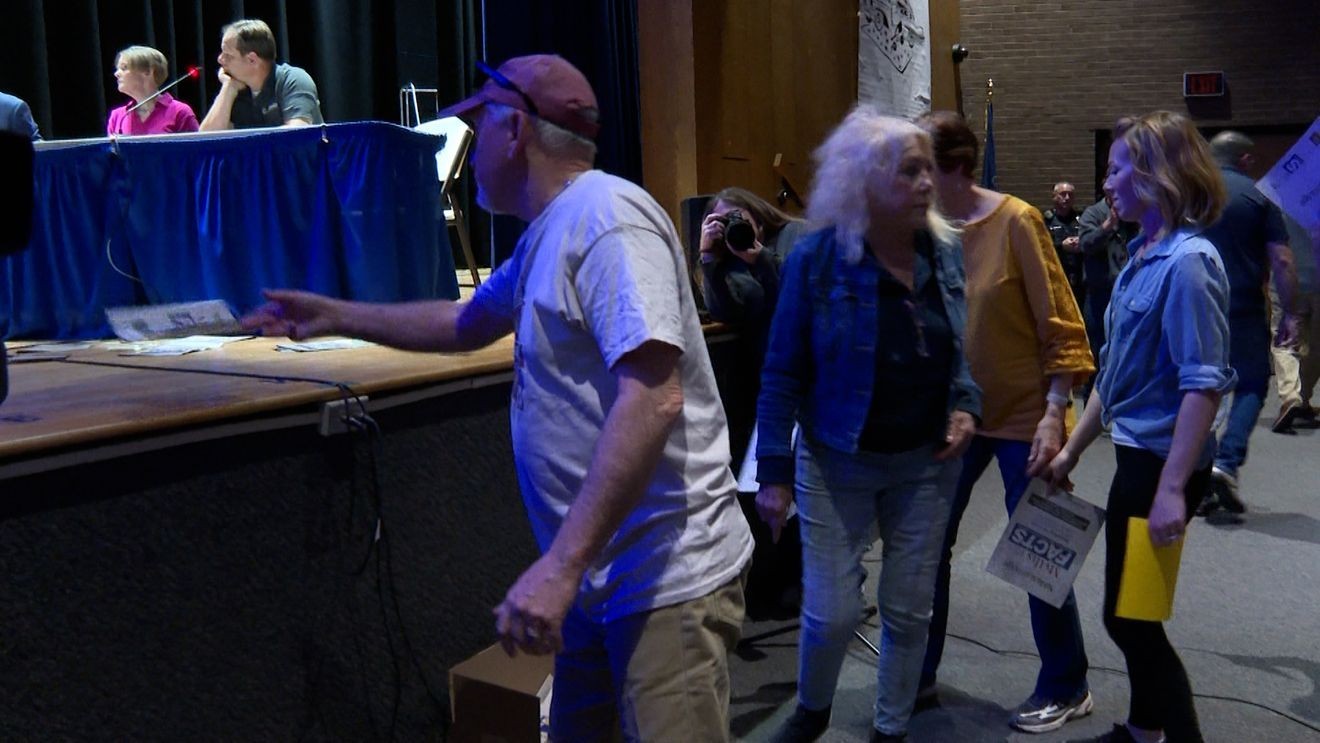
The meeting began with controversy, after an attorney for the applicant objected to a box of flyers placed on the dais.
“I noticed that there are a lot of materials that have been tossed up on the deus and there’s a box that’s on your desk inviting people to drop, I think the phrase they use is propaganda, and return propaganda. I find inappropriate for the decorum of the meeting,” said attorney Ed Campbell.
Within seconds, the room erupted, residents rushed forward, tossing pamphlets back toward the front of the stage.
Officials later clarified the box was not placed there by any borough member.
The debate in Archbald shows no signs of slowing down. There are currently five data center proposals still under consideration, with one already denied. Monday night’s hearing focused on the Wildcat Ridge Data Center Campus, proposed by Brooklyn-based Cornell Realty Management LLC.
The company applied in December to develop more than 574 acres along Business Route 6 and Route 247, also known as Wildcat Road, on the former Pine Line mining property.
Plans include: 14 two-story data center buildings, each up to 80 feet tall, administrative and security buildings, nearly 60 acres of additional commercial development, including retail space, an upscale supermarket, and a multi-story office building, and hundreds of parking spaces.
The developer’s website describes the project as “ultra-modern” with a 200-foot wooded buffer, exceeding the ordinance requirement of 50 feet.
Opposition continues to intensify, not just toward the developer, but toward local leadership and businesses as well.
Residents expressed anger over a local PR firm, Ryan Leckey Media hired by the project, accusing them of “selling out” the community as messaging spreads across social media.
Outside the meeting, opponents gathered in the parking lot selling signs and T-shirts while collecting signatures for a petition calling for the resignation of borough officials. Organizers say they have raised nearly $40,000 for a legal fund to challenge the project.
During the meeting, resident Bill Gaughan pushed back on questions raised in a flyer about who is funding the opposition.
“Have you not been paying attention? It’s the people who are sitting behind me tonight,” said Gaughan.
A major focus of the hearing was traffic impact. The developer presented a traffic consultant who prepared a trip generation report, not a full traffic study, based on the project’s square footage.
Key findings included: 2,498 estimated daily trips, 359 trips during morning peak hours, 342 trips during evening peak hours. Traffic primarily routed along Wildcat Road
Projected average daily traffic increase of about 2,400 vehicles
The consultant also said a Highway Occupancy Permit (HOP) would be required from PennDOT—a legal requirement for access to state roads. The report assumes roadway upgrades, estimating around $2 million in improvements.
However, under questioning from an attorney representing the opposition group Stop Archbald, inconsistencies surfaced between the consultant’s data and the applicant’s claims.
“How do you reconcile your data driven analysis and your conclusion with the statement of the applicant that even assuming all 1280 employees arrive simultaneously +200 delivery people a total daily trip remain under 2000?” questioned attorney Justin Richards?
“I didn’t write that,” answered the expert.
“I understand, but how do you reconcile your expert analysis with that statement? One of them is incorrect. Is it you or is the applicant? Which statement is incorrect?” asked Richards.
“The applicant,” the expert replies.
That exchange drew strong reactions from the crowd.
Residents and officials also raised concerns that the application does not include input from three local volunteer fire companies and how slopes and site topography were not analyzed.
Adding to confusion, the developer’s website states the project would generate fewer than 2,000 vehicles per day, even in a worst-case scenario, citing staggered employee shifts to reduce congestion.
The tone of the meeting remained intense throughout the night.
Former judge Tom Munley delivered one of the strongest warnings to officials:
“Unless you are agreeing to a moratorium to learn these residents alone or put this on the ballot pack your bags, get out of this place and don’t come back,” said Munley.
The next conditional use hearing is scheduled for Thursday, May 14, at Valley View High School.