
ARCHBALD — Before testimony could begin Monday night on Archbald’s largest proposed data center campus, lines of residents converged on a cardboard box at the front of Valley View’s High School auditorium, filling it with hundreds of glossy flyers and booklets mailed throughout the borough last week in an effort to gain public support.
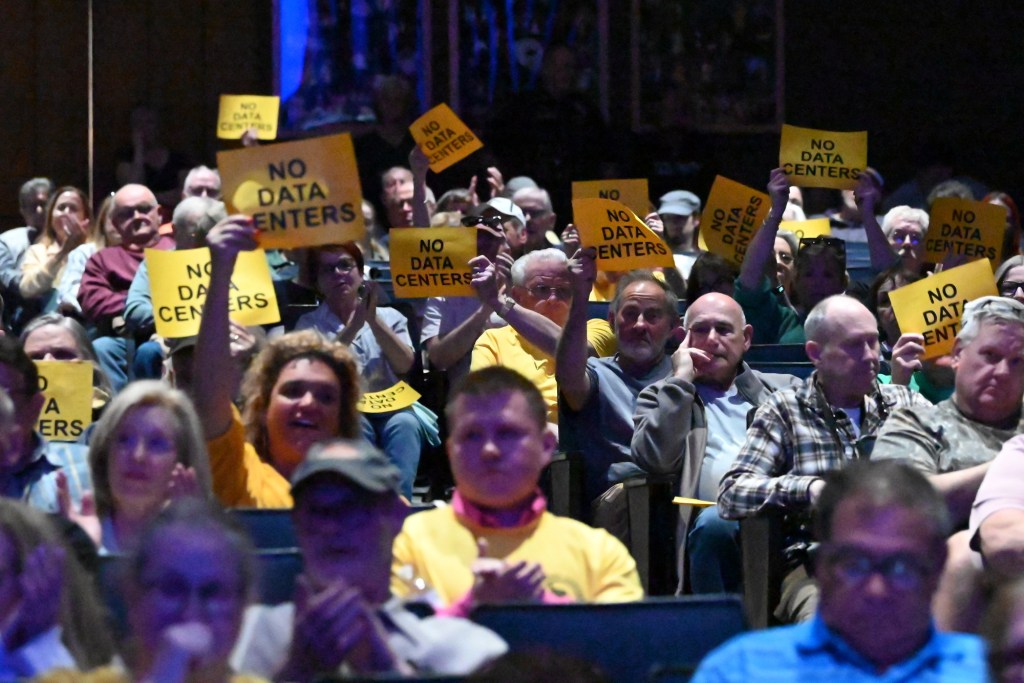
The display of opposition set the tone for the next three hours as more than 500 residents packed the room for Archbald’s third public hearing on the Wildcat Ridge Data Center Campus — the largest turnout yet for a Midvalley data center meeting.
Following Wildcat Ridge’s newly launched public relations campaign, impassioned residents loudly vocalized their stance on data centers throughout the night, cheering on anti-data center speakers while booing and heckling the developer’s representatives.
Many in attendance wore bright yellow “Stop Data Centers” T-shirts, with even more in the crowd holding “No Data Centers” signs.
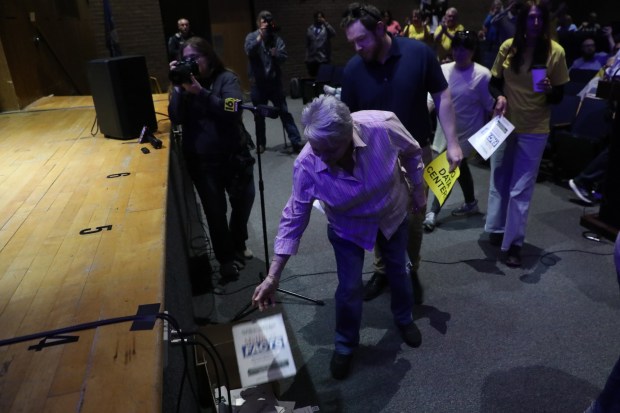 Community members deposit booklets Wildcat Ridge Data Center Campus developers mailed to them during the public hearing regarding the proposed project at Valley View High School on Monday, April 13, 2026. (REBECCA PARTICKA/STAFF PHOTOGRAPHER)
The Wildcat Ridge Data Center Campus proposes building 14 two-story data centers plus commercial and office space along 574.2 mountainside acres along Business Route 6 and extending up Route 247, or Wildcat Road. Each data center would be up to 80 feet tall with a 202,340-square-foot footprint. The campus would also have 316,000 square feet of commercial space, including a 50,000-square-foot grocery store with 1,800 square feet of retail space; two four-story, 85,000-square-foot buildings, with one mixed use and the other an office; and a 96,000-square-foot surface parking lot with about 360 spaces. The campus would have 41 backup diesel generators per data center, totaling 574 generators, each with a 2,000-gallon fuel tank amounting to 1,148,000 gallons stored on site.
Wildcat Ridge was the first proposed data center campus in Lackawanna County when representatives approached council during a January 2025 work session, and despite at least 12 more data center campuses proposed throughout the county since then, including five more in Archbald, it remains one of the most controversial developments due to its location, water demands and electricity needs.
The campus would use a maximum of just over 3.3 million gallons per day of water during the hottest summer weather while requiring 1.6 gigawatts, or 1,600 megawatts, of electricity, though Wildcat Ridge emphasizes it would need significantly less water during cooler weather, using about 53,553 gallons per day from October through April.
Brooklyn-based Cornell Realty Management LLC filed a 777-page conditional use application for Wildcat Ridge on Dec. 15. Council held previous hearings on Jan. 28 and March 10.
The fourth public hearing will resume May 14 at 5 p.m. in the Valley View High School auditorium, 1 Columbus Drive, Archbald, Borough Solicitor Jay O’Connor said.
Mailer return
With its third hearing looming, Wildcat Ridge worked with Ryan Leckey Media, a local marketing agency, to distribute booklets and flyers to residents touting the campuses economic benefits and minimizing its impacts. A newly launched wildcatridgedatacenter.com shared the same messaging.
At the start of the hearing, Wildcat Ridge attorney Edmund J. Campbell Jr. of King of Prussia-based Campbell Rocco Law addressed the “Wildcat Ridge Propaganda Mailer Return” box, which was initially on the stage of the auditorium near where the developer’s representatives sit. Campbell said his client sent out the materials to explain that its cooling system would not draw water during a drought, and that the campus would not impact electricity use, calling electricity “a much more regional, or even national, issue.”
“I find it inappropriate for the decorum of the meeting,” Campbell said of the box, speaking over boos from the crowd. “There’s lots of social media out there discussing this application and others, and anytime anyone suggests or posts something on those forums that is in any way supportive of data centers or this application, those things are immediately stricken.”
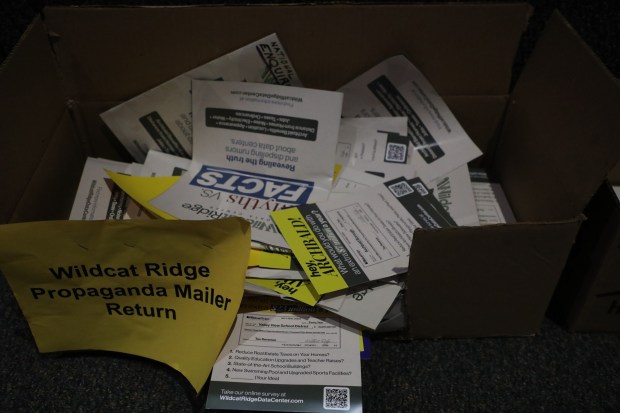 A box of booklets community members left near the stage in the auditorium at Valley View High School on Monday, April 13, 2026. (REBECCA PARTICKA/STAFF PHOTOGRAPHER)
O’Connor responded that council will consider Wildcat Ridge’s conditional use application based on the evidence they present. He then asked for the box to be removed from the stage, prompting residents to flock to the front of the auditorium to stuff it with their booklets and flyers.
Councilwoman Erin Owen said she and her fellow council members all received the same materials in the mail, but they did not ask residents to bring them.
The nearly 8,900-member Stop Archbald Data Centers group on Facebook set up the box and encouraged residents on social media to return the mailers.
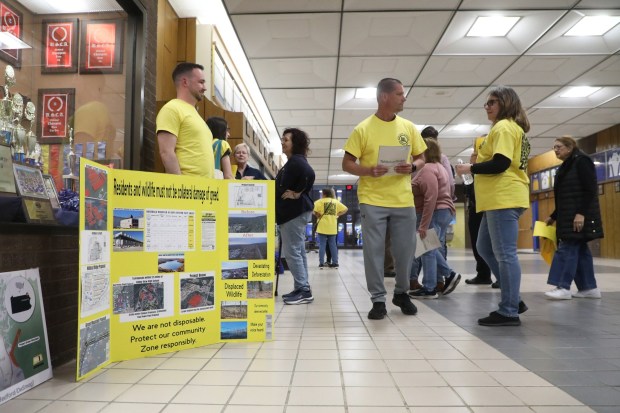 Community members enter the auditorium at Valley View High School for the public hearing regarding the Wildcat Ridge Data Center Campus at Valley View High School on Monday, April 13, 2026. (REBECCA PARTICKA/STAFF PHOTOGRAPHER)
Traffic scrutiny
Traffic drove Monday’s hearing.
Traffic engineer Jerilyn Luben testified about a traffic generation report compiled by her engineering firm, Honesdale-based L&V Engineering LLC. Her report faced scrutiny during cross-examination.
Luben projected a weekday average of 2,498 trips per day, with weekday “a.m.” peaks of 359 trips per hour and “p.m.” peaks of 342 trips per hour.
The project will need a Highway Occupancy Permit, or HOP, from the Pennsylvania Department of Transportation, but it is not yet required at this point in the process, Luben said through testimony elicited via questions from Campbell. The sole purpose of the HOP is to ensure safe and efficient traffic, and Cornell Realty Management assured them that, regardless of the lengths needed to mitigate traffic, they will construct the improvements required by the HOP, Luben said.
Wildcat Ridge would accept as conditions of approval that it must have an HOP and that it would fund any necessary improvements, according to Luben and Campbell.
Attorney Justin Richards, who is representing residents challenging the borough’s data center zoning, quickly questioned the traffic projections.
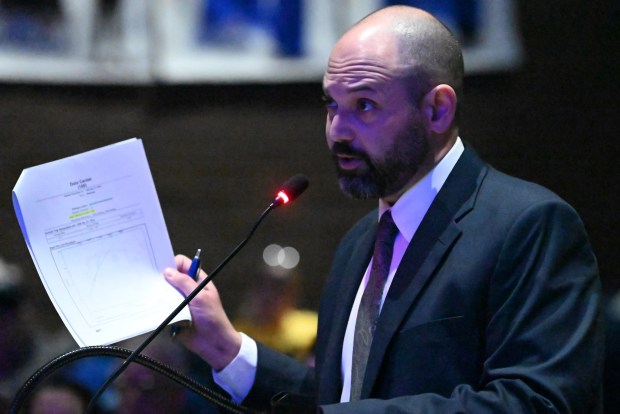 Attorney Justin Richards, who represents a group of borough residents challenging Archbald’s data center zoning, asks questions about the presented traffic study during the public hearing regarding the Wildcat Ridge Data Center Campus at Valley View High School on Monday, April 13, 2026. (REBECCA PARTICKA/STAFF PHOTOGRAPHER)
Richards pointed out that the 16 studies used to calculate the traffic generation report were based on an average of 557,000 square feet — nearly 10 times smaller than Wildcat Ridge’s proposed 5.665 million square feet, which includes its 14 data centers and a 33,000-square-foot office building.
He asked Luben if she believes her firm’s report is accurate based on that disparity.
“This is the standard that is used,” she said. “There is no other data available.”
Richards further questioned Luben about whether traffic from the commercial and office space, including a 50,000-square-foot grocery store, were included in her projections.
Luben said the additional commercial and office space were not included in the traffic projections. Wildcat Ridge’s conditional use application acknowledges “development of the commercial zone is expected to significantly increase traffic along Business Route 6” but that it would create new high-volume intersections to address it.
Wildcat Ridge also included a community impact analysis by Honesdale-based Shepstone Management Company in its application. Planning consultant Thomas Shepstone presented the analysis during the March 10 hearing.
Although the commercial and office space were not part of Luben’s traffic generation report, Shepstone’s analysis frequently references their economic benefits for the borough.
Richards pointed out that the community impact analysis quotes about 500 fewer trips per day than Luben’s report, writing, “The project’s total daily trip generation remains under 2,000 vehicle trips per day.”
“How do you reconcile your expert analysis with that statement?” Richards asked.
“I can’t,” Luben replied.
“So one of them is incorrect,” Richards responded. “Is it you, or is it the applicant? Which statement is incorrect?”
“The applicant’s,” Luben said as the crowd erupted in applause.
Opposition leader Tamara Misewicz-Healey, who founded Stop Archbald Data Centers in October with her husband, Justin, continued the cross-examination. She noted that the traffic generation report characterized truck traffic as “negligible” and asked Luben whether she stands by that.
“Yes, as a proportion of all the trips,” Luben said.
Public opposition
Public comment normally occurs after all of an applicant’s witnesses testify, but with five-plus pages of speaker signup sheets, O’Connor said council would begin listening to public comment on Monday, though commenters had the option to defer until Wildcat Ridge concluded its testimony.
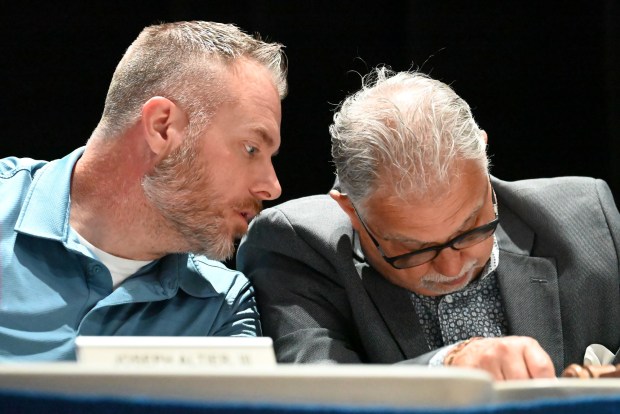 Archbald Borough Council Vice President Joseph Altier whispers to President Louis Rapoch during the public hearing regarding the Wildcat Ridge Data Center Campus at Valley View High School on Monday, April 13, 2026. (REBECCA PARTICKA/STAFF PHOTOGRAPHER)
A dozen Lackawanna County residents took up the offer, including a retired longtime judge, a county commissioner and the county’s controller.
Retired Lackawanna County senior Judge Thomas J. Munley, a Jessup resident, referenced his 19 years as a judge to criticize Wildcat Ridge.
“After 19 years of seeing applications, I would’ve thrown this out in five minutes,” Munley said. “It’s totally inadequate.”
He decried the developer’s characterization that it would use an average of 50,000 gallons per day during most months.
“You don’t care about our environment here, number one. You don’t care about what you’re doing to our water system, number two. You don’t care what you’re doing to our electricity system, number three,” Munley said. “And number four, you don’t care about the quality of life of these people.”
He concluded his remarks with a warning.
“Let me tell you something, unless you agree to a moratorium for a couple of years and let these people alone, or agree to put it on the ballot, pack your bags,” Munley said to a standing ovation. “Pack your bags, get out of this place and don’t come back.”
Lackawanna County Controller Gary DiBileo called on Archbald to make data centers a referendum for voters to consider on the ballot. DiBileo is a Scranton resident who has testified at previous data center hearings in Archbald and Dickson City following his experience opposing a data center proposal in Ransom Twp. just outside his neighborhood in Scranton’s Keyser Valley section.
“The developers and corporations should want this, because why would they come to a town where they are not wanted?” he said, extending his call to municipalities throughout the county to consider data center referendums.
Lackawanna County Commissioner Bill Gaughan, an outspoken critic of data centers who urged Gov. Josh Shapiro to enact a three-year moratorium on hyperscale campuses, took issue with Wildcat Ridge’s marketing campaign, including a flyer sent to Valley View taxpayers asking, “Hey Valley View School District! What would you do with an extra $23 million a year?”
“When someone tries to buy your future, it’s because they cannot earn your trust. … Let them keep their pamphlets. Let them keep their fake checks. Let them keep their carefully crafted fantasies. We will not be tempted, tricked or traded,” Gaughan said. “Archbald is not a line item. It’s not a projection. It’s not a number on a postcard. Archbald is a place. It’s a people, and it’s a promise, and Archbald is not for sale.”
Gaughan also took aim at questions posed by the developer in its marketing that asked who’s behind the data center opposition.
“Who is behind the opposition? Have you not been paying attention?” he said. “It’s the people who are sitting behind me tonight.”
The same marketing questioned the source of funding for T-shirts and signs opposing data centers.
Megan Farrell answered those questions.
“It’s me,” the fifth generation Archbald resident said. “I place approximately $1,000 of signs on my credit card at a time.”
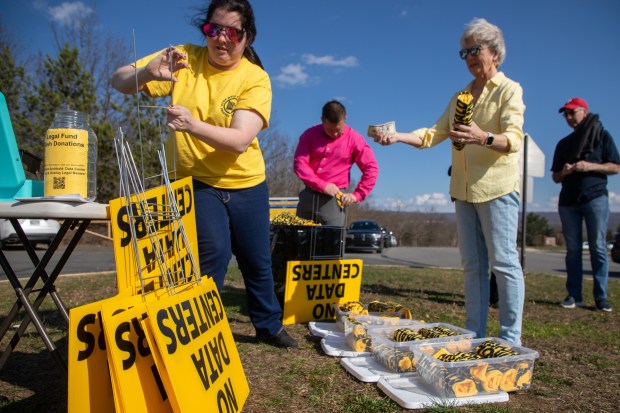 Megan Farrell, left, sells “No Data Centers” signs and t-shirts before the public hearing regarding the Wildcat Ridge Date Center Campus at Valley View High School in Archbald on Monday, April 13, 2026. Proceeds of the items go to a fund to help to pay for legal fees for residents to oppose Archbald’s data center zoning. Farrell believes that a data center would not be beneficial to the community and would put stress on natural resources. (REBECCA PARTICKA/STAFF PHOTOGRAPHER)
Stop Archbald Data Centers recoups costs for signs $5 at a time, and she ordered about $1,800 worth of T-shirts, which the group recoups at $10 per shirt. A small group of family and friends donated to allow her to design and print flyers to distribute, she said.
“We do it for our family,” Farrell said. “Our passion to protect this town and its residents, it’s something that you will not be able to afford or pay for from your employees.”
Judy Quinlan, an Archbald resident, cautioned data center developers about opposition from residents.
“Don’t ever underestimate the power of the people, the power of conviction and the power of protest,” she said. “We won’t back down, so if there’s 70-, 80-year-old women standing at the construction site, don’t be surprised. We’ll be there, and we’ll stop it because we’re going to resist the billionaires.”