
OLYPHANT — A divided council voted Tuesday to declare its zoning invalid because it excludes data centers, giving the borough six months to regulate the rapidly expanding industry.
Facing opposition from a crowd of at least 70 packed into Olyphant’s council chambers Tuesday night, borough council voted 4-3 to reject a proposed zoning amendment that would have regulated data centers by restricting them as conditional uses across 1,000 acres east of the Casey Highway. After it rejected the amendment, council again voted 4-3 to declare its zoning ordinance substantively invalid and to pursue a curative amendment addressing data centers.
Council members Joseph Collarini, Michael Abda, Dina Harrington and Beth Frushon voted to reject the initial zoning amendment and instead seek a curative amendment. Council President Jimmy Baldan, Vice President Bob Hudak and Councilman Eric Hartshorn voted in favor of the zoning amendment and against the curative amendment. The decision mirrors the strategy used in neighboring Throop when its council voted in January to declare its zoning exclusionary to data centers.
Collarini suggested the curative amendment moments before council was about to vote on the zoning amendment.
The strategy gives Olyphant 180 days to adopt zoning standards for data centers. Should a data center campus apply with the borough in the interim, it would be bound by those upcoming zoning regulations. The move leverages a provision under the Pennsylvania Municipalities Planning Code, or MPC, that is more commonly used by property owners than municipal governments.
Municipalities in Pennsylvania must allow for every type of lawful land use somewhere within their borders, from landfills to data centers. Failing to do so exposes communities to legal challenges over exclusionary zoning. The MPC allows property owners to challenge the validity of a zoning ordinance when it prohibits or restricts the development of their land. To “cure” that defect, property owners can file a curative amendment providing their own zoning standards, effectively shifting control from the municipality.
The MPC also allows municipal governments to adopt their own curative amendments, though the provision is rarely used locally.
‘Meaningful restrictions’
Olyphant’s proposed zoning amendment had defined data centers and associated uses while restricting them as conditional uses in the borough’s “large scale mixed commercial/manufacturing district,” or CM-2 zone, which encompasses about 1,000 acres south and east of the Casey Highway opposite most of the town, including the Triboro Industrial Park.
Conditional uses allow a municipality to impose additional conditions on a development. To prove they can abide by those conditions, developers must attend public hearings to testify on their project. The hearings also give residents the opportunity to testify before borough council votes on a conditional use application. Other conditional uses in Olyphant’s CM-2 zone include junk yards, sanitary landfills, solid waste facilities, fracking, adult businesses, correctional facilities and power plants.
The borough spent seven months working on the ordinance after council voted Sept. 16 to authorize its solicitor, code enforcement officer and engineer to draft a zoning amendment on data centers.
Olyphant’s special counsel, Isaac P. Wakefield of Camp Hill-based Salzmann Hughes P.C., began Tuesday’s meeting by emphasizing that council was only considering a zoning amendment, not approvals for any individual developer or application. Wakefield stood in for Olyphant’s solicitor and borough manager, C.J. Mustacchio, who was absent Tuesday.
“I understand what’s happening in some other municipalities around the region. That is not before council this evening,” Wakefield said. “There’s no data center project formally proposed in the borough. No application has been submitted for one, and no plan is under review.”
Although Olyphant has not yet received a formal proposal for a data center, recent maps from Pennsylvania American Water and PPL Electric Utilities depicting other data center projects have both included references to a project east of the Casey Highway along Marshwood Route and Route 247 in the area of the Triboro Industrial Park. Pennsylvania American Water’s map referenced a “Project Triboro.” The majority of Lackawanna County’s proposed data centers use “project” in their name, including Project Boson, Project Gold, Project Gravity, Project Green Mountain, Project North and Project Scott.
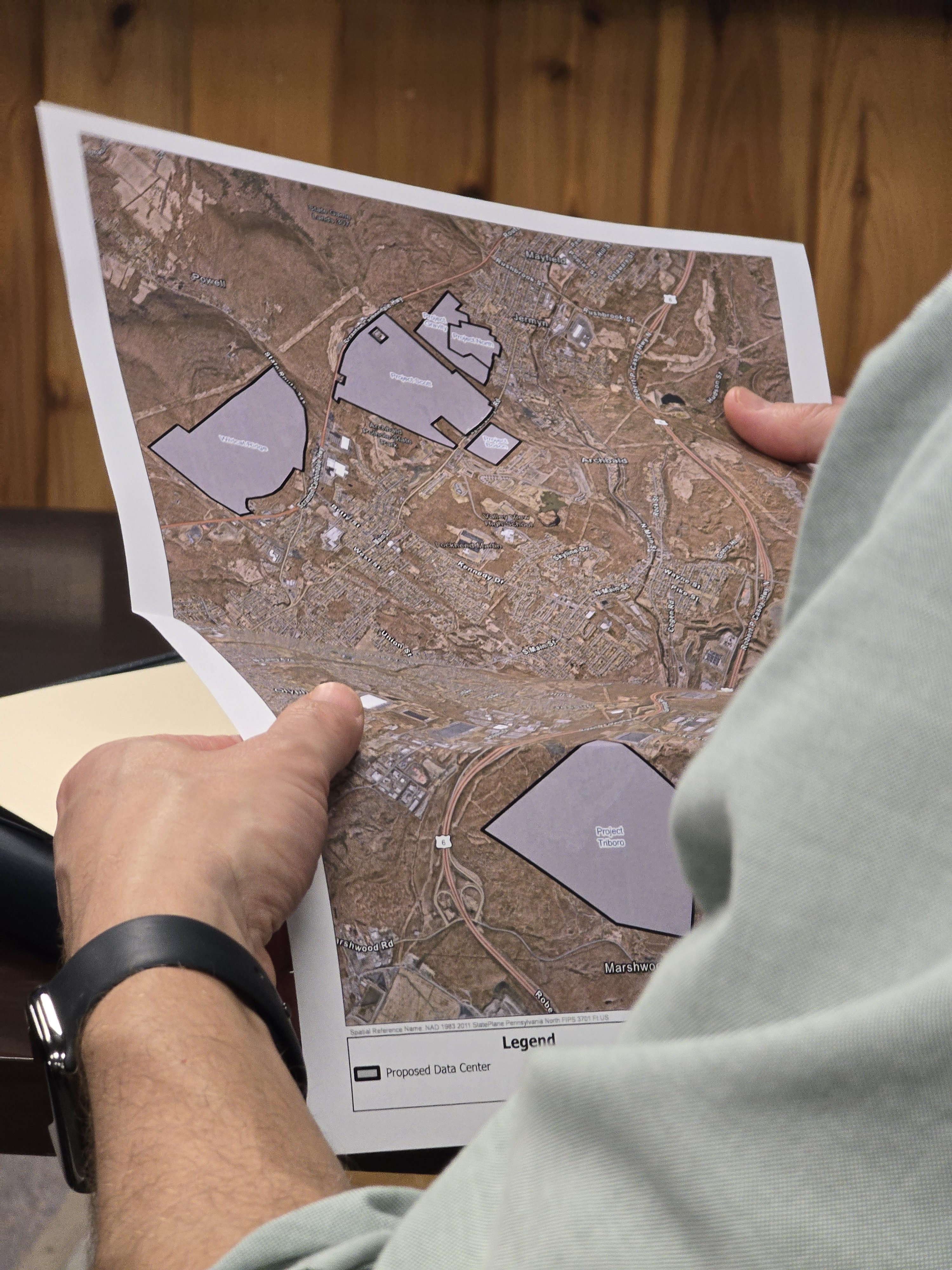
A Pennsylvania American Water employee holds a map of Midvalley data center projects during an Archbald council work session in the Borough Building on March 11, 2026. (FRANK WILKES LESNEFSKY / STAFF PHOTO)
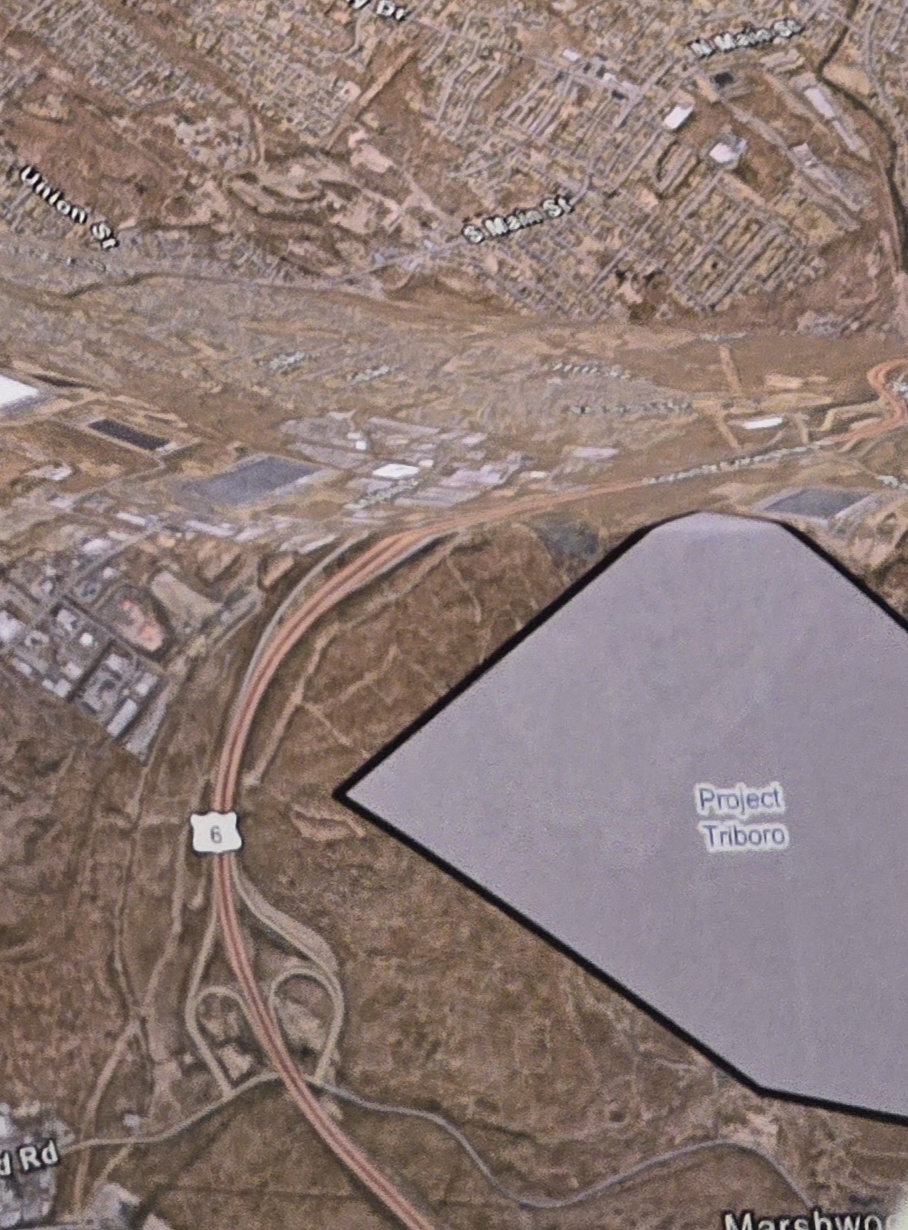
A Pennsylvania American Water employee holds a map of Midvalley data center projects during an Archbald council work session in the Borough Building on March 11, 2026. (FRANK WILKES LESNEFSKY / STAFF PHOTO)
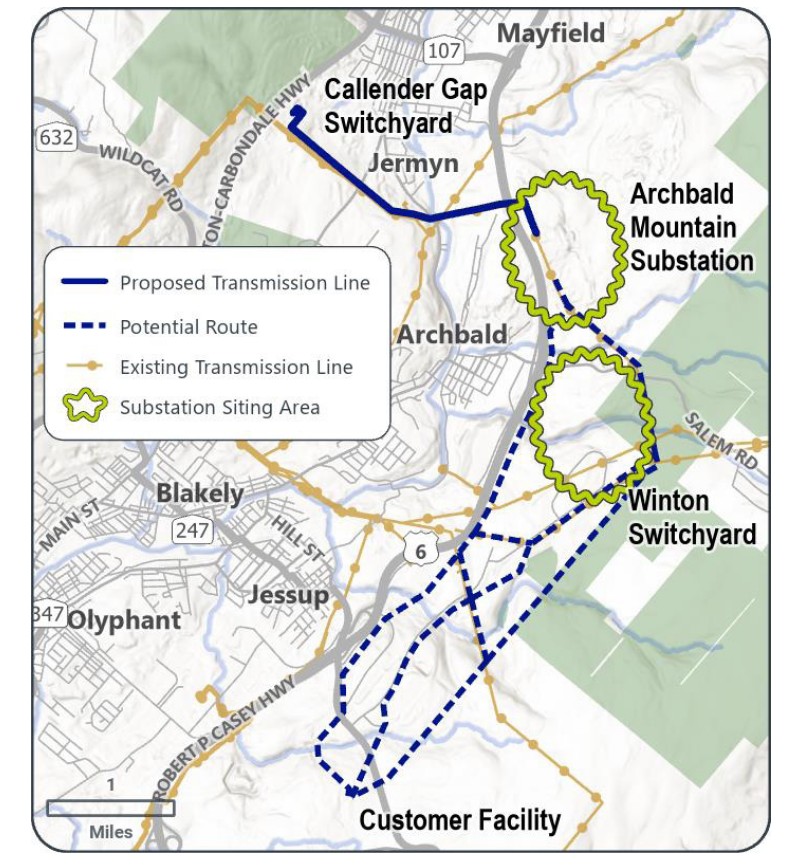
PPL Electric Utilities’ plans for its Archbald Mountain Transmission Project. (SCREENSHOT VIA pplarchbaldmountainproject.com)
Show Caption
1 of 3
A Pennsylvania American Water employee holds a map of Midvalley data center projects during an Archbald council work session in the Borough Building on March 11, 2026. (FRANK WILKES LESNEFSKY / STAFF PHOTO)
Mustacchio previously said that while the borough had not received any applications, it had received interest to develop 12 data centers at Triboro.
Wakefield said the borough’s proposed amendment was proactive because it would have filled a hole in Olyphant’s zoning. Without amending its zoning, council lacks any regulation whatsoever over data centers, he said.
“The borough cannot completely exclude a lawful land use under zoning, even one that is unpopular in the opinion of the residents and in the opinion of council, so however unpopular a proposed data center may be, they are a lawful land use as it stands now,” Wakefield said. “The borough must provide for them somewhere, and the borough is doing its level best to accommodate that in a way that allows them to regulate it appropriately with meaningful restrictions.”
If adopted, Olyphant’s zoning amendment would have limited data centers to 80 feet tall with 200-foot setbacks from residential areas. It also required applicants to submit multiple preliminary reports, including a narrative of on-site activities and operations; a site plan depicting proposed improvements, wetlands, waterways and cultural and historic resources on the property or within 500 feet; an evaluation of potential positive and negative impacts from the data centers, including to emergency services and fire protection, water supply, sewage and solid waste disposal, school facilities and school district budgets, municipal revenues and expenses; and environmental impacts, including odor, noise, smoke, dust, litter, glare, vibration, electrical disturbance, wastewater and stormwater, with specific measures employed to mitigate any negative impacts.
The amendment would have prohibited on-site power generation aside from backup generators for power outages while requiring data centers to receive their power from Olyphant Borough Electric, which is Olyphant’s electric company. Applicants would have also been required to submit an analysis of their raw water needs from private or public sources, with proof a utility could supply them if they use public water, or a water feasibility study if they use a nonpublic source such as a well.
‘Nobody wants them’
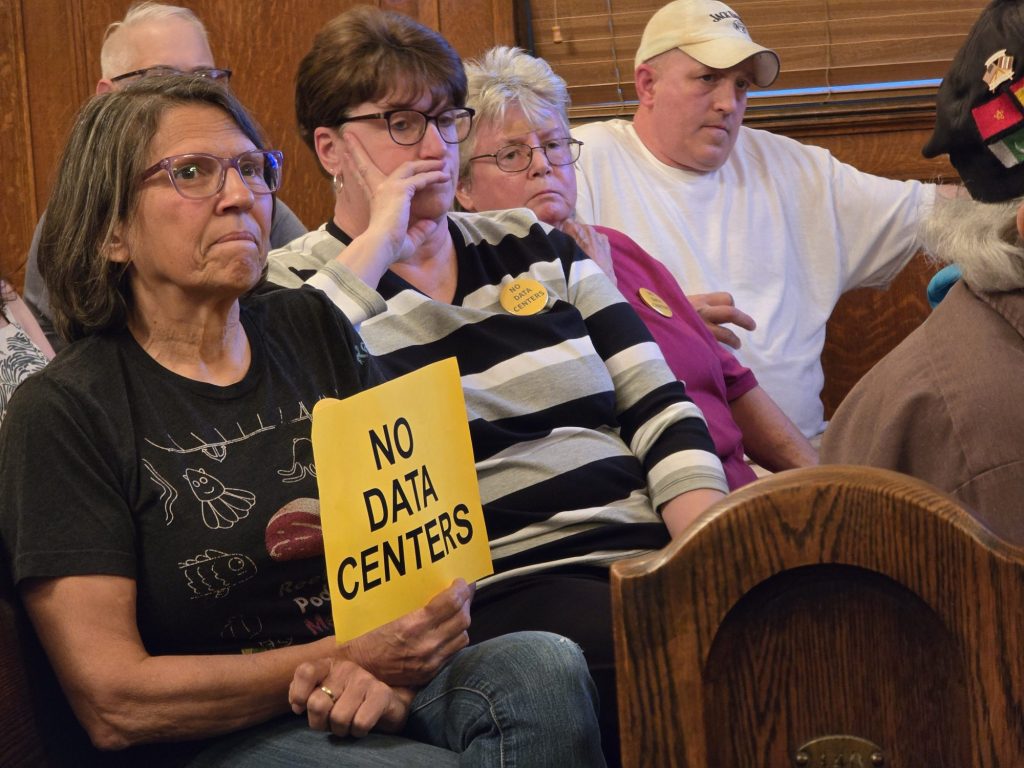
Throughout the nearly hour-and-a-half-long meeting, 15 residents addressed council about data centers. Their comments ranged from urging council not to allow data centers — which the municipality cannot legally do — to calling for additional enforcement mechanisms if a data center violates its conditions. Other concerns included impacts on the environment and wildlife, reduced property values and calls to limit data centers to a smaller area.
Resident Donna Liples told council they have a monumental task in front of them and that she and her husband pray for them daily before offering a prayer from the podium of the council chambers.
“We thank you for what you have planned for us in this little borough of Olyphant,” Liples said. “I pray that you would give all of those in authority the wisdom and the knowledge that they need to move us forward safely, steadily and surely.”
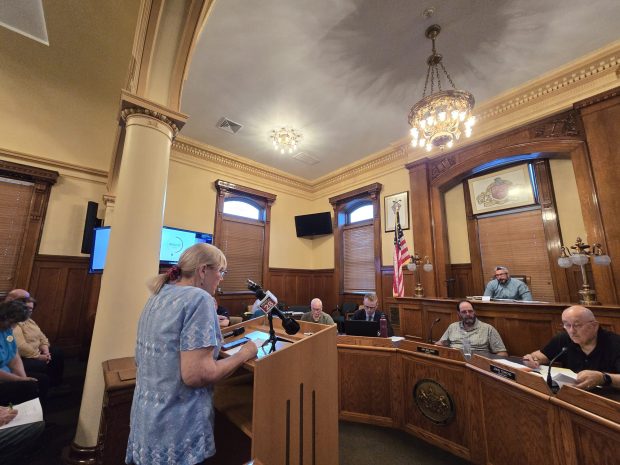 Olyphant resident Donna Liples prays for “those in authority the wisdom and the knowledge that they need to move us forward safely, steadily and surely” during an Olyphant council meeting at the Municipal Building on Tuesday, April 14, 2026. (FRANK WILKES LESNEFSKY / STAFF PHOTO)
Resident Lauren Telep questioned whether data centers would be built at Triboro Industrial Park and pointed to visible site work at the property. Zoning Officer Bill Shigo and Wakefield both pointed to current plans for four 1-million-square-foot warehouses at Triboro; any construction is under a prior land development plan approved for warehouses, Wakefield said.
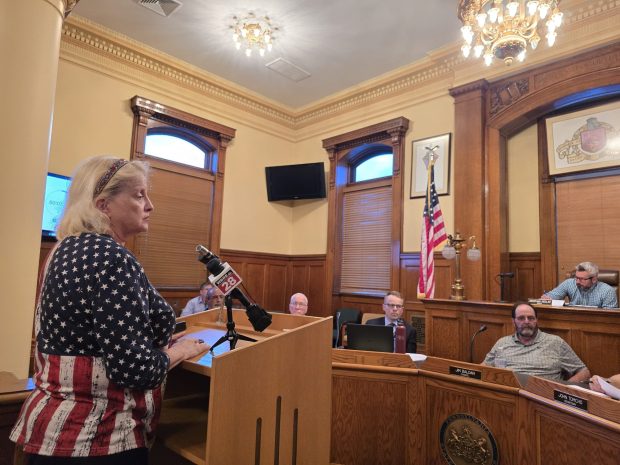 Olyphant resident Lauren Telep questions the impact data centers would have on electricity during an Olyphant council meeting at the Municipal Building on Tuesday, April 14, 2026. (FRANK WILKES LESNEFSKY / STAFF PHOTO)
Telep also inquired about the impact data centers could have on electricity and whether there were any guarantees that residents’ electric bills would not increase.
Data centers — and any other large user — would be required to pay for upgrades needed to supply them with power, Shigo said. He said there are no guarantees in life, but he doubts electric bills would rise.
Unlike most municipalities in Pennsylvania, Olyphant administers its own electricity. Blakely is the only other local town to do so.
Telep concluded by advocating for a referendum on data centers on the November ballot.
“Let this go to the people of Olyphant,” she said.
During a data center hearing in Archbald on Monday, Lackawanna County Controller Gary DiBileo advocated for the same.
Paul Kazinetz asked borough officials why they would allow data centers across 1,000 acres in the CM-2 zone.
“Why do we have to do that?” the borough resident said. “Nobody wants them here, and if they have to come in, put them in those last 20 acres as far away as possible.”
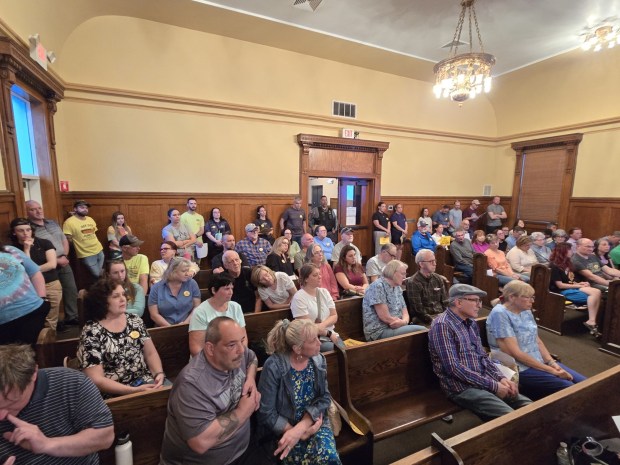 Residents listen to public comment during an Olyphant council meeting to consider regulations for data centers in the Municipal Building on Tuesday, April 14, 2026. (FRANK WILKES LESNEFSKY / STAFF PHOTO)
Wakefield said Kazinetz is correct that there is no specific law about acreage, but there is a law about exclusionary zoning when a municipality provides an area that is so small that the use can’t be engaged.
Shigo noted the CM-2 zone encompasses uses like commercial, warehousing, industrial, light and heavy manufacturing, and it has been in place since the 1990s.
‘Six more months’
Seconds before council would have taken a roll call to vote on its proposed zoning amendment, Collarini asked, “Would it be in our best interest to move for a stay similar to Throop to give us six more months?”
The crowd erupted into applause.
Collarini’s proposal briefly created confusion among council members as Wakefield guided them through the process of adding an agenda item mid-meeting without violating Pennsylvania’s Sunshine Act, also known as the Open Meetings Law.
Council initially voted 4-3 to adopt the zoning ordinance with Baldan, Hudak, Hartshorn and Harrington voting in favor of it. Council then voted a second time after Shigo clarified they were voting to adopt the amendment, prompting Harrington to change her vote to “no” and killing the ordinance.
Council then voted to amend their agenda to add Collarini’s motion before finally voting to declare their zoning invalid and seek a curative amendment.
After the vote, Baldan asked Wakefield if the borough is safe should it receive a data center application.
If the borough denies the application on the basis that the ordinance does not provide for data centers, the applicant would not be able to challenge it as exclusionary, the attorney said.
As the meeting proceeded, Collarini offered advice to the crowd.
“Keep being loud,” he said.