
READING, Pa. – During its Committee of the Whole meeting Monday night, Reading City Council considered a proposed ordinance that would rescind the prohibition on mayor to use a city-owned vehicle.
The proposed ordinance is on the agenda for next Monday night.
Managing Director Jack Gombach explained the administration’s position that there are many requests for the mayor to attend different events, both in the city and elsewhere, and that it puts an undue burden on the mayor’s personal vehicle.
Gombach added that most comparable cities in the state either allow the mayor access to a vehicle or assigns the mayor a vehicle.
Council President Donna Reed vehemently opposed the proposal.
“We have gone many years without mayors needing cars with us,” Reed said. “We’re all out there. You have nine elected city officials, all of whom are using their own cars.”
Reed said this request came up during Eddie Moran’s first term as mayor, and the ban on using a city-owned vehicle was upheld by the entire council at that time.
“With taxes as they are and our budget as it is, I think it is irresponsible to even ask this body to consider it,” she said.
Gombach said no other community has this type of restriction on their CEO, or the chief executive of the city.
“If the mayor wants to use [a city-owned vehicle] to attend an event or represent the city, he should be able to do that,” Gombach said.
Reed asked if such a policy would apply to councilmembers and the auditor — the other eight elected city officials.
“If you want to discuss how if you guys can utilize different city resources, we’re happy to have that conversation, but we’re here about the ban of the use [of a car] for the mayor,” Gombach said.
Councilmember Chris Miller said the issue is a matter of timing because of where the city is financially.
“The timing is wrong, and hopefully one day we’ll be able to say that financially we’re in better shape, but at this time, it just does not seem realistic, and I’m sure the public would look at it the same,” Miller said.
Councilmember Jaime Baez Jr. clarified with Gombach that this request is not for the purchasing of a new vehicle.
“We have to be mindful of perception,” Baez said. “I think that if it comes down to accountability, and we do have a policy in place for usage tracking and reporting so the public knows it’s being used appropriately. I’m not against it if it’s not the purchase of a new vehicle.”
Reed asked Gombach to clarify whether the request would be a day-to-day basis or if the mayor would be allowed to take a car home at his disposal.
Gombach said he couldn’t speak to that question specifically.
“This is dealing with an ordinance that’s already in the books that’s preventing the mayor from doing his duties because it’s been an undue burden on his personal vehicle,” Gombach said.
“It’s astonishing to me we all have our own vehicles, and we’ve managed to do what needs to be done,” Reed commented.
Councilmember Rafael Nunez said if the issue does not involve the purchase of a new vehicle, he sees no problem with allowing the mayor to have access to a car on the city fleet.
Real estate transactions
In other business, council adjourned the Committee of the Whole meeting and entered a closed-door executive session to discuss three real estate matters:
Approving an agreement of sale for the purchase of a former bank building at 2040 Centre Ave.
Amending the lease for First Energy Stadium to add 2040 Centre Ave. to the agreement.
Authorizing the agreement of sale for the conveyance of 431, 437 and 443 Penn St. to Callowhill Development LP. Those Center City historic properties are also identified as 445, 447, 449, 451 Penn St. and 12 N. Fifth St. The properties are part of $52 million Fifth and Penn redevelopment project that Shuman Development Group will undertake to create residential and retail space.

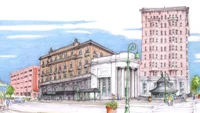
City officials signed a letter of intent to redevelop the properties at Fifth and Penn streets, which sat vacant for years.
All three issues are on next Monday’s voting agenda as ordinances for adoption.
City Council is permitted to discuss real estate matters privately as long as any voting occurs at a public voting meeting.