
When I became the superintendent of the Allentown School District three years ago, one of the first things I noticed was that our community is a vibrant mix of cultures, languages and lived experiences. But while we offered world language programs, they did not yet reflect the full richness of our community.
Today, approximately 48% of our residents speak a language other than English at home, with Spanish as the most common. Within our schools, 74% of our students identify as Hispanic, with the vast majority speaking Spanish at home, while another 5% speak one of the dozens of other languages represented in our global community. Within our schools, linguistic diversity is even more pronounced. Our students arrive each day with rich cultural and language assets that should be recognized, honored and developed.
I knew we needed to create programs that reflected and celebrated our students’ diverse cultural backgrounds. Through deep listening sessions and the work of the 100-plus-member Steering Committee, the community affirmed that dual language learning is a priority. When we created Lighting the Way: A Blueprint for Innovation and Excellence 2030, we knew the strategic plan had to respond.
To represent the diversity of our community, we conceived and implemented the Sonia Sotomayor Dual Language Immersion Academy, a pioneering initiative designed to acknowledge and affirm the cultural and linguistic heritage.
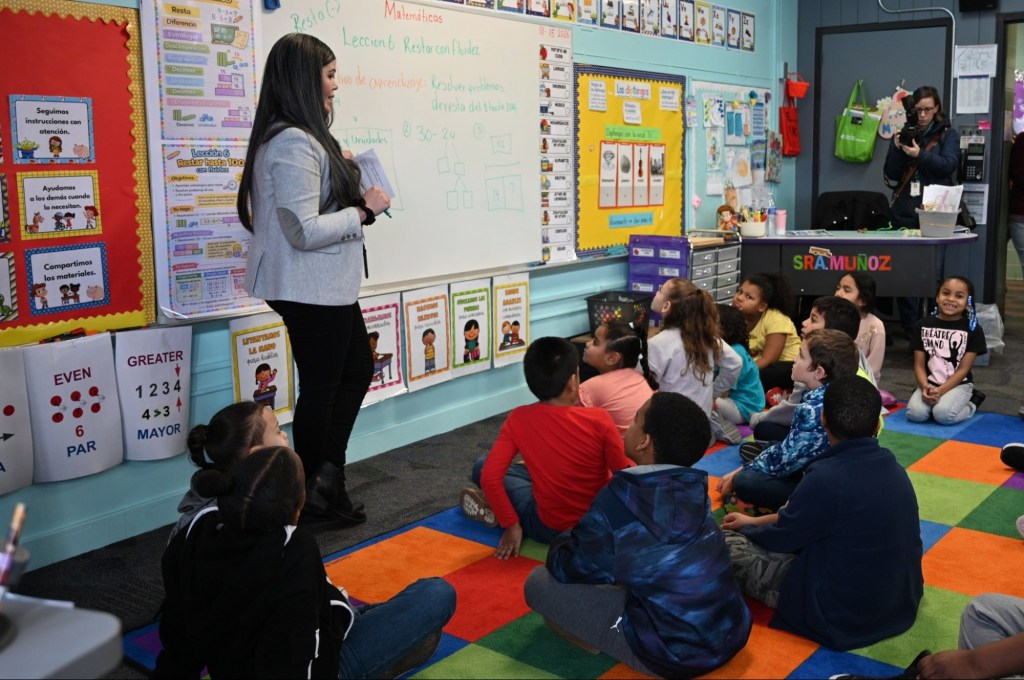
When you walk into any of our dual language immersion classrooms, you will see pre-K-2 studentslearning to read, solve math problems and develop critical-thinking skills in Spanish and English. Bringing English- and Spanish-speaking students into the same classroom to learn core subjects and develop fluency in both languages supports their journey to becoming multilingual and helps instill a deep understanding of and appreciation for different cultures. Each student enriches the experience by sharing their language, culture and family traditions with their peers.
Dual immersion programs also help students see the world through a perspective other than their own. It teaches them how to listen, collaborate and value differences. That is something we need nationwide now more than ever. Those skills matter not just in school, but in life after high school, in college, in their careers and in our increasingly interconnected world.
More than learning critical early education skills, they are learning to navigate between languages, build cross-cultural connections, and prepare for their future in a globally connected world.
Research by Thomas and Collier, Lindholm-Leary, Steele et al. (RAND) and others consistently shows that students in high-quality dual language programs meet or exceed their peers academically over time, particularly in reading and math.
The integration of a dual language immersion model is not merely a modern trend; it is a data- driven mandate for excellence supported by the most extensive longitudinal research in American education. According to Thomas and Collier (2017), dual-language schooling is the only educational model that accelerates learning for English learners while simultaneously boosting the performance of native English speakers. Their research reveals that by the time students reach middle school, those in dual-language programs typically perform one to two grade levels ahead of their peers in monolingual classrooms.
We talk a lot about preparing students for the future, and the evidence is clear: rigorous bilingual education prepares students not just to succeed academically, but to lead in a global society. Our work is only beginning and part of our progress thus far includes an expanded world languages offering across all grades and a Seal of Biliteracy to recognize multilingual achievement and to affirm the value we place on fluency in more than one language.
The foundation for this success begins early. Early childhood is a critical period for language development. During these years, children are uniquely positioned to acquire multiple languages in a way that is both natural and lasting. A strong start in kindergarten sets the trajectory for long-term success, academically and beyond.
That is why kindergarten registration is so important. It is not simply the beginning of school. It is the beginning of a student’s pathway. Across the Allentown School District, families have access to high-quality kindergarten programs that support literacy, language development and foundational skills. For families interested in bilingual education, the Sonia Sotomayor Dual Language Immersion Academy is one of several opportunities available within our district that reflect our commitment to expanding access to specialized, high-quality learning environments.
To every parent, family member and caregiver in our community, I encourage you to take that first step. Register your child for kindergarten and explore the programs available within the Allentown School District. To begin the registration process or learn more, visit https://www.allentownsd.org/families-and-students/enrollment or contact the Office of Accountability and Assessment at (484) 765-4029 or ASDEnrollment@allentownsd.org.
This is a contributed opinion column. Carol D. Birks is the superintendent and chief executive officer for the Allentown School District and can be contacted at superintendent@allentownsd.org.The views expressed in this piece are those of its individual author and should not be interpreted as reflecting the views of this publication. Do you have a perspective to share? Learn more about how we handle guest opinion submissions at themorningcall.com/opinions.