
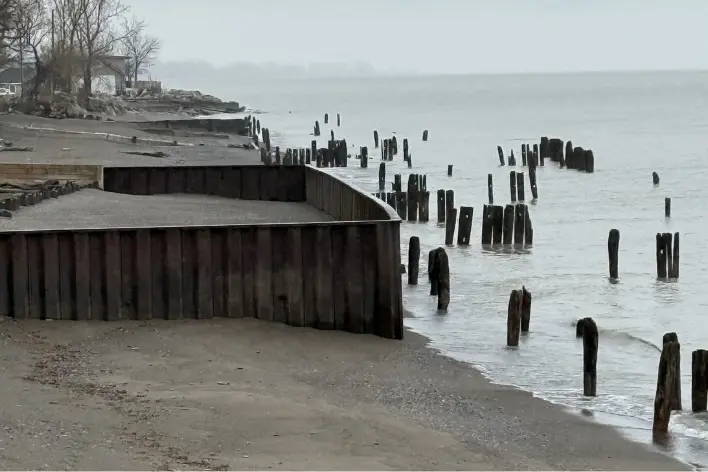
Walking along the shoreline of Erie Shore Drive, a narrow stretch of road along Lake Erie in Chatham-Kent, Ontario, the signs of climate change are hard to miss. Aging breakwaters, patchwork protection barriers, and empty lots where homes once stood, all point to its growing impacts. The area has become a visible example of what happens when climate impacts outpace planning, infrastructure, and policy responses, and when responsibility for those impacts remains unclear.
While this community is far from alone, Erie Shore Drive offers a stark view of how climate risk is reshaping communities and raising a more difficult question: who is responsible for the costs when changing environments put infrastructure and human lives at risk?
Declining ice cover is a key driver. According to local shoreline studies, Lake Erie has experienced a steady reduction in winter ice over recent decades, with projections suggesting it could be largely ice-free by late century. Without ice to protect against wave energy, shorelines are increasingly exposed to erosion and winter flooding.
“We’re seeing signs that things are changing—less ice cover, and erosion and damage happening during months when we haven’t seen it before,” said Jason Wintermute, manager of watershed and information services at the Lower Thames Valley Conservation Authority, in whose territory Erie Shore Drive is located.
The risk is not always gradual or predictable. “Shorelines and shoreline protection can look stable for years, and then suddenly fail—losing several metres of shoreline all at once into the lake,” Wintermute said. He added that much of the Lake Erie shoreline is composed of soil rather than bedrock, making it especially vulnerable. “It’s not as stable as bedrock, and it can collapse and erode over time.”
For homeowners, those risks are translating into financial uncertainty. “From a realtor’s perspective, people don’t realize that if a property falls within the 100-year flood line, you may have trouble getting a mortgage, and insurance likely won’t cover it,” said Nickey Calford, a real estate broker based in London, Ontario.
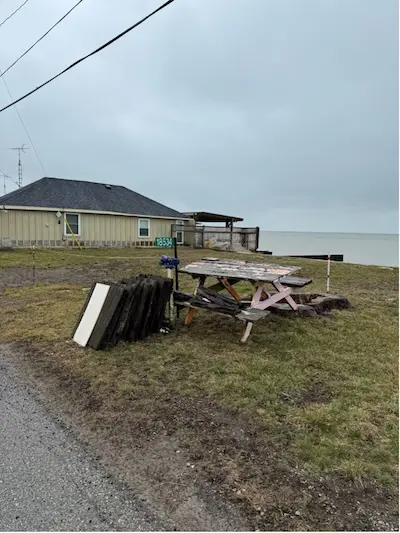 A vacant residential lot along Erie Shore Drive. (Kylie Brezden)
Without access to insurance or financing, the financial burden falls increasingly on homeowners, often leaving them with limited options. “What you’re really buying can start to feel more like a time-limited asset than a long-term investment,” Calford added. In some cases, these risks are contributing to properties being left vacant, as owners face limited options to sell, insure, or reinvest in homes exposed to ongoing erosion and flooding.
In many cases, insurance availability is becoming an early signal of climate risk, shaping what can be bought, sold, or financed. In Canada, as the 2022 report from a federal Task Force on Flood Insurance and Relocation explains, insurance providers already use risk assessments to determine coverage and pricing, and in some high-risk areas, coverage is becoming more limited or unavailable, influencing property values and development decisions.
Despite growing awareness of climate impacts, systems designed to manage risk are struggling to keep pace. Conservation authorities play a key role in reviewing development and regulating activities in hazard-prone areas such as shorelines, but responsibilities are split across multiple levels of government and gaps remain in how risks are managed.
In Ontario, provincial planning policy directs municipalities to consider natural hazards such as flooding and erosion, but how those risks are assessed and managed can vary in practice. “There’s [a] clearer [mandate] from the province on climate considerations in municipal planning, but less clarity when it comes to permitting and how those risks are actually managed,” Wintermute said.
The result is a fragmented approach to adaptation, where responsibilities are split across municipalities, conservation authorities, and higher levels of government, often without clear coordination or sufficient funding, a challenge widely identified in Canadian climate adaptation reports.
That challenge becomes especially visible when considering long-term solutions such as strategic relocation. While precedent exists in some parts of Canada, where governments have supported buyouts and relocation programs in high-risk areas, applying those approaches in practice can be complex.
Associate Professor Brent Doberstein of the University of Waterloo notes that where development was originally approved, governments may bear partial responsibility for addressing the consequences. In practice, however, limited municipal budgets and unclear cost-sharing frameworks can make large-scale solutions difficult to implement.
As risks intensify, homeowners are left in a precarious position, caught between declining property values, limited insurance options, and uncertain pathways forward.
Erie Shore Drive is not an isolated case. It reflects a broader national challenge. As climate risks accelerate, Canada is increasingly forced to confront a difficult question: When past development decisions collide with present-day climate realities, who pays for the cost of adaptation or relocation?