
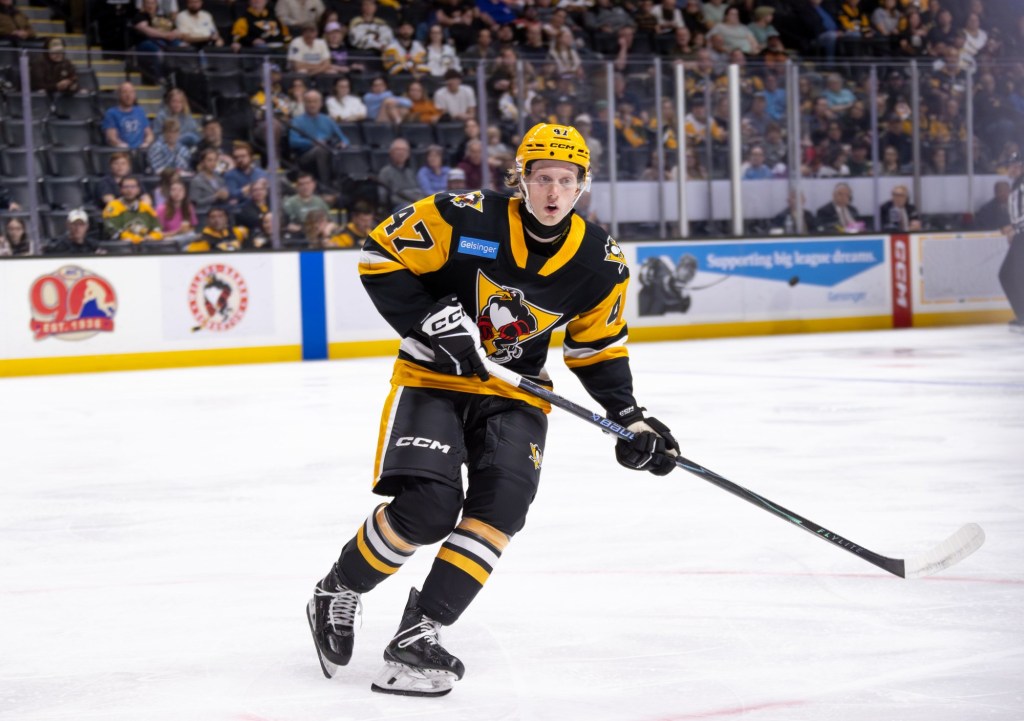
WILKES-BARRE TWP. — With the college hockey (NCAA) season finished and the number of teams in the Canadian junior hockey league playoffs dwindling, many players are getting a head start at transitioning to the pro hockey landscape this spring — joining American Hockey League teams on tryout contracts.
Some players are signed to amateur tryout contracts (ATO) to preserve potential future NCAA/CHL eligibility, while others who are turning pro in 2026-27 without remainingeligibility sign professional tryout contracts (PTO) or even standard player contracts — looking to turn pro full-time in 2026-27.
The Wilkes-Barre/Scranton Penguins have been active in signing players to AHL contracts for the 2026-27 season and beyond, and one of the first players they brought in jumped right into the lineup last week and made an immediate impact.
Signed to a one-year AHL contract for the 2026-27 season on April 2, undrafted forward Daniel Russell joined Wilkes-Barre/Scranton earlier this month on an ATO — making his professional hockey debut April 9 at Bridgeport and recording an assist.
Two nights later on home ice, Russell made it points in back-to-back games — creating a 2-on-1 first-period rush with Atley Calvert and banking a hard low shot off Clevelandgoaltender Zach Sawchenko’s right leg pad, creating a rebound tap-in goal for Calvert to give the Penguins a 1-0 lead in a game that remained 1-0 deep into the third period.
“I wanted to get it over to him, but I couldn’t really find a lane,” Russell said after the Penguins’ win last Saturday. “So the old pass off the pad, classic move, and it was right on his tape.”
Russell has been no stranger to the scoresheet throughout his hockey career.
At Michigan State University, he recorded at least 25 points in each of his four seasons of NCAA hockey — coming off a career-high 39 points (11 goals, 28 assists) in 37 games this season playing alongside a pair of first-round draft picks in Charlie Stramel (2023-first, Minnesota) and Porter Martone (2025-first, Philadelphia).
While certainly not the biggest skater on the ice, listed at 5-10 and 165 pounds, Russell thrived at the NCAA level, which is notably more physical and defensively structured against older competition as compared to junior hockey leagues which have teenagers as young as 16 years old on the ice.
Penguins head coach Kirk MacDonald got to know a lot of the Michigan State staff during his two years as the head coach of Dubuque in the USHL before becoming Wilkes-Barre/Scranton’s bench boss, as colleges recruit players from the USHL and Michigan State had recruited some of MacDonald’s players.
“Speaking to them a lot over the last few weeks and they’re like, don’t judge him on his size. He’s not the biggest guy. He’s going to compete. They weren’t wrong,” MacDonaldsaid. “I think his hockey intelligence, his IQ, is really high. But, he’s got a great stick. He competes hard.”
Adding size and strength will certainly be on Russell’s to-do list over the summer, but simply being able to join the professional hockey world for a few weeks before headinginto off-season training will be invaluable experience for him as he gets a first-hand view of everything the pro game is about.
“I mean, it’s awesome,” Russell said. “College hockey is pretty different, so you kind of get a feel (for) how it is, and it helps a ton going into next year.”
He looks to build off his strong senior season at Michigan State — a season which he showed he was capable of not only playing alongside high-end players in a large role but creatingoffense and setting up his teammates for success.
“They’re getting opportunities, but it also gets us to see hey, like, is this guy? Can he play for us in the playoffs down the road? Who knows when we’re going to need them, right?” MacDonald said. “And it kind of will set the table. And some guys have done a really good job putting themselves in positions where I think we’re like, OK, this guy, maybe he’s not in opening night on game one, but he’s on deck, right?”
If his first few games are any indication, Russell made a strong first impression with the AHL Penguins staff. And while some of the younger players getting into games at the end of the season might not play a factor into the success of the 2025-26 Penguins, they are setting themselves up to be part of the conversation for next year’s roster with strong impressions this spring.