
By SHANNON O. WELLS
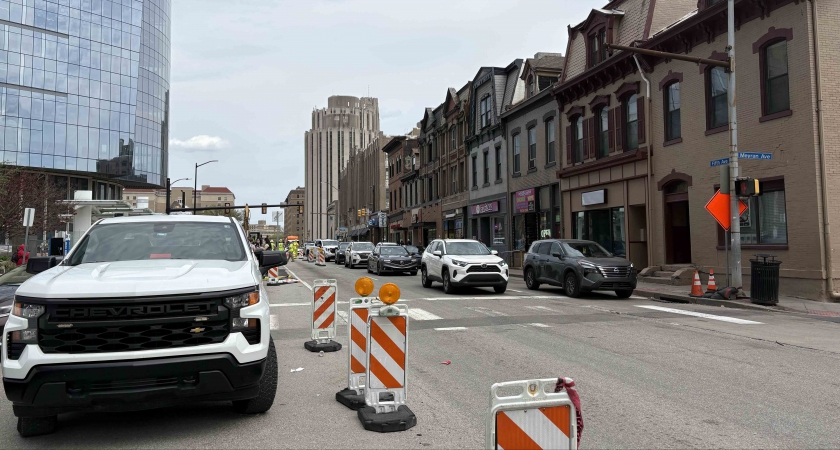
Anyone driving in Oakland knows that construction on Pittsburgh Regional Transit’s Bus Rapid Transit line is impacting Fifth Avenue from Bellefield Avenue to Robinson Street.
“Just about every intersection has been impacted at some point or will be impacted, for milling, patching, paving the roadways and basically installing new sidewalks, curb cuts and accessible ramps throughout,” Pitt Police Commander Bradley Kiefer told the Senate’s Campus Utilization, Planning, and Safety (CUPS) committee on April 7.
Pitt Police has additional patrols along the Fifth Avenue corridor where construction is underway, and a special traffic enforcement detail has been out and about, “paying particular attention to these problem areas where there’s pedestrian safety concerns,” he said. “Officers are out there writing citations, providing warnings as appropriate, and provide education and awareness about the ongoing construction in the area.”
Drivers are permitted to use the former counter-flow bus lane traveling toward downtown on Fifth Avenue “at least through the end of April, from what I’m told, to help alleviate some of the traffic and congestion,” Kiefer noted.
Also, curb cuts on sidewalks and subsequent paving is taking place on Fifth Avenue between University Place and Thackeray Avenue.
“Each week, we should see some progress in some of these intersections starting to open up to help alleviate … both pedestrian traffic and vehicular traffic,” Kiefer said, noting crews will be on site, depending on weather, between 7 a.m. to 5 p.m. Mondays through Saturdays.
He added that representatives from Public Safety, Pitt Mobility, and Pittsburgh’s Department of Mobility and Infrastructure have examined most intersections that have generated complaints about pedestrian safety.
“We’re working really hard to bring all the right people to the table to help make these safer for both pedestrians and vehicles,” he said. “There’s some short-term recommendations, some long-term solutions. Obviously, just paving it and finishing the job should help correct it all.”
Kiefer noted that two flaggers now are on duty at the intersection of Fifth Avenue and Darragh Street in front of Biomedical Science Tower 3 during contractors’ work hours Mondays through Saturdays, and the crosswalk will remain open.
“They’re going to install temporary water buffalo-like barriers to create more gap between where vehicles are traveling northbound on Darragh Street, going up the hill and away from pedestrians,” he said, adding that the project could be completed by mid-April.
One block down Fifth Avenue, at Lothrop Street, the original crosswalk will be moved about 15 feet up the hill where there’s been a temporary crosswalk with cones and signs.
“They’re going to put in temporary paintings on the ground for that. We’re hoping that this is going to improve visibility for drivers, … and make it safer for pedestrians there as well,” he said.
Two stop signs are supposed to be installed at Fifth and Bouquet Street, where the traffic light has been out. “So, if you’re on Fifth Avenue approaching Bouquet Street going westbound, there’s going to be a stop sign in each of the two lanes,” Kiefer said. “That should help make it safer for pedestrians to safely cross over.”
At the April 15 Faculty Assembly meetings, CUPS Chair David Salcido praised the steps that have been taken at Fifth and Darragh. “We had a pretty serious issue with the construction on Fifth Avenue and Darragh Street — a lot of faculty concerns, staff concerns. We had a very productive engagement with our public safety partners who contacted the contractor, as well as PRT … and everybody came together and made some great changes. So I just want you to know that please continue to tell us when there are issues, because things can get done thanks to all those partners.”
Tornado warnings
The CUPS committee also heard information about what to do in the event of a tornado, in light of the tornado warning that was issued for the Pittsburgh area on March 26.
Ted Fritz, vice chancellor for public safety and emergency management, said changing weather patterns have made tornados an active topic of concern.
“The National Weather Service put out an alert (and city of Pittsburgh) police put out an emergency notification as well, so it’s a good time to just cover some basics on tornado events,” he said, noting that Pitt’s communication center in the Public Safety Building operates “24/7.”
“We always have a weather connection there in the form of a weather radio (that’s) certified by the National Weather Service as a storm-ready institution. … You have to jump through several hoops to get that designation,” Fritz noted. “One of the reasons we got that is because of our ability to monitor the weather.”
Especially when big events are going on, Pitt receives tailored forecasts from the National Weather Service, “which is really helpful. The bottom line is, we are monitoring that.”
Different classifications trigger what actions the Public Safety department will take. “If there’s a tornado watch, for example, we will be posting on our social media, ‘Hey, there’s a tornado watch out there. Make sure you’re paying attention and keeping an eye on the weather … (and) go over what your individual or department plans are in the event this watch becomes a warning that could impact your area.’”
An official tornado “warning” is issued only if it appears Oakland and the Pitt campus are in the storm’s track.
“We also do that for the regional campuses,” he said. “But if we did one, for example, at (Pitt–Greensburg), you all would not get an emergency notification unless you’re signed up for Greensburg ENS alerts,” he said of the Emergency Notification System. “We’re monitoring that for all the different campuses. What the warning means is this is an immediate threat, and there’s actions that you should take.”
The ENS message will likely contain a website link with “lots of specific directions,” such as “Go to a basement or an interior room,” Fritz noted. “If you’re outdoors, you should be seeking shelter in a sturdy building. Those types of actions.”
The National Weather Service recently added the “tornado emergency” classification, where a tornado is often on the ground or about to be on the ground. “If it’s a violent tornado, and they expect catastrophic actions from that tornado … we would issue, obviously, emergency notification for that as well.”
Fritz noted that most tornadoes that have impacted the University come from the east, toward Greensburg, along with just north of Pittsburgh.
“The Westmoreland area seems to be more in a track,” he said, along with a “similar track” to the north of Pittsburgh, “but we’re not immune.”
If a tornado is imminent and you’re in a high-rise building such as the Cathedral of Learning, Fritz said the key advice is to stay out of elevators and seek shelter away from windows, such as in a stairwell.
“Getting from the very top of the Cathedral to the bottom poses some difficulty, and it’s not without danger either. … You have a bunch of people storming down the stairs,” he said. The best places of refuge in most of Pitt buildings, including the upper floors of the Cathedral, are the stairwells, if you can’t get downstairs to the basement, Fritz said.
If a building’s stairwell has glass doors or windows, such as the Strand building on Forbes Avenue, Fritz recommended retreating to any interior room away from windows. Bathrooms tend to be strongly reinforced to protect plumbing infrastructure.
“You definitely want to go to … wherever there’s an interior room away from windows, something solid. The bathrooms are a great idea, usually, to be able to go there,” he said, adding that all Pitt buildings have emergency plans associated with them.
For more information about safe building evacuation, visit the Office of Public Safety & Emergency Management’s Environmental Health & Safety website.
Shannon O. Wells is a writer for the University Times. Reach him at shannonw@pitt.edu.
Have a story idea or news to share? Share it with the University Times.
Follow the University Times on Twitter and Facebook.