
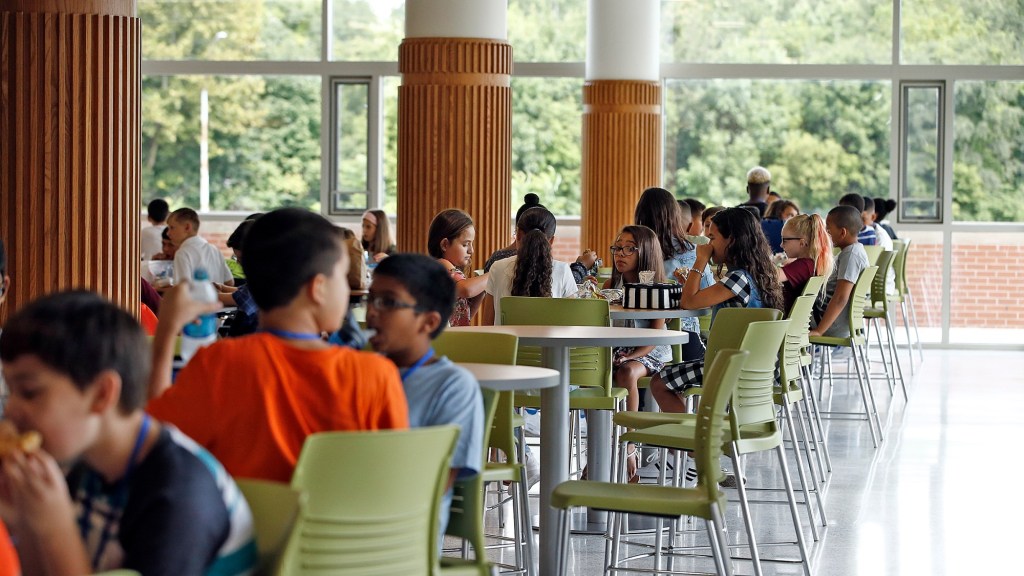
Bethlehem Area School Board members expressed a willingness to pilot a universal free lunch program at a select number of district schools during a Monday night committee discussion, but also said more data is needed to assess the potential financial impact.
District residents and organizers from the Lehigh Valley DSA have spent months advocating for a universal free lunch program. Multiple board members referred to that advocacy, in particular parent testimony delivered at the board’s March meeting, as they considered an annual report delivered by the district’s business manager and supervisor of dining services.
Implementing universal free lunch would mean changing how the district handles federal reimbursement for meals, and the district’s chief financial officer has repeatedly warned that such a change could make it more difficult to close a projected budget deficit.
Should Bethlehem Area schools fund universal free lunch? How budget math is complicating the debate
The core of the debate is whether it would be beneficial to take advantage of a federal reimbursement mechanism called the Community Eligibility Provision. Enrolling in that program, either districtwide or at selected schools, would mean families no longer need to fill out annual applications for the National School Lunch Program (known colloquially as “free and reduced lunch”).
Free breakfast already is available to all Bethlehem Area students through a state program. While enrolling in CEP would also make lunch free for all students, it would not be free for the district.
When districts enroll in CEP, the federal government calculates how many students qualify for meals that are reimbursed at 100% and how many students qualify for meals that are reimbursed at a lower level.
The wide socioeconomic spread of Bethlehem Area families means that the district would not qualify for 100% federal reimbursement if it enrolled in CEP districtwide.
The business office and dining services calculated that the district would qualify to have 70% of meals served reimbursed at 100% (the federal government sets a value of $4.62 per meal), while the other 30% of meals served would be reimbursed at only 46 cents per meal.
That would leave the district on the hook to cover the gap. Chief Financial Officer Harry Aristakesian said Monday that the district is facing a budget deficit of $8 million — one it is obligated to close before next month’s passage of a proposed final budget for public review — and he continues to believe that enrolling in CEP districtwide is not financially feasible.
Selecting pilot schools
Business Manager Frank Pearn Jr. and Dining Services Supervisor Ashley Kelly presented board members with a range of options for partial CEP enrollment, which would potentially allow the district to only enroll schools at which 100% of meals served would be fully reimbursed.
Representatives from Metz, the district’s food service company, told the board that partial CEP enrollment comes with potential downsides. Metz Assistant Vice President Andrew Chandler said the company serves 80-plus districts in Pennsylvania, and its sister company serves another 70 in New Jersey, and that nearly all its schools that enroll in CEP do so districtwide.
Metz representatives presented two primary concerns: Parents whose children are different ages and therefore at different schools can get confused when free lunch policy differs from site to site, and that can result in fewer families filling out the annual application for free and reduced lunch at the sites where that application still is required.
In Lehigh and Northampton counties, Southern Lehigh is the only public school district that doesn’t meet the districtwide eligibility threshold, according to a 2025-26 school year report from the Pennsylvania Department of Education that estimates program eligibility.
Six Lehigh Valley school districts are enrolled in CEP as a district: Allentown, Catasauqua Area, Easton Area, Northern Lehigh, Salisbury Township and Whitehall-Coplay.
Nazareth Area and Northwestern Lehigh enroll at least one school in their district, according to the state report.
Enrolling some schools and not others in universal free lunch risks stigmatizing entire schools, Chandler said.
Pearn echoed those arguments, saying, “We wouldn’t be shaming individuals, we’d be shaming schools.”
But board members pushed back on that argument. Board President Michael Faccinetto said the district’s community schools already receive additional resources designed to meet the needs of families and universal free lunch could become another of those resources.
Business office and dining services projections show nine schools would potentially qualify for 100% federal reimbursement: Lincoln, Marvine, Freemansburg, Thomas Jefferson, William Penn, Donegan and Fountain Hill elementaries, plus Broughal and Northeast middle schools.
Clearview Elementary School’s data shows it would potentially qualify for 99.26% federal reimbursement. Pearn said Clearview has historically seen income levels that would qualify it for 100% federal reimbursement.
As discussion turned to which schools might participate in a universal free lunch pilot, board members said they need more data to assess what groupings might make the most sense and how many schools the pilot should include.
An idea to include only one or two schools did not win much support, with more board members saying they’re open to a larger pilot, potentially of all the schools that would qualify for 100% federal reimbursement or of all the district’s Title I schools.
Federal funding impacts
Title I is a U.S. Department of Education budget program that allocates funding to schools based in part on the number of families that fall below federal poverty levels. It is the most well-known and the largest of federal programs that support public schools.
BASD’s budget projections assume Title I funding will largely remain stable relative to recent years, which would place the district in line for nearly $4.6 million. That’s a little over 1% of the district’s total budget.
Bethlehem Area Superintendent Jack Silva told The Morning Call that Title I has historically been seen as the most stable of federal funding streams, but added that doubts are rising among school leaders as to whether it will remain protected as the federal government continues to express support for moving education funding from the U.S. Department of Education to the states.
The stability of Title I funding was a large part of the discussion regarding universal free lunch because federal funding streams are connected. Both Title I and the free and reduced lunch program use eligibility for other federal assistance programs to help determine how much federal funding a school can get.
The federal Supplemental Nutrition Assistance Program is an important eligibility metric for those other federal funding programs. Families that are enrolled in SNAP automatically qualify for free and reduced lunch and don’t have to fill out the annual application.
Not all families that are eligible for SNAP enroll, and there are other ways to qualify for free or reduced lunch, including Medicaid enrollment and Head Start participation. Currently 53% of Bethlehem Area families qualify for free lunch, with another 5% qualifying for reduced-price lunch, leaving 42% of students in the paid lunch category.
Annual free and reduced lunch applications help the district determine which of its families fall below or slightly above federal poverty levels, which is data it needs to ensure it is not shortchanged when applying for Title I funds.
If the district enrolls in CEP and no longer requires families to fill out those annual free and reduced lunch applications, it would need a different way to gather income data.
Further complicating the situation are cuts to SNAP. Currently, 4,000 of Bethlehem Area’s 12,500 students qualify for SNAP, but the federal budget act passed in July included eligibility restrictions that have already reduced the number of district students enrolled in the food assistance program, Pearn said.
Those federal restrictions include limiting which immigrant families qualify for SNAP.
SNAP enrollment is also one of the main factors used to help determine how many students qualify for 100% federally reimbursed meals under CEP. That means if SNAP enrollment falls, a school district enrolled in CEP would likely need to use more of its own funds to cover universal free lunch.
Figuring out how much SNAP enrollment will fall and the ripple effects of that on both CEP reimbursement levels and Title I funding is like “trying to flip eight coins,” Pearn told The Morning Call.
Pearn told the board, “If anybody has a crystal ball, that would help us out tremendously, but I don’t think anybody really knows what the impact is going to be.”
With so many unknowns left on the table, board members requested more data to better estimate how a universal free lunch pilot would affect the district’s budget, families and particular schools.
Silva said district staff would work on preparing additional data regarding CEP enrollment and universal free lunch pilot options, plus Title I funding implications, for future discussions.
Board member Silagh White drew applause from the audience when she threw yet another wrinkle into the discussion, asking whether the district should reconsider its investments in Chromebooks for younger students as more data emerges regarding the efficacy of technology in the classroom.
“I just want us to be thinking, not just so narrowly — but if you could look beyond in other projections,” White said, after noting that money spent on devices could help pay for programs like universal free lunch.
Lehigh Valley DSA organizer Sebastian Zawierucha, the only person who spoke during public comment during Monday’s finance committee meeting, closed the meeting by thanking the board for “listening and acknowledging” and also thanked the business and food service teams.