
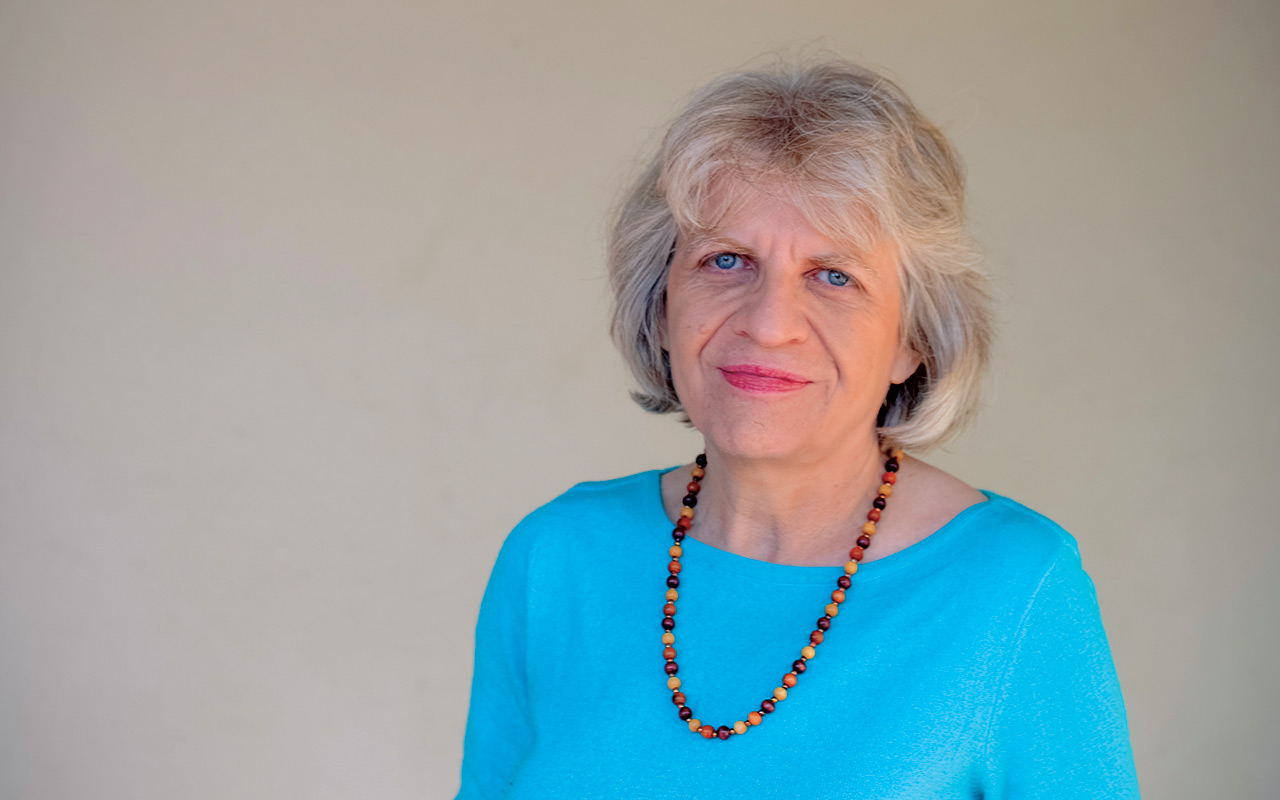
 Collingswood New Jersey Poet Ruth Rouff
“Soft-spoken but sharp, Collingswood writer Ruth Rouff proves some of the strongest voices live on the page.”
Ruth Rouff was born in Pittsburgh, but raised in South Jersey after her father’s job brought the family to the Philadelphia Navy Yard when she was 3. South Jersey never really left her, and eventually she found her place in Collingswood.
About 25 years ago, she heard that LGBTQ folks were leaving Philadelphia and settling into the big old houses near Knight Park. One walk through the neighborhood was enough. The trees, the architecture, the quiet sense of possibility, it all felt right. She moved. She stayed.
Coming out wasn’t a lightning-bolt moment. While studying at Vassar in the 1970s, a campus with a visible and vibrant gay community, Rouff found herself drawn to writers like Mary McCarthy, whose novel The Group included a lesbian character she admired. Later, Rita Mae Brown became another important presence in the cultural landscape. Still, Rouff didn’t fully come out until her mid-20s, when evenings at Philadelphia women’s bars became part of her real-world education.
Books, though, were always her constant.
At Vassar, a writing instructor told her plainly that she was a writer. Sometimes it takes just one person to say it out loud. Even so, the path wasn’t direct. Rouff worked retail, and office jobs, and spent years teaching in Philadelphia and Camden before landing in educational publishing in South Jersey. There, she wrote developmental reading materials and vocabulary books for middle school students, work that felt purposeful and grounded.
Her literary heroes reflect both heart and precision. The poetry of Elizabeth Bishop has long resonated, especially given Bishop’s complicated, largely closeted life. And a line from poet John Keats, “Unheard melodies are sweeter,” has stayed with Rouff for decades.
She’s also not afraid of big subjects. One of her most research-intensive projects focused on the groundbreaking athlete Babe Didrikson Zaharias. The work took years of reading and digging, but Rouff describes the process as more invigorating than daunting, a deep dive into the life of a woman who refused to fit neatly into anyone’s expectations.
These days, she’s writing a series of poems about the Kennedy family, exploring ambition, legacy, and the complicated cost of power. It’s a subject she grew up with and one that still feels strangely current.
In person, Rouff is soft-spoken, something she suspects people sometimes misread. Quiet doesn’t mean unopinionated. In fact, she can be sharp and incisive; she just prefers to let that edge live on the page. Sometimes, she admits, she wishes she were more outwardly forceful in debate. But that’s not her style. “I have to do it in writing,” she says, a simple sentence that explains a great deal. The page is where her arguments sharpen, where her convictions stand fully formed.
Ask where she feels most like herself and the answer comes quickly: a library. Coffee shops are pleasant too, she doesn’t mind the hum of conversation, but bookshelves feel like home. At the same time, she values connection. She participates in a local Buddhist group, chanting regularly and attending weekly meetings, and she’s part of Aging with Pride, the over-55 LGBTQ group at the Katz JCC in Cherry Hill, where community and conversation continue well beyond the page. She loves baseball. She enjoys nature. She’s planning a trip to New Orleans this spring. And yes, she’s single — open to being pleasantly surprised by what might come next.
A perfect writing day? Late morning into early afternoon at her desk, followed by a walk and dinner with someone she cares about.
In Collingswood, among tree-lined streets and a community she chose, Ruth Rouff has built a life shaped by language, curiosity, and steady conviction. It may not be flashy, but it’s deeply, unmistakably her.
Excerpt from Rouff’s poem “Malin”:
Six feet tall, 200 pounds, hair
blond as the sun, spoke with a lisp.
Did a mean Mae West. Was
a swish, but would knock
you into next week if you called
him the F word.