
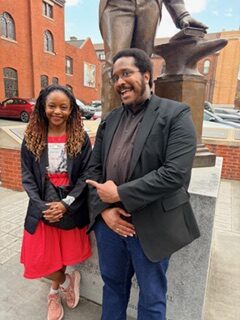
Raina Yancey and Mijuel K. Johnson, the owner and lead guide of The Black Journey walking tours. They stand in front of the statue of Rev. Richard Allen, founder of Mother Bethel AME Church.
Photo: Constance Garcia-Barrio
By Constance Garcia-Barrio
On a warm Saturday afternoon in April, Mijuel K. Johnson, lead guide with The Black Journey, which offers Black history walking tours, gave a tour that sparkled with knowledge, passion, and a dash of theatre.
This tour — an easy five-block stroll even using a cane as I was — included such iconic sites as the President’s House, Mother Bethel AME Church, and more. The Black Journey also offer tours centered on the city’s Black medical history, the 7th Ward, the focus of W.E.B. DuBois’ classic “The Philadelphia Negro,” and on other facets of Philly’s African American heritage.
“We bring history to life on the very streets where it happened,” said Raina Yancey, owner of The Black Journey and a technology transactions attorney with a large bank.
History has long held a key place in the lives of Yancey and Johnson, both native Philadelphians.
“My grandmother had family photos on a wall in her home,” said Johnson, who has a degree in history and political science from La Salle University.
Yancey’s mother was a ranger at Independence National Park. “I grew up listening to history,” said Yancey, who is a graduate of Temple University’s Beasley School of Law and Richmond University in London, England, where she studied international relations, history and economics.
A course at Richmond University helped shape Yancey’s approach to presenting the past.
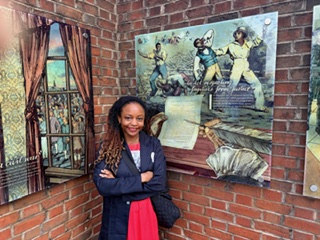
“The class would meet at different historic sites, like [the remnants of] one of the seven gates of London the Romans built [roughly between AD 190 and 225] to protect the city,” she said.
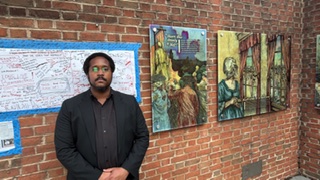
Yancey and Johnson stand in front of the President’s House exhibit after panels were returned.
Photos: Constance Garcia-Barrio
Besides studying abroad, Yancey has worked in Beijing, China, and Dubai, United Arab Emirates. She has also visited many U.S. states and all seven continents, including Antarctica, taking tours and gleaning information about Black history wherever she went. Now, it’s as if the world is repaying her by attracting international tour participants.
“Visitors come from Paris, Switzerland, New Zealand and other places,” Yancey said. “We have a five-star rating.”
Johnson also brings a cosmopolitan perspective to tours, adding comments about Black history in the Caribbean, Brazil, and Spanish America. He pointed out that Simon Bolivar, who helped free Spanish America from Spain’s rule, is said to have had African ancestry.
In planning the content and structure of the tours, Yancey consulted Temple University’s Blockson Black History Collection, the Historical Society of Pennsylvania, and other premier archives.
The tours pull no punches.
“Of the 56 signers of Declaration of Independence, 41 were slaveholders,” Johnson told our group. He and Yancey don’t dilute sometimes-harsh truths for children.
“Our children can handle it,” Yancey said, noting that the tours are appropriate for children from age five and up. “They understand what is being said and often ask questions, which we welcome.”
One tour stop popular with young and old is Congo Square, now known as Washington Square, at 6th and Walnut Streets. Black city residents, enslaved and free, used to meet here on Sundays, Johnson said. Children often enjoy learning that besides containing the Tomb of the Unknown Soldier of the Revolutionary War, the land was also a potter’s field, where poor people remain buried to this day.
Black women street vendors may have taken advantage of the Congo Square gatherings to sell their famed pepperpot soup or stew, a spicy dish traditionally made with beef stomachs and vegetables like onions, carrots, and potatoes.
“You can still buy pepperpot stew in Africatown [an economic hub on Woodland Avenue between 47th and 74th Streets], but it’s probably different from what was sold in the Revolutionary War era and the 19th century,” Johnson said.
The tour ended at Mother Bethel African Methodist Episcopal (AME) Church, located at 419 S. 6th Street.
“It’s the oldest piece of real estate continuously owned by Black people in the U.S.,” Johnson said of the church, founded in 1794. The Rev. Richard Allen, minister, abolitionist, and former slave, founded the church after members of nearby St. George’s Methodist Episcopal Church tried to force Black congregants into segregated seating.
Mother Bethel has magnificent stained-glass windows, a museum, an archive, and the tomb of Rev. Richard Allen.
The mood of our interracial group of tour guests was lively and receptive. However, Yancey notes that the political climate has changed since Black Journeys began in 2019.
“We get a fair amount of heckling now,” she said.
In tough moments, Yancey and Johnson may embrace the enthusiasm of tour participants and recall the grit of favorite figures in Black history.
“Frederick Douglass is one of my heroes for taking control of his life and identity, and I also admire Henry ‘Box’ Brown,” Johnson said. “He was so determined to be free that he had himself mailed to Philadelphia in a box.”
Yancey admires Ona Judge, an enslaved maid to Martha Washington. Judge escaped from the Washingtons in the 1790s when they lived here during Washington’s presidency.
“Ona defied the most powerful man in America over and over again,” Yancey said.
Yancey has gone beyond giving tours to preserve Philadelphia’s Black history. The removal and limited restoration of “Freedom and Slavery in the Making of a New Nation,” an exhibition on slavery at the President’s House, led her to join the City of Philadelphia’s lawsuit to require the National Park service to fully restore the exhibition.
Avenging the Ancestors Coalition (ATAC), a group of historians, clergy, lawyers, activists and neighbors fighting for telling the whole truth of Black history, has also joined the lawsuit, Yancey said.
Meanwhile, Yancey and Johnson suggest ways to defend African American history:
• Buy a banned book.
• Advocate for that book to be read in your child’s school and included in the school library.
• Put a banned book in a Little Free Library for circulation throughout your community.
• Consult the Black Caucus of the American Library Association for lists of excellent books for children at: https://www.bcala.org/booklists.
• Be a griot for your community, reminding neighbors of past accomplishments
• Join or support Avenging the Ancestors Coalition (ATAC) at: www.avengingtheancestors.com.
• Register to vote
Yancey adds one last suggestion. “Consider taking one of The Black Journey’s tour,” she said.
For details about the tours, visit: www.blackjourneyphiladelphia or call: (267)702-3479.