
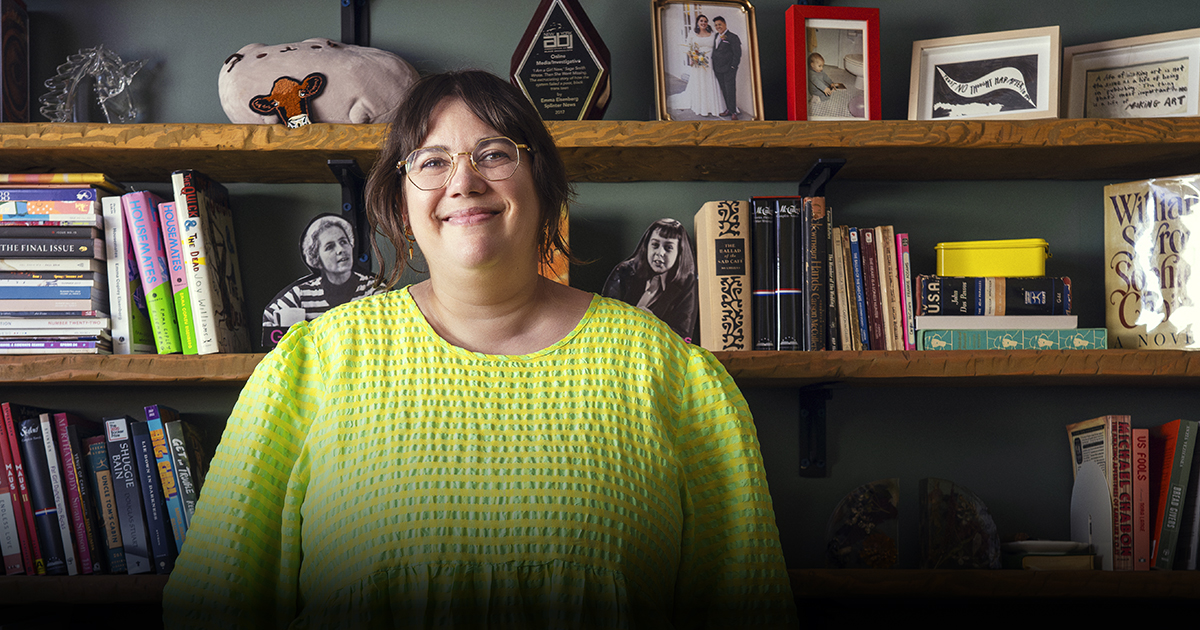
The acclaimed South Philly novelist is back with a new work of fiction, set in and around Philadelphia.
Get a compelling long read and must-have lifestyle tips in your inbox every Sunday morning — great with coffee!
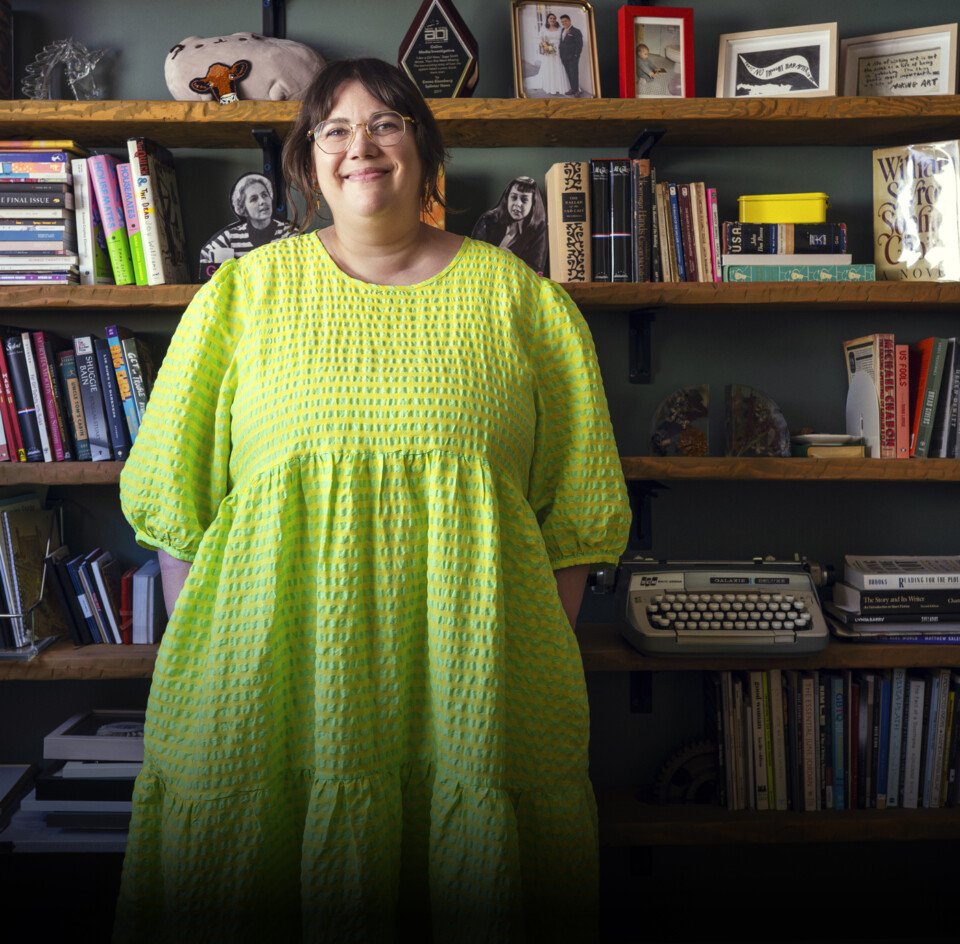
Writer Emma Copley Eisenberg, who has a new book called Fat Swim / Photography by photography by Kyle Kielinski
Writer Emma Copley Eisenberg, whose byline has appeared in The New York Times, Esquire, McSweeney’s, and right here in Philly Mag, made a big splash with her 2024 novel, Housemates, inspired by her experiences living in West Philly. This month, the queer Haverford grad and fat liberationist returns with Fat Swim, a collection of short stories about our city. Here, she explains why she’s moved to South Philadelphia, why she’s pissed at Serena Williams, and why she requests that you never, ever call her “curvy.”
Hi, Emma. How are you?
Well, I have to go to the dentist right after this.
My condolences.
I’m trying to make sure my body doesn’t collapse as I approach 40.
At 51, I more than commiserate. At what point did you realize you wanted to be a writer?
I was very, very young. Do you remember the magazine called Cricket?
I sure do! That and Highlights.
[Laughs] My mom was a children’s librarian and my dad was a labor organizer for Broadway actors. I am, by the way, named after Emma Goldman, the socialist activist who also ran an ice cream store for years. So I come from a very nerdy, bookish family. And my parents got me Cricket. I entered its little literary contest when I was seven and won. It was the best thing that ever happened, and I realized, Wow, I can communicate to people through my writing. That was the coolest feeling.
I just blazed through your 2024 novel, Housemates, which is set in a West Philly queer group house, very close to where I lived for years. It made me really miss that neighborhood and the quirky community of people who make it up.
It really has its own way of life out there. I’m originally from Martha’s Vineyard — before it got fancy — and grew up in Chelsea in New York City. I came to Philly in 2005 to go to Haverford, graduated in 2009. Then I went to West Virginia for a couple of years and moved into that West Philly house in 2011.
Why West Philly?
I didn’t have a clue what I was doing. I didn’t know where to live. What I did know was that a lot of my friends from Haverford were in West Philly and that it was filled with artists and queers. It felt very alive. Truly diverse.
For those people who don’t understand the concept of a West Philly group house, please explain.
You are living with a bunch of other people in a very communal way. It felt very warm — it was like a family that you came home to at the end of the day. I felt much less alone, and that was good because this was a very alone period in my life.
I think it was during your early days of West Philly living that you wrote for Philadelphia Weekly.
[Sighs] I miss Philly’s alt-weekly days. I did a lot of fact-checking and arts writing for the Weekly, back when the paper was doing a lot of really important journalism about race and sexual assault, and I also wrote for The Philadelphia Citizen [now Philly Mag’s sister publication], which was very new at the time and trying to do something really different.
I know a lot of folks are anxiously awaiting Fat Swim, which comes out on April 28th. This is a collection of short stories, all fiction?
Yes. It’s a little strange, in a way, because Fat Swim was supposed to be my very first book. I started writing it more than 10 years ago but just wasn’t happy with some of the stories. So in 2020, I published The Third Rainbow Girl, a nonfiction book about two girls who were killed in West Virginia in 1980. That was my first book. Then Housemates in 2024. And now Fat Swim, which is weirdly both my newest and oldest book.
Are these stories set in Philly?
Most, yes, and a lot of the characters from one story will know characters in another story. One story is set at the Jersey Shore; a couple are in rural central Pennsylvania.
Housemates was clearly inspired by your experience living in the group house. Is that level of inspiration from your personal life also turning up in Fat Swim?
I like to say that I write about my real-life experiences whether I’ve lived them or not. Some of the things I have not lived directly, but I feel are emotionally true or connected to something that I grappled with or thought about. Like all fiction writers, we take little pieces from everywhere, bits of other people, things we imagine, things we watch on TV, and we make this nest.
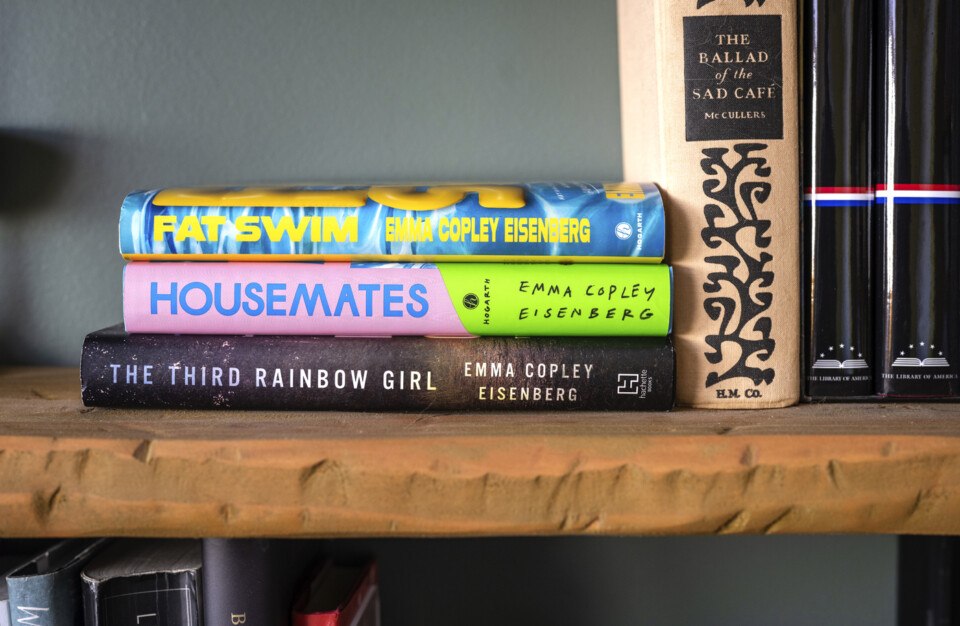
Books written by Emma Copley Eisenberg
What’s the oldest story in Fat Swim, and which is the newest?
The oldest is called “Ray’s Happy Birthday Bar,” after the real bar in South Philly. I’ve only been a patron a handful of times, but I have heard many stories. It’s about a particular character who is a person I’ve seen around in South Philly many times, even if she’s not a real person. She’s a character struggling with sexuality, her friendships, what it means to be a white working-class person in Philly, and with a choice she made a long time ago to become a parent or not — a choice that is now haunting her.
And the newest?
“Camp Sensation.” What if there was a camp in the woods of central Pennsylvania where you could go fix your relationship with your body, where they could help you understand what a body is and how to love it? That story is particularly vulnerable for me, because it is not completely realist. It has some strange and magical elements, which was new for me.
I’ve gathered that your body is something you’ve spent a lot of time thinking about. What is your relationship with your body these days?
It changes all the time. My thinking and my sensations and my feelings about my body and my understanding of it have changed so much and continue to change every day, so there is no one quote-unquote journey. I think the idea that there could be one journey is something that troubles me a lot.
Is there a better way to describe or discuss it?
Maybe we should think about how the shapes of stories we use to talk about our bodies are really limited. Like, there’s the weight loss journey: Here’s a before picture where I’m fat and the camera is making me look pale and washed-out and ugly. Oftentimes, in those photos, the fat body is very dehumanized. But then, in the after photo, the person is thin and happy and colorful, and their life seems more full. That’s one shape of a story we get a lot. And now that I’ve been fully exposed to the fat liberation movement — a social justice movement founded during the 1960s along with the civil rights movement and the disability justice movement — it’s really just about body autonomy and saying that every person has rights and values just as they are. Even fat people. Fat people shouldn’t have to change their bodies to have basic protections in the workplace and comfort as they move and travel in the world.
Do you consider yourself a fat liberationist?
There’s a difference between me as a person and my art — the books I write. My books don’t have any message or political views. But in my public-facing life and me writing opinion pieces and advocating, yes, I definitely believe in the ideology of fat liberation. Which, again, to me just means body autonomy and basic rights and respect.
It seems like not that long ago, we were all cheering on these commercials that suddenly had fat people in them. You didn’t have to be a waif to get a job in an advertisement. But more recently, I feel like everybody is talking only about Ozempic; the pursuit of not being fat almost seems bigger than it ever was before.
There are so many people smarter than me out there looking at this moment in a sociological and historical way. I’m just a fiction writer. But my armchair comment from my little couch is that this has been really sad to see. Any kind of public joy over the existence of fat people is met with slapping us on the wrist and saying, Just go away. You’re gross. You’re disgusting.
People are just … mean. Like it’s junior high all over again.
I fully anticipate that when you publish this interview online, there will be comments that say, “She’s advancing this idea that is unhealthy and disgusting.” It’s very much in every ecosystem. Seeing fat people living normally and not hating themselves can provoke a very intense and immense reaction that is very interesting to me.
And getting back to those ubiquitous Ozempic ads, they don’t seem to be helping one bit.
It’s not just the GLP-1 ads. I did not need Mike Tyson coming on during the Super Bowl to tell me how much he hates fat people in his “real foods” commercial. And then you have Serena Williams, someone I really used to admire, coming out and promoting GLP-1 programs. Of course, then we find out that her husband is an investor in that company and profiting on it.
You left West Philly for South Philly in 2025. Why the big change?
I’m still in West Philly a couple of times per week, seeing people that I love, eating at all the restaurants, and hanging out at Clark Park watching queer acrobatics and cats on leashes. But I fell in love with Art and got married and we decided to choose a new neighborhood together, to start the next chapter of our lives in a new place. And Art is Chinese-Viet American and wanted to be near all the soup.
Favorite stop for soup?
Café Nhan for pho tai, and I also really like those delicious spongy meatballs and the brisket in the soups there. And the other thing about South Philly we love is that there is this culture of protecting each other’s packages. [Laughs]
Many of my friends in South Philly eat out all the time, just because there are so many options within walking distance. Do you cook at home at all?
Oh, yes. I usually make something that is very gluten- and pasta-forward. But, really, Art should do the cooking. They are a hot pot aficionado master.
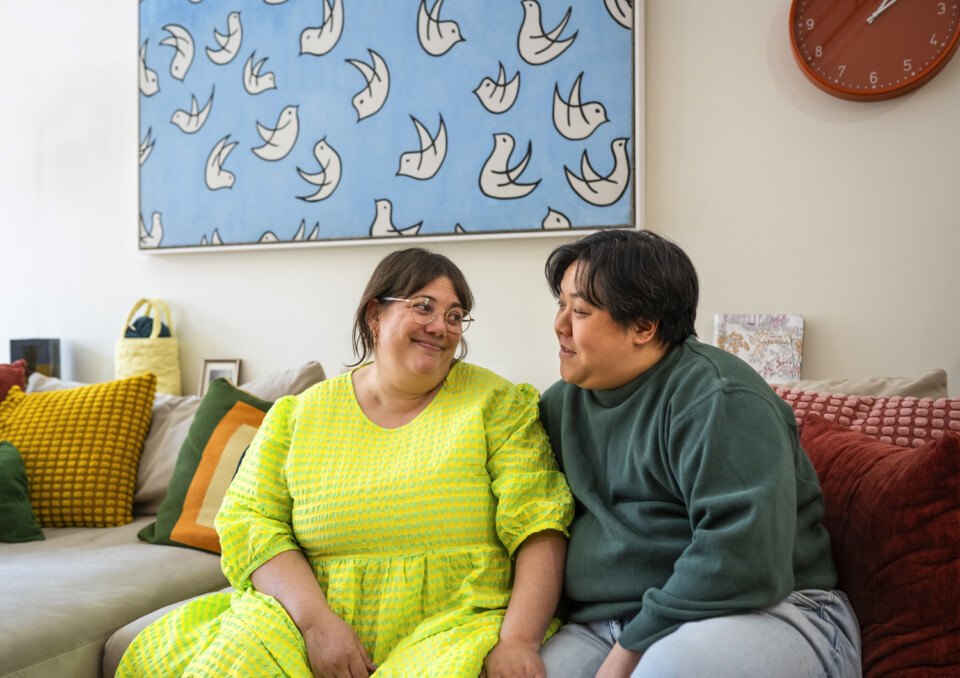
Emma Copley Eisenberg with spouse Art Phùng
How did you two meet?
On Tinder. [Laughs] We found love in a hopeless place. I was looking for someone in New York, just because West Philly is very small, and I felt like all the people it made sense for me to date, I had already dated — or they had dated a friend of mine. So I thought I would fish a New York City fish, but instead fished a Trenton fish, who is Art. We did long-distance for a while and then when the COVID lockdown hit, it was sort of like, commit or never see each other again. So we spent the pandemic making doughnuts together and watching Tiger King like everybody else.
Are you working on the next book?
I am! I’m writing another novel, and I write a Substack newsletter every month called Frump Feelings. I just got a Pew fellowship, and that will allow me to really spend a lot of time on my book over the next year. It’s in the very early days.
Okay, for a change of pace, how about if I just throw out some words and phrases and ideas to you, and you give me quick responses?
Sure!
TikTok.
Something I just deleted due to all the fascism on there. It used to be a really fun place to get inspiration about nails and nail art.
“Plus-sized.”
I hate all the euphemisms. Plus-sized. Curvy. No thanks. I like fat.
Relaxation.
Swimming. I swim in any pool I can find. Sometimes I rent pools using that app Swimply, which is like Airbnb for pools.
Friday nights.
They are made for getting high, watching a comedy special, and eating guacamole. That’s our Friday-night tradition.
Winning $10 million in Powerball.
I would open a socialist ice cream shop/bookstore and fix all the air conditioners in all of the Philly libraries.
How to piss me off.
Talk about the Mets. I hate the Mets.
Fuck, Marry, Kill: tequila, bourbon, gin.
I would most definitely fuck gin, because of that Patricia Highsmith old-world martini glamour, kill tequila due to a really bad throwing-up experience in high school, and marry bourbon. It’s smoky yet reliable.
Playlist.
Bad Bunny. No, I don’t speak Spanish. It doesn’t matter. And sad music feels really satisfying, because I am a depressive. So I listen to a lot of Lana Del Rey and Robyn, whose new song “Dopamine” has been getting me through. I’m excited to see her on tour this fall, even though I’m almost 40 and it’s hard to stand up for two hours.
This interview has been edited for length and clarity.
Published as “Lit and Liberation” in the April 2026 issue of Philadelphia magazine.