
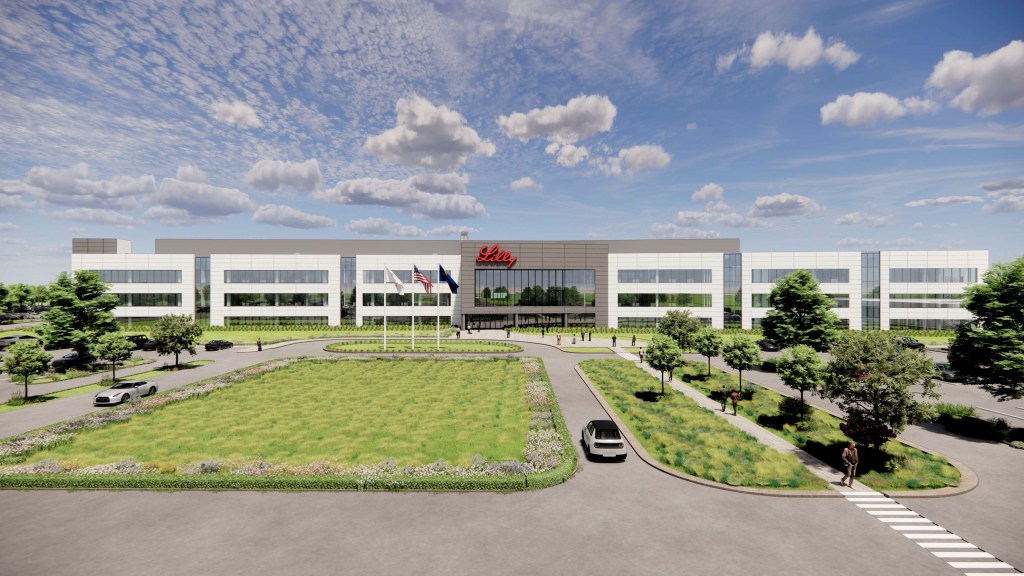
Parkland School Board members expressed deep skepticism about a proposed tax break for Eli Lilly, using their Tuesday workshop meeting to voice concerns that the district cannot afford to forego tax revenue from the pharmaceutical manufacturer’s proposed Upper Macungie plant.
Opposition was not universal, but the majority of board members said the district is facing economic headwinds that make it difficult to agree to a proposed 10-year contract that would see the district give up millions in revenue.
At issue is a proposed Local Economic Revitalization Tax Assistance program. Known as LERTA, the state program aims to spur development in “deteriorated areas” and permits township, county and school district officials to authorize tax breaks that allow land owners to delay full payment on the value of construction.
The most up-to-date projections of what the proposed LERTA would mean for the Parkland School District range widely depending on the final assessed value of Lilly’s proposed $3.5 billion plant.
It is the township’s responsibility to set the boundaries of a LERTA district. Upper Macungie has done so, and the presentation Superintendent Mark Madson delivered Tuesday says the properties inside that district, which is located on Main Street, generated $183,547 in school district tax revenue in 2025.
Business incentives versus tax revenue
Determining the long-term impact of Lilly’s investment on the Parkland School District means both calculating how much tax Lilly would owe to the district and estimating the larger spillover effects of economic growth the pharmaceutical plant could spur.
To estimate how much money Lilly might provide to the Parkland School District over the 10 years of the proposed LERTA, which would begin in 2028 when project developers hope construction will be completed, the Lehigh County Office of Tax Assessment provided two scenarios:
The “low assessed value” scenario values the completed Lilly plant at $68 million. In that scenario, the proposed 10-year tax abatement would mean the school district gains $7.3 million and forgoes $8 million in tax revenue over the life of the agreement.
The “high assessed value” scenario values the completed Lilly plant at $105 million, and means the district would gain $11.3 million in tax revenue and forego nearly $12.5 million.
Representatives from the Lehigh Valley Economic Development Corp. told school board members that it is difficult to find comparable projects that would make it easy to estimate how the completed Lilly project will be assessed and what its full value will be.
Tuesday’s workshop discussion kicked off with a LVEDC video that featured organizations and companies involved in bringing Eli Lilly to the Lehigh Valley. The slides Madson then presented called the project “a historic anchor for Upper Macungie Township” and highlighted how the 925,000-square-foot manufacturing campus could impact the community.
The presentation also noted the $100 million in state incentives that are attached to the project, the governor’s support and the “300 competing locations” for the proposed Lilly plant.
But the presentation did not sway everyone.
School board member Jon Macklin called the video a “sizzle reel,” noting its format seemed drawn from advertising promotion strategies. He said he is “incredibly happy Lilly is coming here” but feels the proposed LERTA is a “massive financial loss for the Parkland School District.”
Calling the tax abatement proposal “kind of one-sided,” he said it “feels like Parkland is giving a lot more than it seems to be receiving” and asked whether or not the company has made any concrete commitments to the school district.
Opportunities for students
Madson told The Morning Call that the district has been in conversation with Lilly representatives but that their conversations have been “higher level” and have not yet included any details for how the company might form a partnership with the district.
As part of the incentive package to attract Lilly, Lehigh Carbon Community College is set to receive a $5 million state grant to upgrade its science labs and create training programs designed to prepare students for the estimated 850 permanent jobs the Lilly plant will bring. Company officials have said those jobs will have an average salary of $100,000.
“We want to make sure that our students at Parkland are really positioned well to enter into those types of jobs as well,” Madson said.
It remains to be determined exactly how Parkland schools will be able to partner with LCCC, as well as other potential partners like the Lehigh Career & Technical Institute, to help develop programs at the high school and build an effective career development pathway for biomedical pharmaceutical manufacturing jobs, Madson said.
“The majority of the people working at this facility will come from the Lehigh Valley, and, moreover, many of them right from our Parkland community,” Madson said. “So we want to make sure that we’re going to have programs that are developed strategically to align with that.”
Redesigning curriculum and building higher ed partnerships is “not an overnight changeover,” and Madson said Lilly could be a key partner in making those connections happen, adding, “I think they’re going to need to help us through some of that.”
Madson also pointed out that the district aims to prepare students not just for jobs at the Lilly plant but for jobs at other surrounding businesses that are going to be hiring as the area grows in response to Lilly’s investment and in continuation of current population trends that have seen Parkland’s enrollment increase.
School budget crunch
Projections of a long-term population boom in Upper Macungie have some Parkland School Board members looking toward the future with a wary eye.
Board member Carol Facchiano said continued enrollment growth could mean the district will need another elementary school or might struggle to adequately staff its buildings as enrollment increases.
“It all is really coming down to money,” Facchiano said, acknowledging the district’s current budget deficit and adding that she needs to hear more from next month’s budget discussions to determine the feasibility of the LERTA.
Projections from the March budget workshop included a need to cut expenses to close a $17.1 million deficit. Those projections noted that a proposed 3.5% increase in the local millage rate for property taxes would bring that deficit down to just under $11.3 million.
The district’s current capital obligations include a $68 million high school renovation that broke ground in March.
A budget seminar is scheduled for May 1. The LERTA will again be discussed at the board’s next full meeting May 12.
Facchiano noted that the projected tax dollars discussed in the proposed LERTA are a “miniscule” percent of Lilly’s annual budget compared to the percent those tax amounts constitute of the school district’s annual budget.
Board member Lisa Roth said different stakeholders in the LERTA proposal have different jobs. It is Lilly’s job to make a profit; it is the governor’s job to do what’s best for the entire state; it is Upper Macungie officials’ job to do what’s best for the township; and it’s the school board’s job to do what’s best for the community of children it educates, she said.
“We have just a completely different set of priorities,” Roth said.
Parkland School Board members skeptical of tax break for Eli Lilly
Bringing business in
The school district is not legally obligated to join the LERTA, regardless of what action the county might take — a vote has not yet been scheduled — and the fact that Upper Macungie has already approved its part of the deal.
“Though the statute doesn’t require it, the value is in the township, school district, and county all participating. That shows collective support from the community,” Jaime Whalen, LVEDC’s executive vice president and chief of staff, said in an email.
“Incentives are one way that states and communities compete for large projects and show they want business growth. They consider them to be an investment in the future and focus on the long-term economic gains of adding a major employer.”
In Whalen’s Tuesday presentation to the school board, she said the LERTA is “not a giveaway” and added, “We’re really looking for partnership here.”
Madson’s presentation calls the LERTA “an upfront capital acquisition cost” in which the district “temporarily defers a portion of new revenue to secure a $3.5 billion commercial asset.” When the abatement ends, the district “captures 100% of the fully assessed, fully escalated property value for decades to come, alongside an enriched local tax base driven by 850 high-income households,” the slides read.
When asked if he believes the Lilly investment is a done deal, Madson said, “It appears to me that all indications are that this is moving forward, based upon everything that’s already occurred in the announcement and all the work that’s been done to get them here, and their public commitment to being here. So, it seems to me like it is, but it’s hard — I couldn’t give a guarantee.”
The Lehigh Valley has become the “No. 1 mid-sized market” in the country because of its fast growth and focus on economic development, and young people who grow up in the valley are choosing to stay, Whalen said, adding that Lilly will become one of the largest employers in the region.
“This is really a once-in-a-lifetime project, so I don’t really anticipate another project this size,” Whalen said. “And you know, you’re fortunate to have it in your school district, in your backyard, quite frankly. I’m sure lots of other schools would be thrilled to have them in their backyard.”