
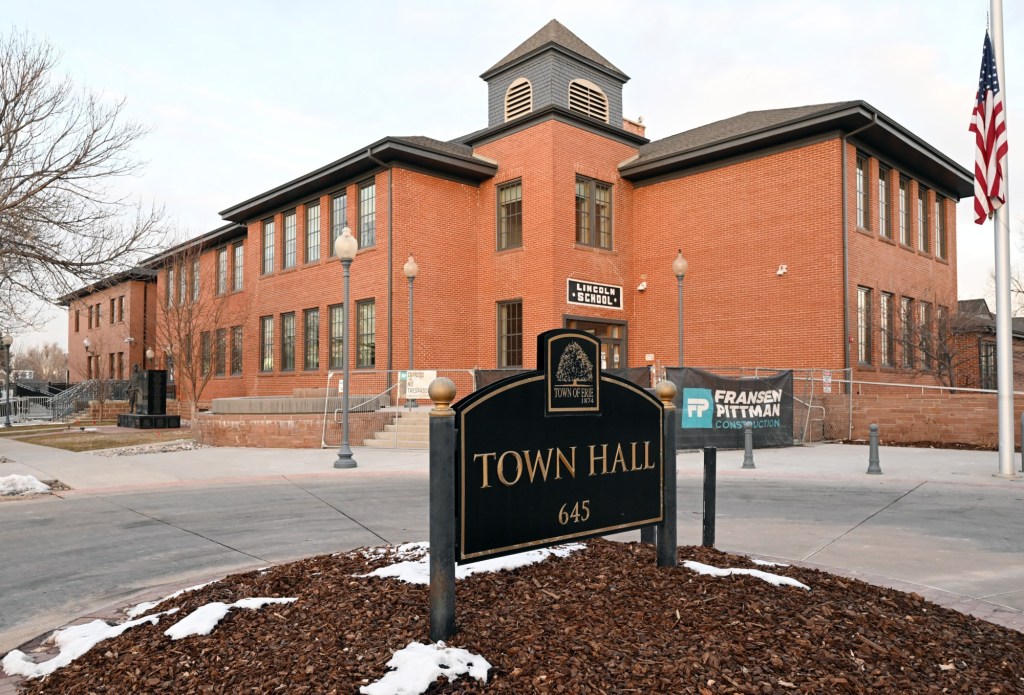
At a special meeting Tuesday night, members of the Erie Town Council were divided over what a potential deal for the town’s mineral rights tied to the planned Draco Pad could mean for the project.
Some of the town’s leaders say the Draco project will inevitably move forward, while others aren’t so sure.
Details of the mineral negotiations remain undisclosed, and the council has talked in private to discuss legal matters. The informational Tuesday meeting was called after members of the Erie community raised concerns about what they say is a lack of transparency about a potential deal.
David Frank, Erie’s director of environmental services, said during his Tuesday presentation that the town was first contacted in “spring 2025” by the Draco project applicant, Civitas Resources — which has since merged with SM Energy Company — about acquiring Erie’s mineral rights within the planned drilling area.
Mineral rights allow their owner to access and extract underground resources, or to lease or sell that access.
No agreement has been reached yet, Frank said, but potential details under discussion could include additional safety measures tied to the Draco project, such as increased local oversight and on-site inspections, as well as compensation including property owned by SM Energy along East County Line Road or payments for the town’s mineral assets.
Frank said Erie’s mineral holdings account for “something like 3.5%” of the total drilling area for the Draco project.
That differs slightly from a figure shared by Mayor Andrew Moore on social media days earlier.
“A bit about the Draco operation for context. It is ~3,692 acres. Erie has ~79 acres of leased mineral rights and ~103 acres of unleased mineral rights. Erie’s (unleased) mineral rights account for roughly 2.8% of the Draco operation,” Moore said in a Saturday post.
Town Attorney Breena Meng said that the discrepancy stems from ongoing efforts to determine exactly what mineral interests the town owns.
“We are in the process of identifying the minerals that we do own,” Meng said. “That’s why you’re hearing different numbers.”
‘Under no delusions’
Regardless of the percentage, if Erie declines to lease or sell its mineral rights, the operator would be required to avoid those subsurface areas.
That is due to state Senate Bill 24-185, which took effect in January 2025 and prohibits local government-owned minerals from being force pooled. Force pooling allows operators to combine mineral interests within a drilling area with approval from the state, even if the owners of those minerals object.
Under the law, local governments can reject lease offers, and the state cannot compel them to participate.
What avoiding those minerals would look like, in the case of Draco, remains unclear, according to Frank.
“We are in somewhat uncharted territory,” Frank said. “This provision … is a bit untested.”
Frank said he expects the Draco project to proceed regardless. The state commission approved the Draco Pad proposal in March 2025 despite pushback from the Erie community. The project includes 26 wells in unincorporated Weld County, with drilling extending west beneath Erie and into Boulder County.
“I would fully expect, no matter what action the town takes, that 26 wells will be drilled at Draco,” he said. “I am under no delusions that Draco will not go forward.”
But Hoback said he’s done research that shows the town’s position could still significantly affect the project.
‘We can impact Draco’
“I’ll be a bit of a voice in the wilderness and say, yeah, we can impact Draco,” Hoback said.
Hoback added that the inability to drill through areas tied to Erie’s mineral rights could create a “major impediment” to accessing other parts of the drilling area and would raise “sub-surface trespassing” concerns.
“This renders the 2.8% or 3.5% figure as rather pointless,” he said. “It’s not enough just to tally up the town’s numbers.”
Without a comprehensive map, it is unclear where Erie’s mineral rights sit within the Draco drilling area.
But in a follow-up email, Hoback told the Daily Camera he is “trying to highlight the fact that SM Energy cannot just drill through town mineral rights or rock formation to reach other properties where they have the rights. It’s trespassing to do so.”
“Some of the law is relatively new … but likely results in difficulty reaching certain properties if SM cannot easily bore through to them,” he wrote.
‘Draco is happening’
Mayor Pro Tem Brandon Bell pushed back on the idea that the town could alter the project’s outcome.
“My job is to tell you the truth,” Bell said during Tuesday’s meeting. “What you heard about this impacting Draco is 100% false.”
Councilmember John Mortellaro agreed, saying it is “highly unlikely” the town could significantly change a project already approved by the state.
In a follow-up email, Bell told the Camera: “Based on everything we have been advised, Draco is happening.”
Councilmembers Anil Pesaramelli and Emily Baer joined Hoback in opposing a deal. The council did not take a vote on the matter at this meeting.
Pesaramelli questioned whether delaying negotiations could affect the project timeline, noting that all wells must be operational by May 2028 under the state’s approval of Draco.
“There was a lot of urgency and a lot of pushing … that has happened in this deal. Which makes me think, why’s it being so rushed?” Pesaramelli asked. “Is there a reason for them to rush it, so the Draco project wouldn’t be affected?”
Frank said he was unsure of SM Energy’s internal timeline but acknowledged the schedule is a “tight window to drill 26 wells.”
“I can do my own math on how long I think it takes to drill and frack, and would say it’s probably soon. It’s got to be, if not this spring, this summer, where they’re going to have to make a decision on whether they move forward with our minerals or without,” Frank said.
Erie has “very unique leverage right now,” Frank added. ”Since our mineral interests that are unleased can’t be pooled, the only way to acquire them is through direct negotiations with us. However, at some point, the company will need to move forward and then we’ll have no leverage.”
‘Repeated requests for a map’
During about an hour of public comment Tuesday evening, most speakers urged the council not to pursue a deal, with many calling for more information to be made available.
Several residents said they want to see a map showing where the town’s mineral rights apply.
“We’ve heard repeated requests for a map, and I am also very interested in a map. I feel like we don’t know, really, what we’re talking about, to Councilmember Hoback’s point, about where these minerals are located,” Baer said.
Other speakers opposed selling public assets tied to a controversial oil/gas project, while some criticized the process itself, including the town’s use of a consultant, Matt Owens of Alameda Mineral Advisors, who previously worked for Civitas.
In closing remarks, Moore acknowledged residents’ frustration.
“Because we can’t share everything, it’s really hard for us to explain the scope of what we’re negotiating,” he said. “I’m trying to understand the trade-offs on a project that is going to go forward anyway.”
The town’s legal team is expected to continue negotiations. If an agreement is reached, the council would consider it at a future public meeting, with documents available for public review in advance.
After Tuesday night’s meeting, the Camera reached out to the state commission and Erie town staff for additional clarity on topics including the Draco project timeline, sub-surface trespassing rules and enforcement, and any methods drilling operators can use to avoid unleased mineral rights while still going forward with a project.
In information tied to the topic of the Draco Pad, it has been unclear whether the town is specifically considering leasing or selling its mineral rights, or both. The Camera has asked an Erie spokesperson whether the town is considering leasing or selling.
The Camera will continue coverage of the Draco Pad proposal.