
Students and staff at Carnegie Mellon University got to showcase their work to NFL and Pittsburgh officials Wednesday. The “Powering the Future of Sport” competition took over CMU’s Robotics Innovation Center in Pittsburgh’s Hazelwood neighborhood. “It’s a wonderful showcase for the broader audience to really see this,” said Ron Yurko, director of CMU’s Sport Analytics Center. “When people think of sports analytics, they think of Carnegie Mellon University. They think of robotics. They think of this amazing amount of technology that’s here.”Yurko was one of several people who showcased their inventions and studies to NFL officials like Commissioner Roger Goodell. Alongside Goodell were Steelers Hall of Famer Jerome Bettis and famous entrepreneur and Mt. Lebanon native Mark Cuban.“The NFL has an amazing amount of tracking data like chips in the shoulder pads,” Yurko said. “Amazing students have done a number of different projects.”Yurko’s station at Wednesday’s showcase was about using data, including Madden NFL video game ratings, to predict the success rate of draft picks. “At the very top of the draft, there’s like a 75% chance of having at least a starter on your roster. But by the end of the first round, you’re already getting to a coin toss,” Yurko said. “Across the draft, we get a look at the ceiling for the value of a player and which teams go above that ceiling. The first overall pick in the draft is worth 3,000 points. What type of picks would a team have to trade to get that pick?”Other displays used artificial intelligence and robotics to do things like launch footballs and present logistics for use in pro sports front offices. Some examples did not have anything to do with sports. However, they are meant to help sports cities be sustainable. Xiaoyu Kaess, co-founder and COO of Aquatonomy, showed off an underwater robot that helps analyze the stability and longevity of infrastructure.“We can cover the same large areas,” she said. “Imagine dams and bridges. That directly impacts on the safety of our infrastructure, given that it’s 50-100-plus years old. We’re moving the industry from manual, dangerous work to autonomous and data-driven.”The showcase ended up netting $1.825 million in start-up money for finalists in the competition.”And now, we’re here talking about the future of Pittsburgh, the future jobs that are going to be created here through this technology that’s being built,” Mayor Corey O’Connor said. “You’re having the future of the world being built here on this old steel mill. It’s a great story.”“You are the incubator for AI growth across this country, across the globe,” Pennsylvania Gov. Josh Shapiro said. “It’s having big economic development deals, relationships that get cemented, opportunity that comes.”Some of the data studies on display will be displayed on the NFL’s website.
PITTSBURGH —
Students and staff at Carnegie Mellon University got to showcase their work to NFL and Pittsburgh officials Wednesday.
The “Powering the Future of Sport” competition took over CMU’s Robotics Innovation Center in Pittsburgh’s Hazelwood neighborhood.
“It’s a wonderful showcase for the broader audience to really see this,” said Ron Yurko, director of CMU’s Sport Analytics Center. “When people think of sports analytics, they think of Carnegie Mellon University. They think of robotics. They think of this amazing amount of technology that’s here.”
Yurko was one of several people who showcased their inventions and studies to NFL officials like Commissioner Roger Goodell. Alongside Goodell were Steelers Hall of Famer Jerome Bettis and famous entrepreneur and Mt. Lebanon native Mark Cuban.
“The NFL has an amazing amount of tracking data like chips in the shoulder pads,” Yurko said. “Amazing students have done a number of different projects.”
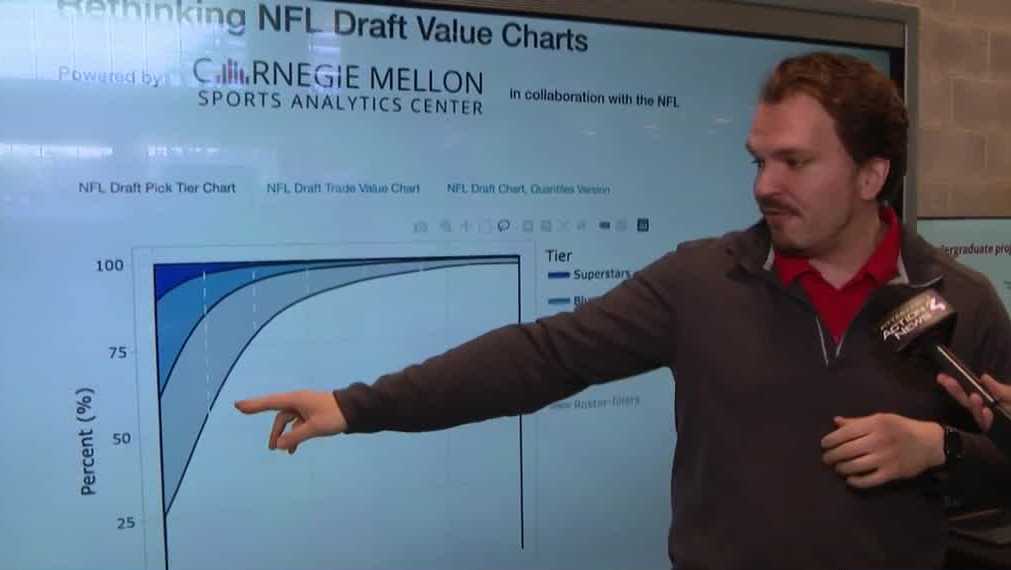
Yurko’s station at Wednesday’s showcase was about using data, including Madden NFL video game ratings, to predict the success rate of draft picks.
“At the very top of the draft, there’s like a 75% chance of having at least a starter on your roster. But by the end of the first round, you’re already getting to a coin toss,” Yurko said. “Across the draft, we get a look at the ceiling for the value of a player and which teams go above that ceiling. The first overall pick in the draft is worth 3,000 points. What type of picks would a team have to trade to get that pick?”
Other displays used artificial intelligence and robotics to do things like launch footballs and present logistics for use in pro sports front offices.
Some examples did not have anything to do with sports. However, they are meant to help sports cities be sustainable.
Xiaoyu Kaess, co-founder and COO of Aquatonomy, showed off an underwater robot that helps analyze the stability and longevity of infrastructure.
“We can cover the same large areas,” she said. “Imagine dams and bridges. That directly impacts on the safety of our infrastructure, given that it’s 50-100-plus years old. We’re moving the industry from manual, dangerous work to autonomous and data-driven.”
The showcase ended up netting $1.825 million in start-up money for finalists in the competition.
“And now, we’re here talking about the future of Pittsburgh, the future jobs that are going to be created here through this technology that’s being built,” Mayor Corey O’Connor said. “You’re having the future of the world being built here on this old steel mill. It’s a great story.”
“You are the incubator for AI growth across this country, across the globe,” Pennsylvania Gov. Josh Shapiro said. “It’s having big economic development deals, relationships that get cemented, opportunity that comes.”
Some of the data studies on display will be displayed on the NFL’s website.