
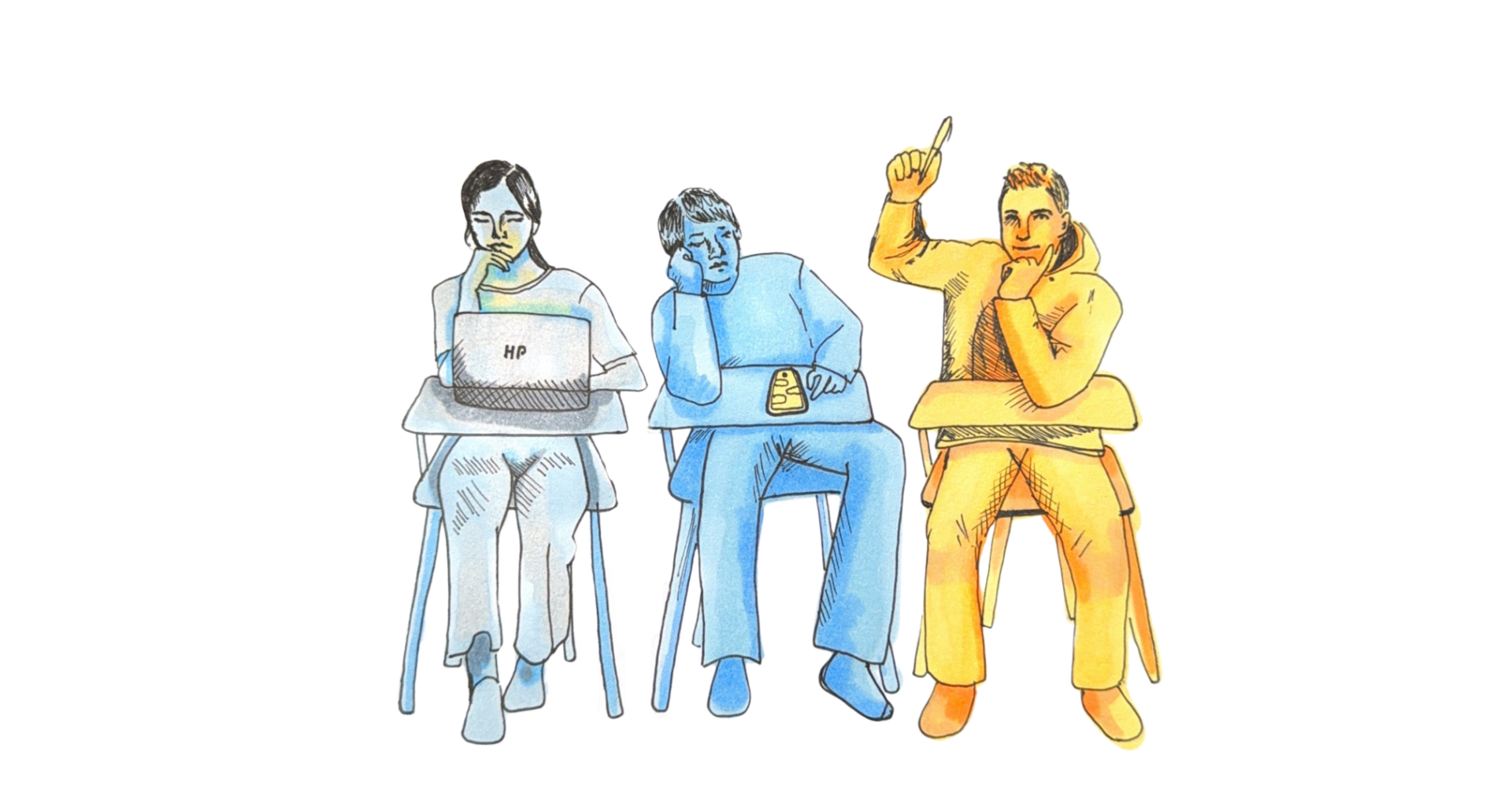
In many college classrooms, participation has become the exception, and silence the norm.
Students sit behind their glowing screens, and when a professor poses a question, the room often waits in stillness rather than responding. Hands rarely go up. Discussions stall before they even begin.
For many students, speaking up feels uncomfortable, even risky. It’s easier to stay quiet than to risk being wrong or judged. But that hesitation shouldn’t define a college classroom, and it didn’t emerge overnight. It’s the result of years spent learning behind screens, where silence was easy, and at times, expected.
During the time of remote learning, platforms such as Zoom reshaped how students engaged with class. Cameras were often turned off. Responses were typed instead of spoken. Long pauses filled class time. Participation became optional, and that mindset didn’t disappear when students returned to in-person learning.
Online learning also introduced more flexibility and asynchronous work, letting students complete discussions in writing and on their own time. While that made participation feel less intimidating, it also reduced the need to speak in the moment and develop verbal confidence.
What appears to be quiet in the classroom isn’t simply shyness. It’s a pattern. Students have grown accustomed to observing rather than engaging, and over time, that habit makes it harder to connect with peers or fully process course material.
The data reflects this shift. A recent survey by Inside Higher Ed found that nearly one-third of students feel their classes lack meaningful engagement. Research from Breakout Learning reports that only 38% of students feel fully engaged in the classroom. These numbers point to a larger issue: disengagement is becoming increasingly normalized.
When students disengage, the consequences go beyond a quiet classroom. They become passive learners, absorbing information without interacting with it. Participation isn’t just a formality, it strengthens comprehension, improves memory retention and fosters a sense of belonging. Without it, a core part of the learning experience is lost.
Classes aren’t meant to be endured. They are meant to challenge students to think critically, articulate ideas and respond to others. When participation fades, so does the purpose of education and its collaborative nature.
One of the clearest reasons is distraction. The most engaged classrooms are often the ones with fewer screens. When laptops and phones are limited, students tend to listen more closely, ask more questions and respond to one another.
Limiting electronics isn’t about control or punishments. It’s about creating an environment where students can focus and engage. Without constant digital distractions, students are more likely to actively practice essential skills such as communication, collaboration and problem-solving.
Reversing this trend requires effort from both institutions and students. Universities like Lehigh should design courses that actively encourage participation. This can include structured discussions, small-group work and low-stakes participation incentives, such as reflection responses or discussion-based grading that promote engagement.
At the same time, responsibility doesn’t rest solely with faculty. Students must be willing to accept discomfort. Speaking up, even when unsure, is part of the learning process. Mistakes aren’t setbacks — they’re opportunities to build confidence.
Classrooms don’t have to feel passive or disconnected. They can be spaces where ideas are exchanged, challenged and developed. That environment depends on active participation from everyone in the room.
Restoring engagement won’t happen immediately. It requires a shift in expectations and habits, but it’s necessary. Participation shouldn’t be rare. It should be the standard.