
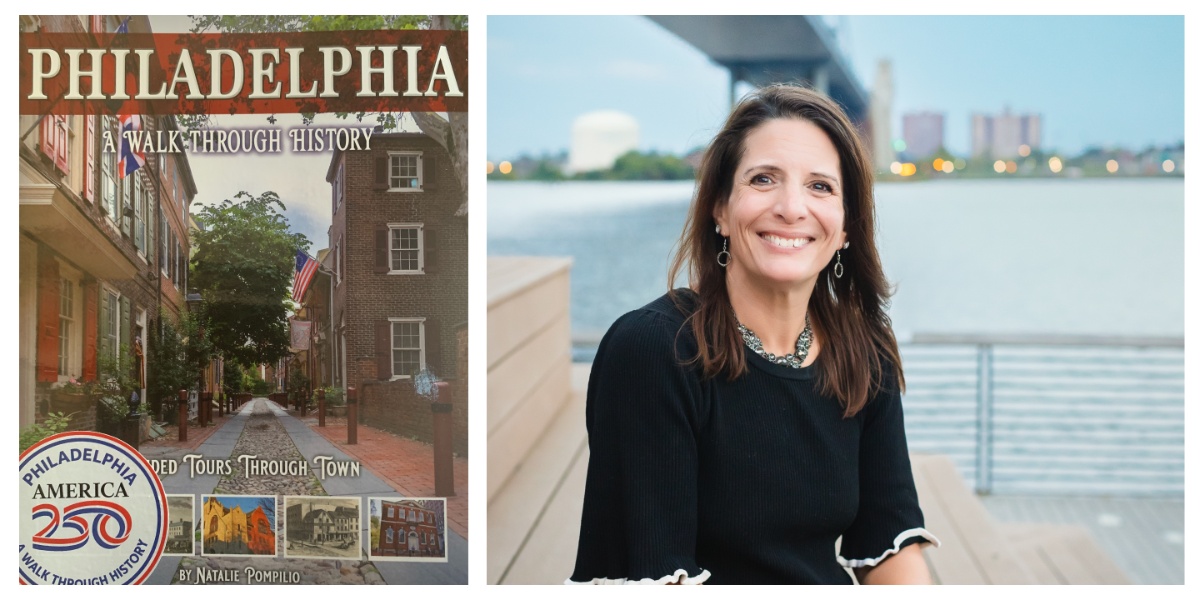
Citizen contributor Natalie Pompilio’s new book, Philadelphia: A Walk Through History, arrives just in time for folks who plan to visit Philadelphia during the United States’ semiquincentennial. Pompilio’s choose-your-own-adventure-style guide lets readers follow in the footsteps of well-known founders including George Washington and Benjamin Franklin. But it also lays out walks that trace the paths of those oft-overlooked by history books, including women, people of color, and immigrants.
The walk excerpted below features sites associated with female historymakers.
Meet Pompilio, join her for a walking tour through Old City, pick up a copy of the book, and attend a reception on May 2 from 3 to 5pm at Carpenters’ Hall.

Colonial women rarely made headlines. Societal norms meant they were to stay at home and serve their husband and children. They had few rights, were banned from voting or inheriting property, and in some places, were prohibited from working outside the home. But the women you’ll meet in this walk weren’t the stay-at-home types, or, if they were, they made sure they still had an impact on the world outside. Most lived during Colonial times, but one is a more modern hero. Or “she-ro.”
Betsy Ross House, 239 Arch Street
First flag-maker Betsy Ross personified patriotism, sacrifice, and perseverance. Despite losing both her first and second husbands to the war, she never closed her busy upholstery shop, making flags, tents, and clothes for American soldiers. When forced to house British soldiers for 10 months when their army occupied the city, she was such an outspoken patriot that they began calling her, “The Little Rebel.” She and George Washington attended the same church, and she’d mended items for him, so it made sense when he approached her with a tentative design for a new national flag. Ross made one significant change, changing the six-pointed stars Washington suggested to five-pointed ones.
Walk one block west on Arch Street.
Arch Street Quaker Meeting House, 320 Arch Street
Abolitionists Sarah and Angelina Grimke worshipped here when they joined Philadelphia’s anti-slavery movement. The pair grew up in South Carolina, where their father enslaved hundreds of people. He made his children work in the fields, too. Sarah later wrote, “Perhaps I am indebted partially to this for my life-long detestation of slavery, as it brought me in close contact with these unpaid toilers.” In 1836, Angelina urged Southern women to join the cause, writing, “I know you do not make the laws, but I also know that you are the wives and mothers, the sisters and daughters of those who do; and if you really suppose you can do nothing to overthrow slavery, you are greatly mistaken.”
Continue for three blocks on Arch Street.
Woman’s Medical College of Pennsylvania, 627 Arch Street
Opened in 1850, the Woman’s Medical College of Pennsylvania was the first all-female, degree-granting medical school in the world. Tuition was about $80 annually — $3,230 today. Students finished their degrees in two years.
Until then, medicine was a man’s world. In 1870, female medical students paid to attend a Pennsylvania Hospital lecture. The male Penn students didn’t like “she-doctors.” They heckled and hissed, and spit tobacco juice on the visitors. The incident made national headlines, inspired more women to enter medicine, and positively shifted public opinion of female doctors. One female student said, “If these poor fellows had sought to do us a life-long favor, they could not have done it more effectively.”
Turn left on South 6th Street. Walk one block to Market Street.
President’s House, 6th and Market streets
Abigail Adams was the first First Lady to really live in the President’s House, joining her husband here after his 1800 election. (Martha Washington traveled back and forth to Virginia for most of George’s presidency.) Adams often sought out his wife’s opinions, and Abigail, an early advocate for women’s rights, readily shared them. Some of her detractors called her “Mrs. President.” When John was in Philadelphia for the First Continental Congress, Abigail advised him to “remember the ladies … Do not put such unlimited power into the hands of the husbands. Remember all men would be tyrants if they could.” Abigail was a prolific letter writer, corresponding over the years not only with her husband but also with Thomas Jefferson, her husband’s political rival.
Briefly close your eyes. Reopen them at the same site.
President’s House, 6th and Market streets
Part of this open-air museum is dedicated to the people Washington enslaved here. One was Oney [whose birth name was “Ona”] Judge, who became Martha Washington’s “body servant” at age 12. Oney moved here at 17, and because she served Martha during social visits, she was given nicer clothes. (That included a new pair of shoes multiple times per year, while other enslaved people received at most a single pair per year.) In 1796, Oney slipped out while the Washingtons dined and hid until she was able to board a ship to New England two days later. The Washingtons were outraged and hurt by Oney’s departure, feeling they’d treated her like family, and offered a reward for her capture. They never succeeded.
Turn left on Market Street. At S. 3rd Street, turn right. Cross Walnut Street.
Powel House, 244 S. 3rd Street
Samuel Powel was the city’s last Colonial mayor and first post-Revolutionary War mayor, but the real political influencer was Elizabeth, his wife. Elizabeth was close to George Washington. When he was unsure about running for a second presidential term, she urged him to do so, writing, “For God’s sake do not yield that Empire to a Love of Ease, Retirement, rural Pursuits, or a false Diffidence of Abilities which those that best know you so justly appreciate; nay your very Figure is calculated to inspire Respect and Confidence in the People …” It was Elizabeth who approached Benjamin Franklin after the Constitution’s signing and asked, “What have we got, a republic or a monarchy? Franklin’s response, “A republic, if you can keep it.”
Return to Walnut Street. Turn left at South 2nd Street.
Welcome Park, 127 S. 2nd Street
Hannah Callowhill Penn, wife of Pennsylvania founder William, was the state’s first — and to this day only — female governor, managing affairs for about 14 years after her husband was incapacitated by strokes and also after his death. The family temporarily lived in a house on this site, now a park named after the ship that brought them from England, the Welcome. Hannah spent most of her life in England and governed from there with the support of a Pennsylvania proxy. In 1984, President Ronald Reagan named Hannah an Honorary Citizen of the United States. Reagan praised her leadership, noting that “like her husband, (she) devoted her life to the pursuit of peace and justice.”
Continue north on South 2nd Street.
John Dunlap Print Shop, 2nd and Market streets
In 1780, this shop printed Esther de Berdt Reed’s “The Sentiments of an American woman,” a broadsheet calling women to donate “vain ornaments” to raise money for the Continental Army. Reed also founded The Ladies Association of Philadelphia. She wanted to send money directly to soldiers, but George Washington feared the men would buy booze. He asked that the organization instead buy materials for shirts. The members sewed more than 2,000 shirts, each embroidering her name on the inside. Washington thanked them, writing, “This fresh mark of the patriotism of the Ladies entitles them to the highest applause of their Country. It is impossible for the Army, not to feel a superior gratitude, on such an instance of goodness.”
Cross Market Street. Continue north, crossing Arch Street.
Elfreth’s Alley
Welcome to the oldest continuously inhabited residential street in the U.S. The 32 houses line what was originally a cart path built between 1703 and 1836, and their exteriors remain unchanged. Credit for this preservation goes to Dolly Ottey, who launched the Elfreth’s Alley Association in 1934. By the 20th century, many of the houses were dilapidated, and some owners wanted to tear down the small homes and erect larger dwellings. Ottey, an alley resident and business owner, protested, writing letters to the editor, rallying her neighbors, and eventually partnering with the newly-formed Philadelphia Society for the Preservation of Landmarks to preserve the alley. The Association later purchased the homes at 124 and 126 to create the Elfreth’s Alley Museum.
Continue north on North 2nd Street.
Elizabeth Drinker, 147 N. 2nd Street
Elizabeth Drinker kept a detailed journal from 1758 to 1807 that provides insight into the lives of ordinary Philadelphians during an extraordinary time. Drinker and husband Henry were Quakers, and therefore pacifists, who stayed neutral during the Revolutionary War. In 1777, Henry Drinker and other prominent Quakers were charged with aiding the enemy (by not fighting in the war) and banished to Virginia. In her diary, Elizabeth Drinker describes how, in April 1778, she and other women whose husbands had been exiled visited Valley Forge to ask General George Washington for their husbands’ releases. Washington declined to do that, but he invited them to an “elegant dinner.”
DID YOU KNOW?
Many women, including Martha Washington, went to war with their husbands. These so-called “camp followers” performed domestic camp duties including cooking and washing.
Some women dressed as men to fight. One, Deborah Sampson of Massachusetts, served under her dead brother’s name.
This excerpt is from Philadelphia: A Walk Through History. Meet author Natalie Pompilio for a walking tour through Old City and reception on May 2 from 3 to 5pm at Carpenters’ Hall.
 MORE PHILADELPHIA HISTORY
Author Natalie Pompilio (right), beneath the Benjamin Franklin Bridge, and her new book, Philadelphia: A Walk Through History.