
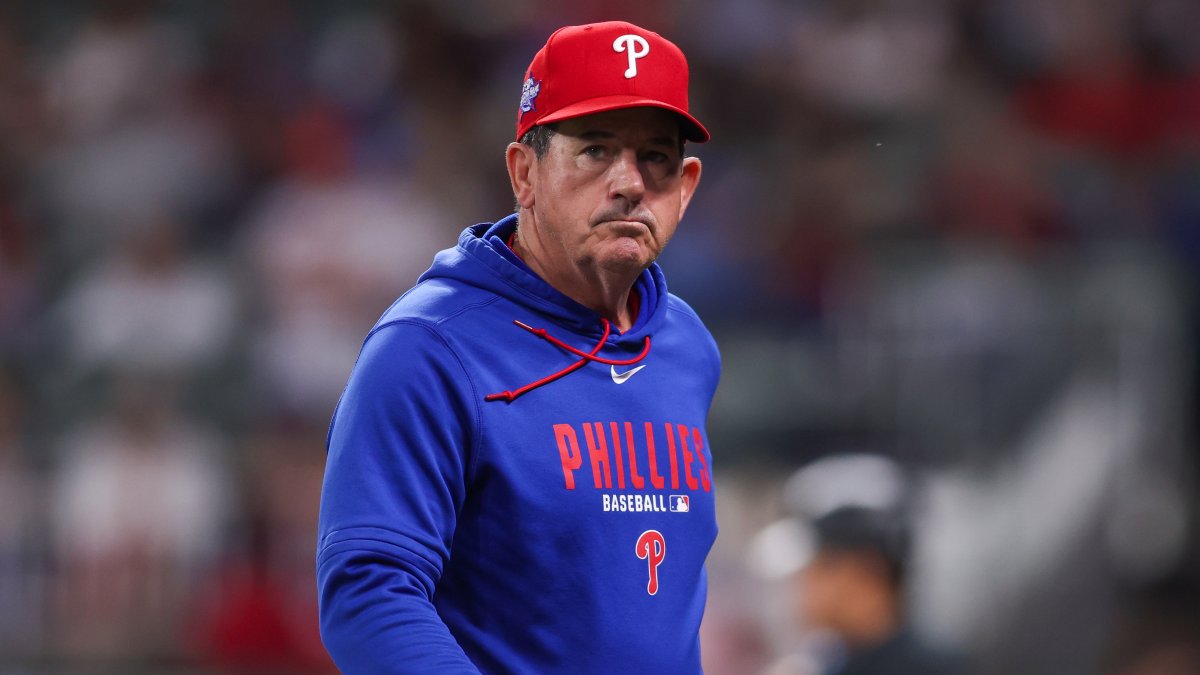
ATLANTA — Rob Thomson said after Saturday night’s extra-inning win, which snapped the Phillies’ 10-game losing streak, that the club needed to “stack well-played games.”
For a moment, it felt like Zack Wheeler’s return might help them find some traction and take a series in Atlanta.
But by the end of the first inning Sunday, that felt unlikely. The Phillies’ worst habits were back out in the open, especially when Matt Olson turned on Aaron Nola’s fastball for a three-run homer.
The Phillies fell 6-2 to the Braves in the series finale at Truist Park, yet another series loss.
Nola, who entered the day with a 5.06 ERA through five starts, did not have sharp location with his fastball or knuckle curve. That is not a good formula when overpowering velocity is not part of the profile.
Even on the Olson homer, Nola missed up and in, out of the zone, and still watched the Braves’ first baseman yank the 93.5 mph fastball into the Chop House seats in right.
The long ball remains Nola’s biggest problem. Since the start of 2023, he has allowed 86 home runs in 518 2/3 innings. That comes out to a 1.49 HR/9, the second-highest mark among starting pitchers with at least 500 innings in that span.
It is hard enough to win when the other team hits a three-run shot. It gets even harder when another two-run homer follows.
That happened in the second, when Atlanta’s No. 8 hitter, Eli White, crushed a middle-in sinker into the Phillies’ bullpen in left-center to make it 6-0.
At that point, any hope of meaningful run support was already on thin ice. And the damage also took a toll on Nola’s pitch count.
BIG INNINGS
Thomson mentioned before the game that one of the Phillies’ biggest issues has been long innings from their starters. Sunday was another example.
A 23-pitch first.
A 27-pitch second.
A 26-pitch fourth.
That has become a theme, and the numbers show it. Phillies starters entered the day leading the National League in pitches per inning at 17.7. That is reflected in their league-high 1.64 WHIP.
They also lead the Majors in 25-plus pitch innings.
And it is not just a pitch-count issue. Phillies pitchers as a whole have allowed two or more runs in an inning 44 times, the most in baseball.
The last Phillies team to allow that many so early in a season was the 1956 club.
LACKING LENGTH
All of that feeds into another problem: the Phillies are not getting enough length from their starters.
That is surprising, considering both the talent in the rotation and what this group has done the last two seasons.
The Phillies led the Majors in starts of seven innings or more in both 2024 and 2025. They had 37 in 2024 and 39 in 2025, 10 more than the next-closest team last season.
This year, 28 games in, they still do not have one.
That has put a real strain on the bullpen, which entered Sunday ranked third in the National League in relief innings. With Jonathan Bowlan, Zach Pop and Jhoan Duran on the injured list, the Phillies have had little choice but to lean on the same relievers again and again.
LEFTY STRUGGLES PERSIST
At this point, the Phillies’ issues against left-handed starters are impossible to ignore.
Chris Sale was the latest to exploit them Sunday. The future Hall of Famer went six innings, allowed one hit, gave up no runs and struck out nine.
The Phillies are now 0-10 in games started by lefties who are not openers. That is the longest such streak in the Majors since the 2007 Royals, who finished 69-93.
And the deeper numbers are even uglier.
Phillies right-handed hitters have produced a .501 OPS against left-handed pitchers this season. Since those splits started being tracked in 1974, that is the worst mark in baseball. They have also posted the lowest batting average (.168), lowest slugging percentage (.249) and a .204 BABIP in those matchups.
That points to both a personnel issue and a performance issue.
The Phillies have tried adjusting the lineup against southpaws. They even hit Felix Reyes cleanup Sunday, and he still has not logged 20 big league at-bats.
Something has to change.
Until it does, teams will keep attacking the same weakness.