
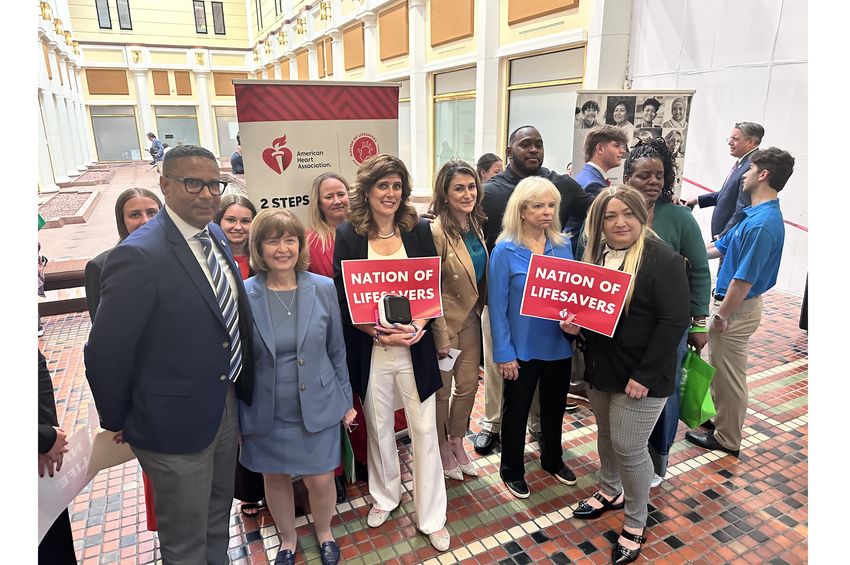
HARRISBURG, Pa., April 28, 2026 —The Pennsylvania House of Representatives has passed legislation requiring cardiac emergency response plans in Pennsylvania schools. Senate Bill 375 would ensure staff trained in CPR and automated external defibrillator (AED) use are on-site in all buildings and at athletic events and make AEDs accessible at all school athletic events. The bill, known as “Greg Moyer’s Law,” and sponsored by Sen. Rosemary Brown, (PA-40), will go back to the Senate for a concurrence vote before heading to the governor for signature.
As a founding member of the Smart Heart Sports Coalition established by the NFL in 2023, the American Heart Association, devoted to a world of healthier lives for all, and their Heart Powered advocates worked alongside members of the Pennsylvania Smart Heart Sports Coalition to push for this policy that will increase survival rates from cardiac arrests that happen outside of a hospital. The legislation was championed in Pennsylvania by coalition members including American College of Cardiology – Pennsylvania Chapter, American Red Cross, Children’s Hospital of Philadelphia Youth Heart Watch, Greg W. Moyer Defibrillator Fund, Parent Heart Watch, Peyton Walker Foundation, Simon’s Heart, The Spencer Davis Foundation, UPMC Children’s Hospital of Pittsburgh Project ADAM and advocates Isaiah Bangoura and Kathryn Santiago.
“The National Football League and the Smart Heart Sports Coalition applaud the House for passing Senate Bill 375, and sending it to the Senate for final approval. Enacting Greg Moyer’s Law will help to protect kids and strengthen school communities across Pennsylvania. Their action is a big victory for students and young athletes in the state,” said Kenneth Edmonds, vice president of public policy and government affairs, National Football League.
More than 356,000 people in the United States experience cardiac arrest outside of a hospital each year. Currently, 10% of those people will survive, most likely because there were people nearby prepared to take action. CPR, if performed immediately, can double or triple a person’s chance of survival.
This bill ensures that school athletic events will have a practiced plan to address cardiac events. Schools with a cardiac emergency response plan can increase cardiac arrest survival rates by 50% or more by enabling people to take action with CPR, use of an AED, and in coordination with emergency medical services. As part of its Nation of Lifesavers™ campaign, the American Heart Association is working to double survival rates from cardiac arrest by 2030.
“When cardiac arrest happens, every second matters,” said Brad Cary, Pennsylvania government relations director for the American Heart Association. “A practiced plan, immediate CPR and quick access to an AED can mean the difference between like and death in the classroom, in the hallway or on the field.
It is estimated that every year more than 23,000 children under the age of 18 in this country experience cardiac arrest outside of a hospital. Of those children, about 40% are sports-related. In schools with AEDs, approximately 70% of children survive cardiac arrest – 7 times the overall survival rate for children.
“Greg Moyer’s Law will be passed in memory of all the Pennsylvania children who lost their lives because there was no AED,” said Rachel Moyer, mother of Greg Moyer who died at age 15 after experiencing sudden cardiac arrest at his high school basketball game in 2000, and founder of the Gregory W. Moyer Defibrillator Fund. “It is our hope that no parents in the future will know the pain of losing a child to sudden cardiac arrest.”
“Youth Heart Watch at the Children’s Hospital of Philadelphia celebrates the passage of Greg Moyer’s Law which will save countless lives and benefit every child, family, school, and community in the state,” said Dr. Victoria Vetter, director of Youth Heart Watch at the Children’s Hospital of Philadelphia. “Thanks to all the families and advocates who have worked tirelessly to make this a reality.”
“We are so very excited about the passage of Senate Bill 375 in Pennsylvania, which will undoubtedly save lives in our great state by helping to prevent tragic deaths from sudden cardiac arrest in student athletes by mandating timely access to AEDs and preparedness for these events through developing protocols and practicing drills of cardiac emergency response plans,” said Dr. Bryan Funari, medical director of Project ADAM at UPMC Children’s Hospital of Pittsburgh.
“The Pennsylvania Chapter of the American College of Cardiology recognizes the critical importance of Senate Bill 375 and its potential to save the lives of our children and strengthen the communities in which they live and thrive,” said Dr. Neerav Sheth, chair of the advocacy committee of the Pennsylvania Chapter, American College of Cardiology. “This legislation addresses longstanding gaps in the delivery of care during life-threatening emergencies—gaps that have persisted for far too long. We fully support and endorse Senate Bill 375 and its vital mission to protect and preserve the lives of our residents.”
“As an organization whose mission is to increase awareness and survival rates of sudden cardiac arrest, we fully support this lifesaving legislation. Protecting our youth and preparing in advance for unexpected cardiac emergencies is going to lead to lives being saved. We applaud the efforts of the Pennsylvania Smart Heart Sports Coalition members and lawmakers for prioritizing the cardiac safety of Pennsylvania’s student athletes,” says Julie Walker, president of Huddle For Hearts & The Peyton Walker Foundation.
“Our son, Spencer, survived a sudden cardiac arrest at school thanks to the immediate actions of coaches and athletic trainers,” said Jennifer Davis, Spencer’s mother and co-founder of the Spencer Davis Foundation. “If a cardiac incident takes place at school, we want others to have the same outcome that Spencer did. With the signing of Senate Bill 375, more athletes like Spencer will be saved!”
Learn more and get involved at heartpowered.org.
###
About the American Heart Association
The American Heart Association is a relentless force for a world of longer, healthier lives. Dedicated to ensuring equitable health in all communities, the organization has been a leading source of health information for more than one hundred years. Supported by more than 35 million volunteers globally, we fund groundbreaking research, advocate for the public’s health, and provide critical resources to save and improve lives affected by cardiovascular disease and stroke. By driving breakthroughs and implementing proven solutions in science, policy, and care, we work tirelessly to advance health and transform lives every day. Connect with us on heart.org, Facebook, X or by calling 1-800-AHA-USA1.
For Media Inquiries:
Larissa Bedrick, larissa.bedrick@heart.org
For Public Inquiries: 1-800-AHA-USA1 (242-8721)
heart.org and stroke.org