
By Erin Flynn Jay
South Philadelphia’s Theatre Exile closes its season with the Philadelphia premiere of ‘The Great Privation (How to Flip Ten Cents into a Dollar),’ a powerful, darkly comic play by Nia Akilah Robinson. Directed by Ontaria Kim Wilson, the production runs May 28 through June 14.
‘The Great Privation’ confronts a troubling chapter of American history while exploring the ways the past continues to echo across generations.
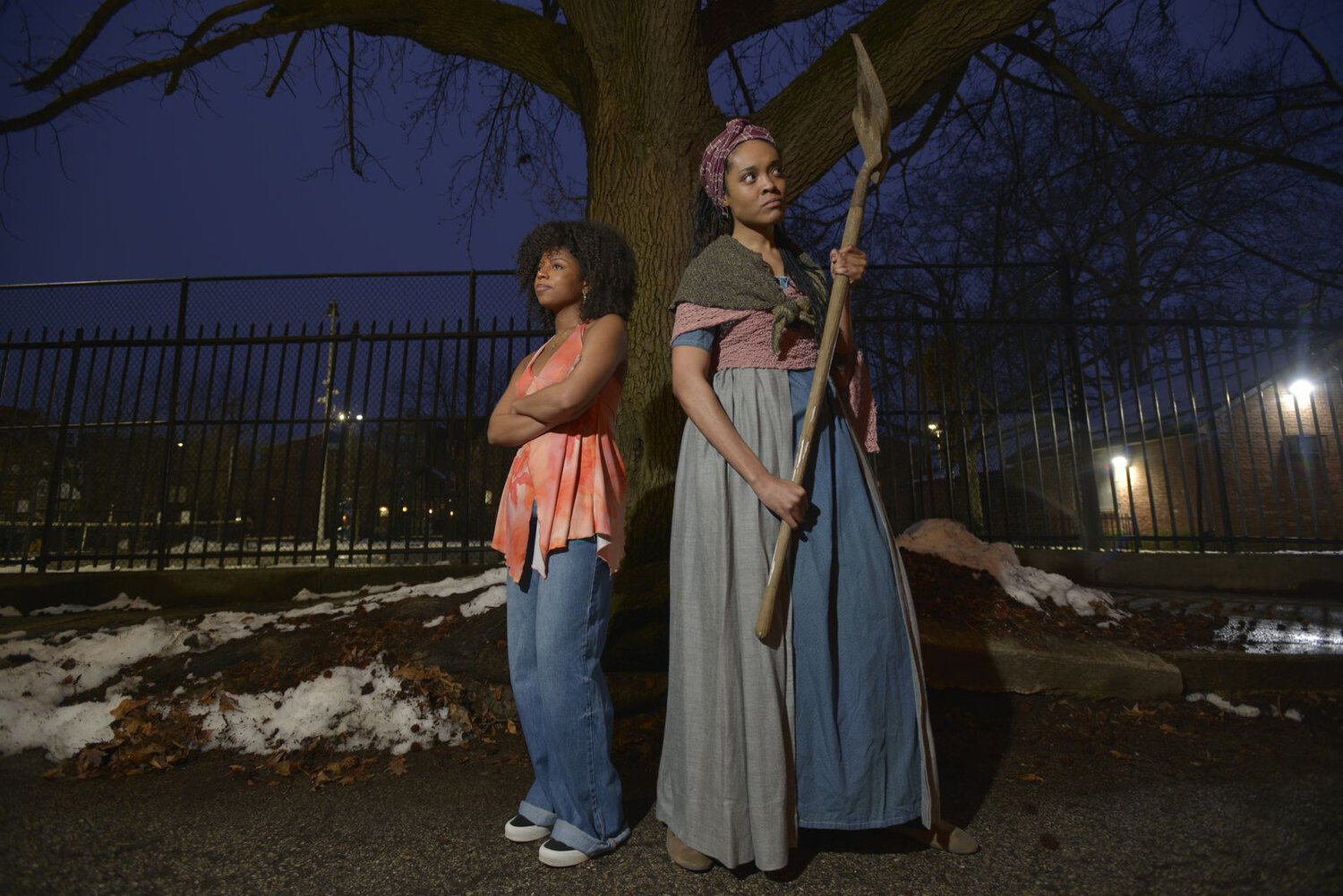
In 1832, a mother and daughter stand vigil at a grave beside the African Methodist Episcopal Church in South Philadelphia. They are there guarding their loved one’s resting place from a grave robber (Aidan McDonald), also known as a resurrectionist, who steals bodies for medical dissection. Nearly two centuries later, on that same ground, another mother and daughter spend their summer at camp—singing songs, clashing, and trying to keep the daughter from being expelled. As both matriarchs struggle to protect their families — both the living and the dead — timelines collide, and long-buried secrets rise to the surface.
The story is rooted in real history. During the early 19th century, as outbreaks like Cholera spread through cities like Philadelphia, demand for cadavers surged. Until the passage of the Pennsylvania Anatomy Act of 1883, so-called resurrectionists were paid to rob graves and sell freshly buried bodies to anatomical halls for dissection. Poor and Black Philadelphians were particularly vulnerable to these crimes, leading many families to guard burial sites through the night to protect loved ones from being taken.
For Wilson, that history was both shocking and deeply resonant.
“Being a Black woman and being a patient, there’s good care and good bedside manners, but there’s still an undercurrent of attention to different demographics based on prior historical data,” the director told Metro. “The taking care of specifically Black women, Black bodies, when it comes down to the healthcare system, is something that we still struggle with in 2026.”
That throughline—from 19th-century grave robbing to modern disparities in medical treatment—is central to Robinson’s script. The writer is very specific about the build, sensitivities and personality types of each character in ‘The Great Privation’.
Wilson said she was struck not only by the historical neglect but by its emotional weight.
“The disrespect for those who were no longer with us was astonishing to me,” Wilson said. “I didn’t know that was a running theme throughout not just America, but throughout Europe. Grave robbing and grave digging specifically for medical research was something that I wasn’t aware of, and it piqued my interest.”
Robinson’s text is also exacting in its character descriptions, which shaped Wilson’s casting process. The modern-day mother, Rayne, is written as a tall, dark-skinned Black woman in her 30s—controlled, private and sharp-witted. Charity, her teenage daughter, is vibrant, funny and bubbly.
“Semaja Murphy is a young lady that I taught at Temple University and directed while I was there. When you see Semaja, she just reads Charity,” Wilson said.
Andre Brown takes on the role of Cuffy, a janitor whose warmth and presence ground the story.
“Andre is so full of life and unapologetic about who he is and how he moves through space, and he’s loving, kind, caring and structured,” said Wilson. “So everything that Cuffy represents, Andre does the same.”
“The casting process was long,” Wilson added. “We had a lot of people come through. It was difficult to choose because we had some really solid people who came through.”
Despite its heavy themes, Wilson emphasizes that ‘The Great Privation’ is ultimately a story of resilience.
“I want people to know that it’s okay to find humor and laughter in serious situations, but at the same time, honor and acknowledge some of the damage that has been done to the African American community,” said Wilson. “Also knowing that we have the ball in our court and we have the power to change the trajectory of the course of medicine and how we deal with those who are marginalized.”
That duality—reckoning and release—is what gives the play its urgency. It asks audiences to confront a painful past while considering their responsibility in the present: to honor the living, respect the dead and demand equity in systems that have long failed both.
Wilson, who previously worked with Theatre Exile, continues to balance directing with her role as an assistant professor at DeSales University, home to the Pennsylvania Shakespeare Festival. She’s set to co-direct ‘The Ways of White Folks’ with EgoPo Classic Theater in 2027 and will also direct ‘Sweet Charity’ at the Labuda Center for the Performing Arts at DeSales University.
But for now, her focus is on bringing ‘The Great Privation’ to life—and ensuring its message lands.
“Bodies are still subject to being used for medical research without consent from those individuals,” Wilson said. “It’s our responsibility to make sure that every human being is honored and taken care of with equity, with understanding, and with human compassion.”
The Great Privation (How to Flip Ten Cents into a Dollar) on stage at Theatre Exile (1340 S. 13th St.), May 28 through June 14. For information and tickets, visit theatreexile.org
More: Temple alum takes center stage in ‘Shucked’ Philly run
Keywords
Theatre Exile,
Great Privation play,
Philadelphia theater,
Nia Akilah Robinson,
Ontaria Kim Wilson,
Philly arts and culture,
South Philadelphia events,
Black history theater,
live theater Philadelphia,
things to do Philly