

SCRANTON — Officials celebrated Friday the success of the Scranton School District’s literacy strategy as a new report credits the district with “demonstrating measurable literacy growth, especially among (its) lowest-performing and most economically-disadvantaged students.”
The event at John F. Kennedy Elementary School featured a literacy-focused roundtable discussion and coincided with the release of the Pennsylvania Literacy Coalition’s report titled “Proof Points: Lessons from Pennsylvania School Districts Driving Literacy Growth.” The report analyzed Scranton and three other “proof point” districts in different parts of the state, highlighting them as success stories.
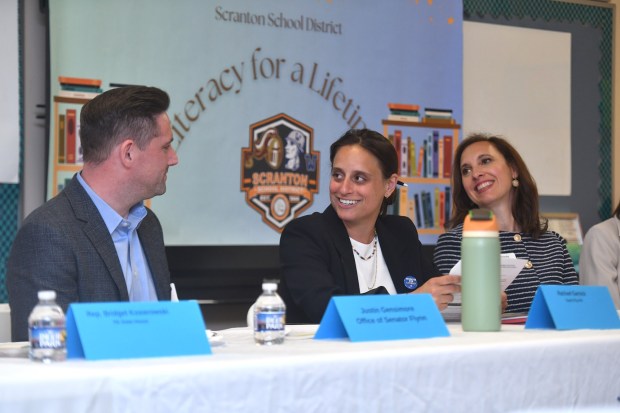 Rachael Garnick, Pennsylvania Coalition Manager at Teach Plus PA, center, leads a roundtable discussion on literacy in the library of John F. Kennedy Elementary School in South Scranton Friday, May 1, 2026. (SEAN MCKEAG / STAFF PHOTOGRAPHER)
“Proof point” districts are districts “where students are performing significantly better than expected given their level of economic disadvantage, while also demonstrating strong academic growth over time,” the report notes. “Proof Points offer concrete evidence that strong literacy outcomes are possible — even in high-need contexts — when evidence-based practices are implemented effectively.”
Much of Friday’s event focused on the district’s concerted embrace of strategies aimed at improving literacy outcomes. Superintendent Erin Keating, Ed.D., thanked the Scranton Federation of Teachers union for “partnering with us on an unbelievable endeavor to make sure every teacher in the Scranton School District … was trained in the science of literacy.”
“When I got here two years ago … literacy became something that, to me, was the crux of where we were going to make school improvement,” Keating said. “If you cannot read you cannot learn.”
Scranton’s recent success stems from a districtwide shift to “supporting the science of reading in our classrooms,” Supervisor of Elementary Education Ann Grebeck said.
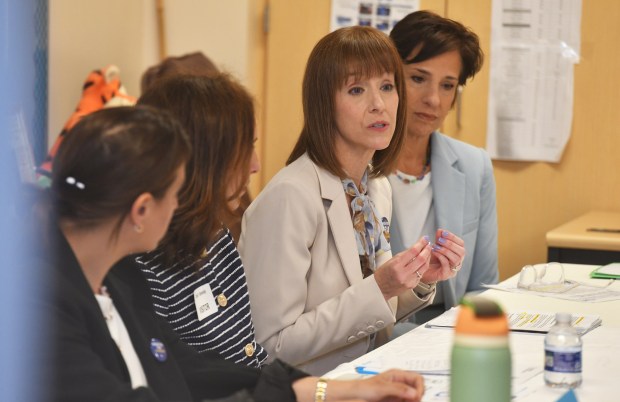 Reading specialist for Scranton School District Kimberly Tesluk speaks during a roundtable discussion on literacy in the library of John F. Kennedy Elementary School in South Scranton Friday, May 1, 2026. (SEAN MCKEAG / STAFF PHOTOGRAPHER)
“So in the past literacy instruction was traditional, it was a whole-language approach, and now we have since transitioned to evidence-based structured literacy, where classrooms today emphasize active-reading strategies and differentiated instruction based on the science of reading through explicit, daily, specific instruction with targeted interventions,” she said.
In short, the district embraced a more effective way of teaching students how to read.
“Across our 10 elementary schools our instruction used to vary widely, so we really made this commitment to try to align our instruction around structured literacy and investing in our teachers: improving the teacher knowledge base to make sure that the teachers had the information that they needed to be able to invest in the students and ensure that the students were receiving instruction that aligned to their needs,” district Reading Specialist Kimberly Tesluk said. “I’m really incredibly proud of the work that we’ve done this year. Like Dr. Keating said, it was a huge undertaking, but because we collaborated we were able to train over 500 educators.”
But Grebeck acknowledged the district’s “hardest work still lies ahead.”
“Scranton needs to continue investing in meaningful professional development, which all of you are aware costs a lot of money,” she said. “We need to expand these high-quality resources that we’re using to ensure that there’s consistent implementation that’s happening in all of our schools.”
The potential reduction of federal Title I funding supporting professional development training for teachers would create a challenge for the district.
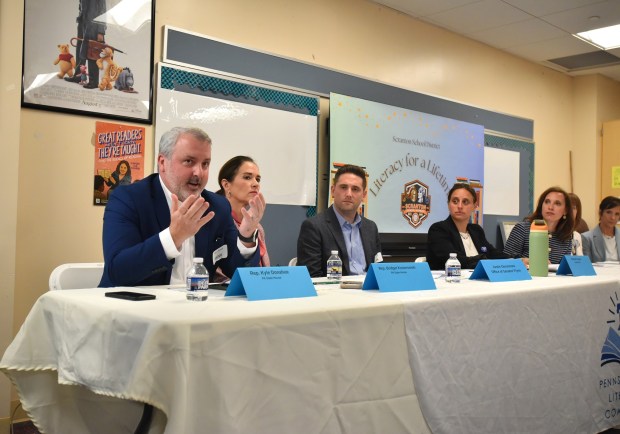 State Rep. Kyle Donahue, far left, speaks during a roundtable discussion on childrens’ literacy in the library of John F. Kennedy Elementary School in South Scranton Friday, May 1, 2026. (SEAN MCKEAG / STAFF PHOTOGRAPHER)
“We need to look at creative ways to help continue this process, not only with educating our veteran teachers, but we have a lot of new teachers that necessarily don’t have the background knowledge on the science of reading,” Grebeck said. “So this was an investment the district made with the coordination of obviously the (Scranton Federation of Teachers) and our superintendent, with securing Title I funds to pay for training after school hours. If title funds disappear or are eliminated we face a huge challenge with building the knowledge level much deeper, not only for the community as a whole with our teachers but with the young workforce that are entering the profession.”
Friday’s event also highlighted the need for more education investments at the state level, as well as the practical impact and economic consequences of low literacy.
Information provided by the Pennsylvania Literacy Coalition shows 66% of third graders in Lackawanna County are not reading proficiently. That number is higher, 76%, among economically disadvantaged third graders. And 56% of adults in the county can’t read proficiently, either.
Low literacy costs the state an estimated $113 billion annually in lost productivity, reduced earnings and increased public spending, per the coalition.
Amy Luyster, vice president of business and workforce development for the Greater Scranton Chamber of Commerce, spoke Friday to the economic and workforce implications, noting “without strong literacy we cannot build a talent pipeline” for current and future workforce needs.
On the heels of that and other warnings, Suzanne Shaffer, Title I Reading Specialist at the district’s McNichols Plaza Elementary School, called the current moment one of the most important of her long career.
“Because after decades in the classroom I can say this with certainty: structured literacy works,” she said. “I’ve seen programs come and go, initiatives lost with best intentions, and I’ve seen us invest time, energy and resources into approaches that simply didn’t deliver the results that our students deserved. But structured literacy is different.”
The “Proof Points” report is available online at paliteracy.org.